
Psychiatrist Quiz
How the Scales are Structured
Who Usually Takes This Test?
See How You Compare
Below is a preview of how scores are typically distributed across each scale.
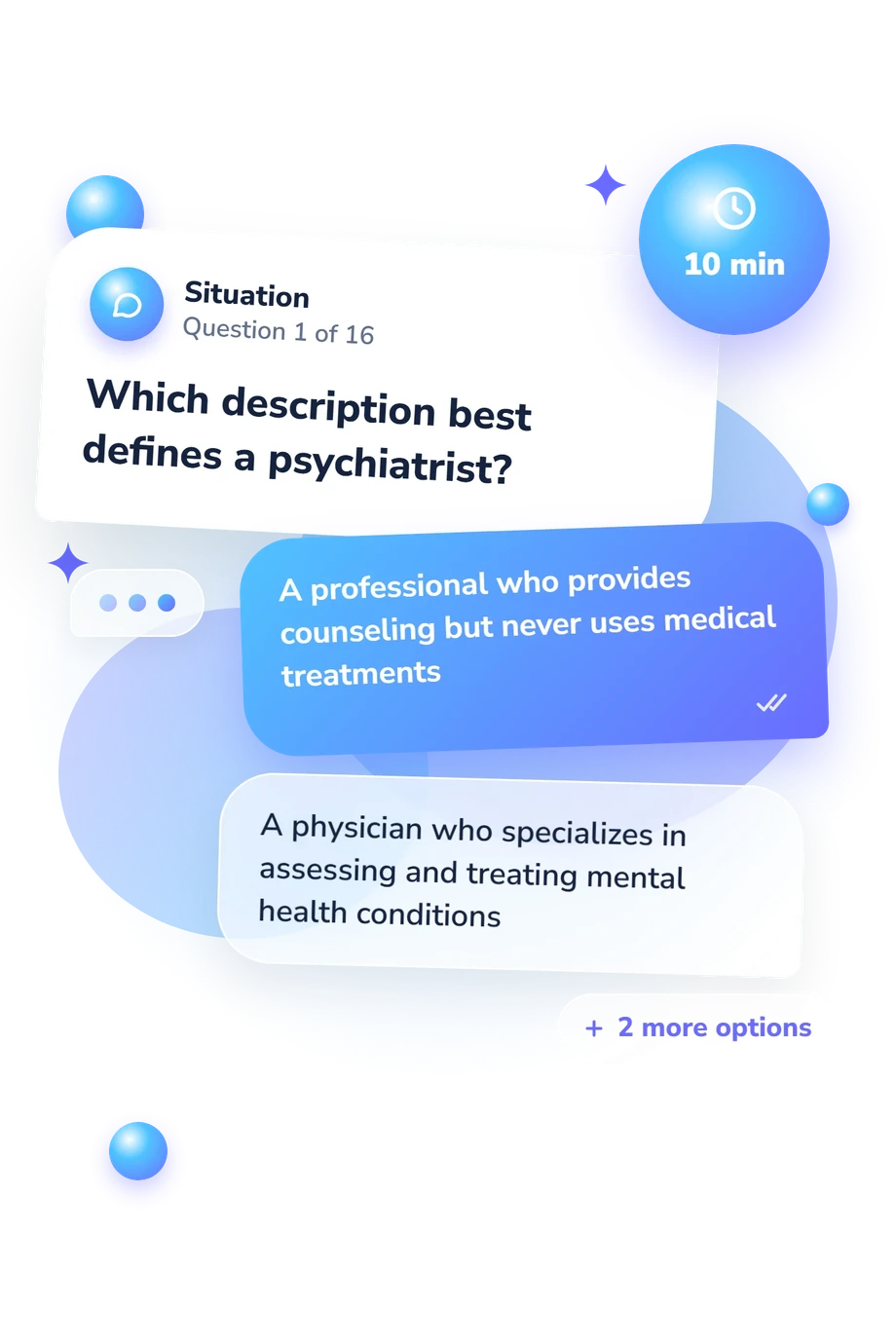
Example Questions From the Test
- A professional who provides counseling but never uses medical treatments
- A physician who specializes in assessing and treating mental health conditions
- A researcher who studies behavior but does not work with patients
- A physician who treats only neurological injuries and disorders
- To provide shared criteria and language that support clinical communication and decision-making
- To reveal the single biological cause of every mental health condition
- To replace individualized assessment with a checklist score
- To predict a person’s future behavior with certainty
- It can improve continuity and help align psychological, psychiatric, and physical-health care
- It allows each clinician to prescribe independently without reviewing other care
- It guarantees that the patient will never experience another symptom
- It removes the patient from decisions about goals and preferences
Psychiatrist Quiz - Description and methodology of the test
People considering psychiatric training, studying mental-health practice, or reviewing core clinical ideas can use the psychiatrist quiz to organize what they know. It focuses on how psychiatrists work, how decisions are made, and how medical, ethical, and safety issues shape care. For anyone weighing a psychiatry career, this psychiatry career quiz offers a practical snapshot of knowledge rather than a prediction of professional fit.
What This Assessment Explores
The questions cover the psychiatrist’s medical role and the reasoning behind safe, individualized care. They suit people exploring the profession or reviewing core practice. As a psychiatry knowledge test, the questionnaire asks what a clinician should recognize rather than inviting self-diagnosis.
The main areas are:
- Roles and training distinguish psychiatrists from related professionals.
- Assessment considers symptoms, history, context, physical health, substances, culture, safety, and functioning.
- Treatment and follow-up cover medication, therapy, monitoring, side effects, and adjustment.
- Ethics and collaboration address consent, confidentiality, shared decisions, and urgent risk.
The result is Psychiatrist Knowledge: 0-16. Foundations to build (0-6) indicates basic ideas need strengthening; Developing knowledge (7-12) reflects many core ideas with applied or ethical gaps; Strong knowledge (13-16) indicates well-rounded understanding. It is an unvalidated educational score, not a measure of clinical ability.
Methodology and Scientific Basis
Structured multiple-choice items present a professional or clinical situation followed by four choices. The respondent selects the option that best fits psychiatric practice. Topics include roles and training, diagnostic classification, assessment, collaboration, consent, risk, physical contributors, medication, monitoring, and follow-up.
Scoring produces a total knowledge score across the 16 items; item weights and a standardized conversion rule are not published. The bands therefore describe performance on these questions rather than population norms. As a psychiatry assessment, the result can highlight study priorities but cannot predict training performance.
Leichner and Kalin (1980) provide a close precedent for structured psychiatric knowledge self-assessment. Jaworowski and colleagues (2014) describe a later validated questionnaire on a narrower psychiatric topic. This questionnaire is conceptually consistent with those examples, but the sources do not validate this online version, which is not presented as an adaptation of either instrument.
Interpretation depends on prior study, terminology, attention, and the limits of selected-answer tasks. No reliability estimates or clinical cutoffs are supplied, so the result is an educational snapshot rather than evidence of clinical competence or a diagnosis.
- Leichner P, Kalin R. Results of the first Canadian psychiatric knowledge self-assessment for residents. Canadian Journal of Psychiatry. 1980;25(4):281-290. 10.1177/070674378002500401
- Jaworowski S, Walter G, Soh N, Freier Dror Y, Mergui J, Gropp C, Haber PS. A Validated Questionnaire to Assess the Knowledge of Psychiatric Aspects of Alcohol Use Disorder. Substance Abuse. 2014;35(2):147-152. 10.1080/08897077.2013.822053
Updated: