
Private Pilot Quiz
How the Scales are Structured
Who Usually Takes This Test?
See How You Compare
Below is a preview of how scores are typically distributed across each scale.
Example Questions From the Test
- A sudden rise in oil pressure
- An immediate increase in engine RPM
- A steady increase in exhaust temperature with no power change
- A gradual loss of engine RPM, possibly followed by roughness
- Drops below its published minimum airspeed.
- Exceeds its critical angle of attack.
- Can no longer produce lift because engine power is too low.
- Exceeds the aircraft’s maximum allowable bank angle.
- An altimeter setting of 29.92 inches of mercury
- A cloud base at 2,992 feet above ground level
- A visibility of 2.992 statute miles
- An atmospheric pressure of 2,992 millibars
Private Pilot Quiz - Description and methodology of the test
For student pilots, recent trainees, and aviation learners, this private pilot quiz offers a focused way to judge which core concepts need another pass before practical application or instructor discussion. Its private-pilot knowledge-test format connects abstract rules with practical flight situations. The result can guide ground-study priorities before scenario-based decisions become more demanding.
What This Assessment Explores
The questions examine applied flight knowledge rather than personality or flying style. They ask how a pilot interprets instruments, manages performance, handles failures, evaluates weather, and applies procedures. For a learner, this short ppl quiz provides a structured review of decisions encountered in ground study and early flight training.
The displayed result is the Private Pilot Knowledge scale, 0-16. Foundation to Review covers 0-6, Developing Knowledge covers 7-12, and Strong Knowledge covers 13-16. These bands describe performance on the sampled material, not an FAA endorsement.
The main knowledge areas are:
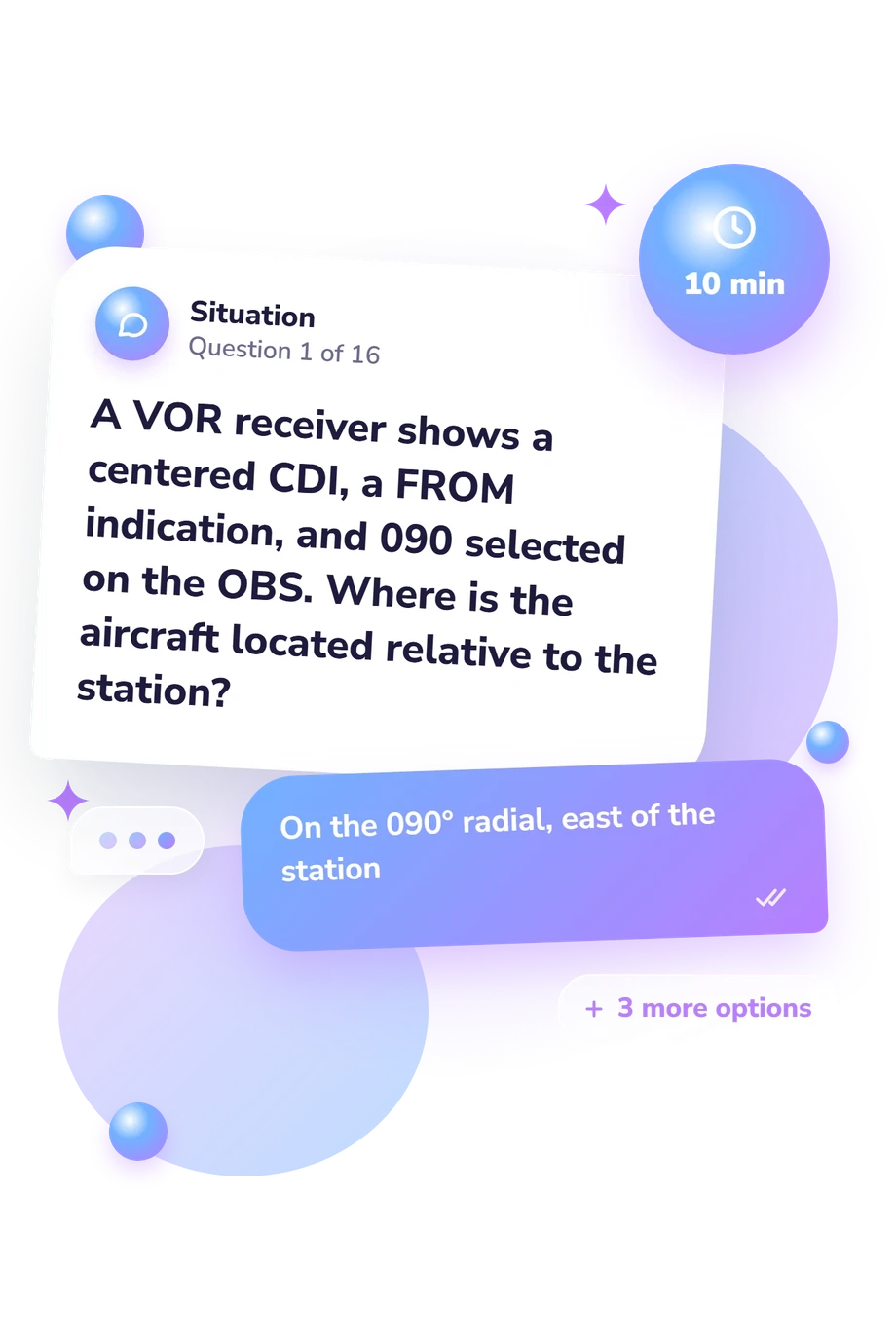
- Navigation and instruments show how you interpret VOR, attitude, compass, and pitot-static information.
- Aircraft performance covers icing, density altitude, center of gravity, stalls, and system effects.
- Emergencies and safety reflect priorities involving engine failure, wake turbulence, hypoxia, and thunderstorms.
- Procedures and decisions examine clearances, IMSAFE, METAR decoding, and risk-aware choices.
Methodology and Evidence Base
Each item presents four answer choices and asks for the best response to a practical aviation situation. This format samples both recognition and application, while terminology familiarity can still affect performance.
Content selection is conceptually consistent with the Private Pilot Airplane ACS (FAA-S-ACS-6C), not an adaptation of it. The FAA-H-8083-25C handbook supplies the aeronautical principles behind the sampled topics.
Casner, Jones, Puentes, and Irani (2004) noted that FAA knowledge tests may involve both learning and rote memorization. Winter, Rice, Reid, and Mehta (2015) examined consistency across private pilot knowledge-exam attempts. For private pilot exam preparation, the result is therefore most useful for choosing what to review next.
The questionnaire reports a bounded educational total mapped to its interpretation categories. The score is limited to the concepts sampled and should not be interpreted as an FAA examination or checkride prediction. Concentration, prior study, and wording familiarity may affect performance, so use current authoritative aviation sources when applying the knowledge in flight.
- Federal Aviation Administration. (2023). Private Pilot for Airplane Category Airman Certification Standards (FAA-S-ACS-6C). Washington, DC: U.S. Department of Transportation.
- Casner, Stephen M., Jones, Karen M., Puentes, Antonio, & Irani, Homi. (2004). FAA Pilot Knowledge Tests: Learning or Rote Memorization? NASA/TM-2004-212814. National Aeronautics and Space Administration.
- Winter, Scott R., Rice, Stephen, Reid, Katie M., & Mehta, Rian. (2015). Consistency of Aviation Students When Taking the Private Pilot Knowledge Exam. Journal of Aviation/Aerospace Education & Research, 24(2), 21-38. 10.15394/jaaer.2015.1608
- Federal Aviation Administration. (2023). Pilot’s Handbook of Aeronautical Knowledge (FAA-H-8083-25C). Washington, DC: U.S. Department of Transportation.
Updated: