
Poison Ivy Quiz
How the Scales are Structured
Who Usually Takes This Test?
See How You Compare
Below is a preview of how scores are typically distributed across each scale.
Example Questions From the Test
- A vine capable of climbing a tree trunk
- Leaves divided into three leaflets rather than the usual five
- Leaves that turn color in autumn
- Growth along a woodland edge
- Urushiol oil in the plant’s tissues
- Pollen released by its flowers
- Sap crystals that puncture the skin
- Spores growing beneath the leaves
- Virginia creeper
- Boxelder
- Poison sumac
- Poison ivy
Poison Ivy Quiz - Description and methodology of the test
People who are unsure whether they can distinguish a suspicious vine from a harmless look-alike can use the poison ivy quiz to check whether their knowledge supports safer choices. As a poison ivy identification quiz, it focuses on the visual clues and judgments that matter when confidence is limited. The result shows which parts of that judgment are familiar and which deserve review.
What This Assessment Explores
The assessment measures knowledge about Toxicodendron exposure, not a rash. Questions connect visual clues-three leaflets, growth forms, fruits, habitats, seasons, and look-alikes-with safer decisions. They also cover urushiol, indirect transfer, delayed reactions, protective handling, and smoke exposure.
These themes group into four practical areas:
- Identification shows how leaflets, growth forms, fruits, habitat, and season support recognition.
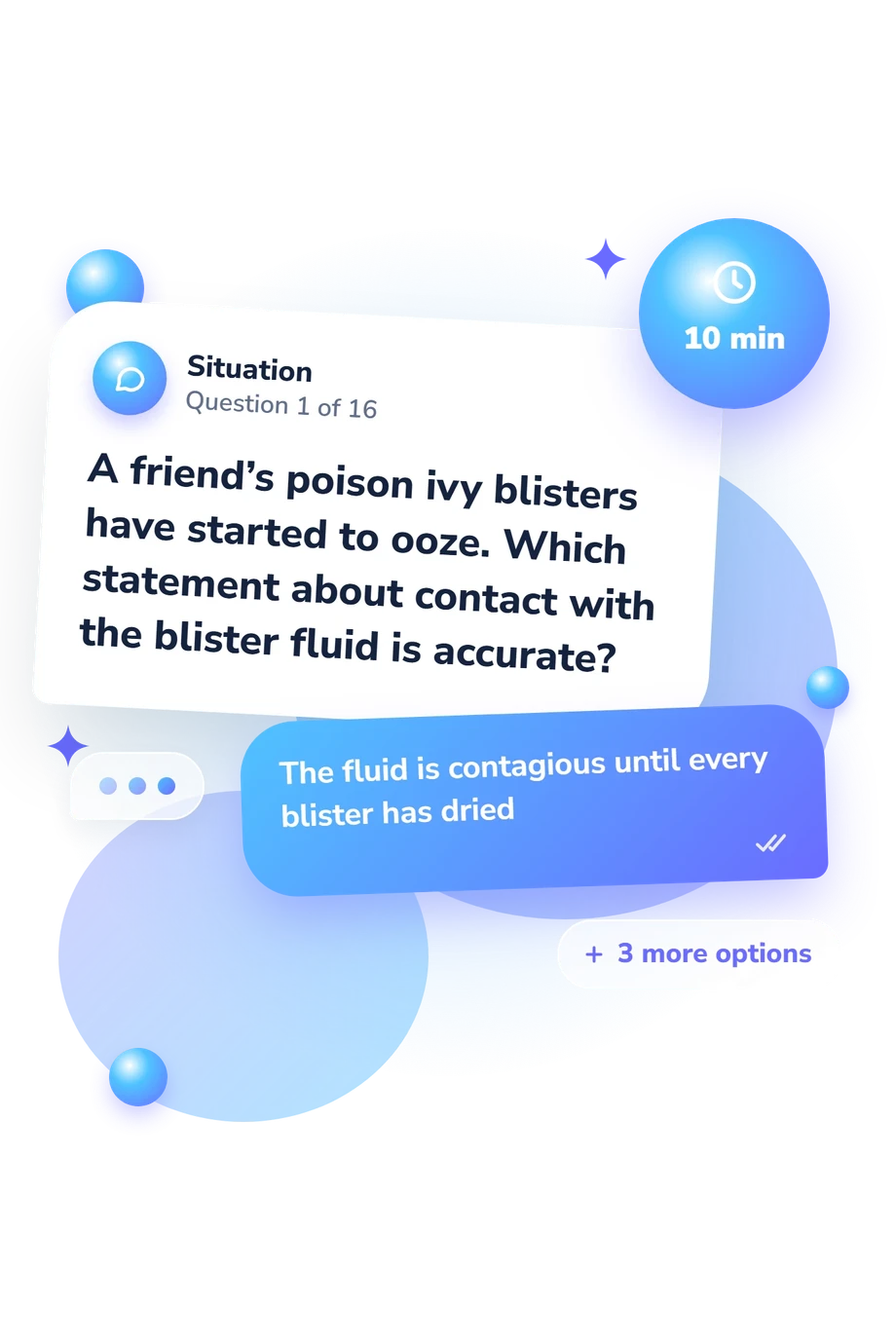
- Exposure pathways explain indirect transfer and why blister fluid does not spread the rash.
- Prevention measures choices about washing, protective clothing, tools, and contaminated items.
- Urgency distinguishes routine care from breathing difficulty or major facial swelling.
Together, these themes produce one overall result for this assessment of poison ivy knowledge. Poison Ivy Knowledge runs from 0-16: Foundation building (0-6), Developing recognition (7-12), and Strong practical knowledge (13-16).
Methodology and Scientific Basis
Each item presents a scenario or identification clue with four answer choices. Selecting the most accurate statement tests applied recognition and safety judgment rather than symptom severity. Situations include comparing look-alike plants, choosing an immediate response after contact, and deciding when exposure may be urgent.
Methodologically, this is an online knowledge questionnaire with one combined outcome. The displayed score summarizes performance across the 16 items; no separate symptom scales are reported. Its content is conceptually consistent with Gladman (2006), which addresses urushiol exposure, clinical patterns, prevention, and management. The questionnaire is not an adaptation of that work. Farber, Sanchez, and Kurouski (2020) report a separate Raman-spectrometer study confirming poison ivy identity, not validating this questionnaire, while Lott and colleagues (2019) document urushiol-related chemistry in poison ivy.
Interpret the bands as study guidance: lower results identify topics to review, while the highest band reflects stronger practical understanding. This poison ivy safety quiz can prompt cautious handling of uncertain plants and contaminated materials.
Its score is educational rather than a standardized medical measure: it cannot confirm plant identity or diagnose a rash, and performance may vary with memory, attention, and current context.
- Gladman AC. Toxicodendron Dermatitis: Poison Ivy, Oak, and Sumac. Wilderness & Environmental Medicine. 2006;17(2):120-128. 10.1580/PR31-05.1
- Farber C, Sanchez L, Kurouski D. Confirmatory non-invasive and non-destructive identification of poison ivy using a hand-held Raman spectrometer. RSC Advances. 2020;10:21530-21534. 10.1039/D0RA03697H
- Lott AA, Baklajian ER, Dickinson CC, Collakova E, Jelesko JG. Accession-Level Differentiation of Urushiol Levels, and Identification of Cardanols in Nascent Emerged Poison Ivy Seedlings. Molecules. 2019;24(23):4213. 10.3390/molecules24234213
Updated: