
Pizza Quiz
How the Scales are Structured
Who Usually Takes This Test?
See How You Compare
Below is a preview of how scores are typically distributed across each scale.
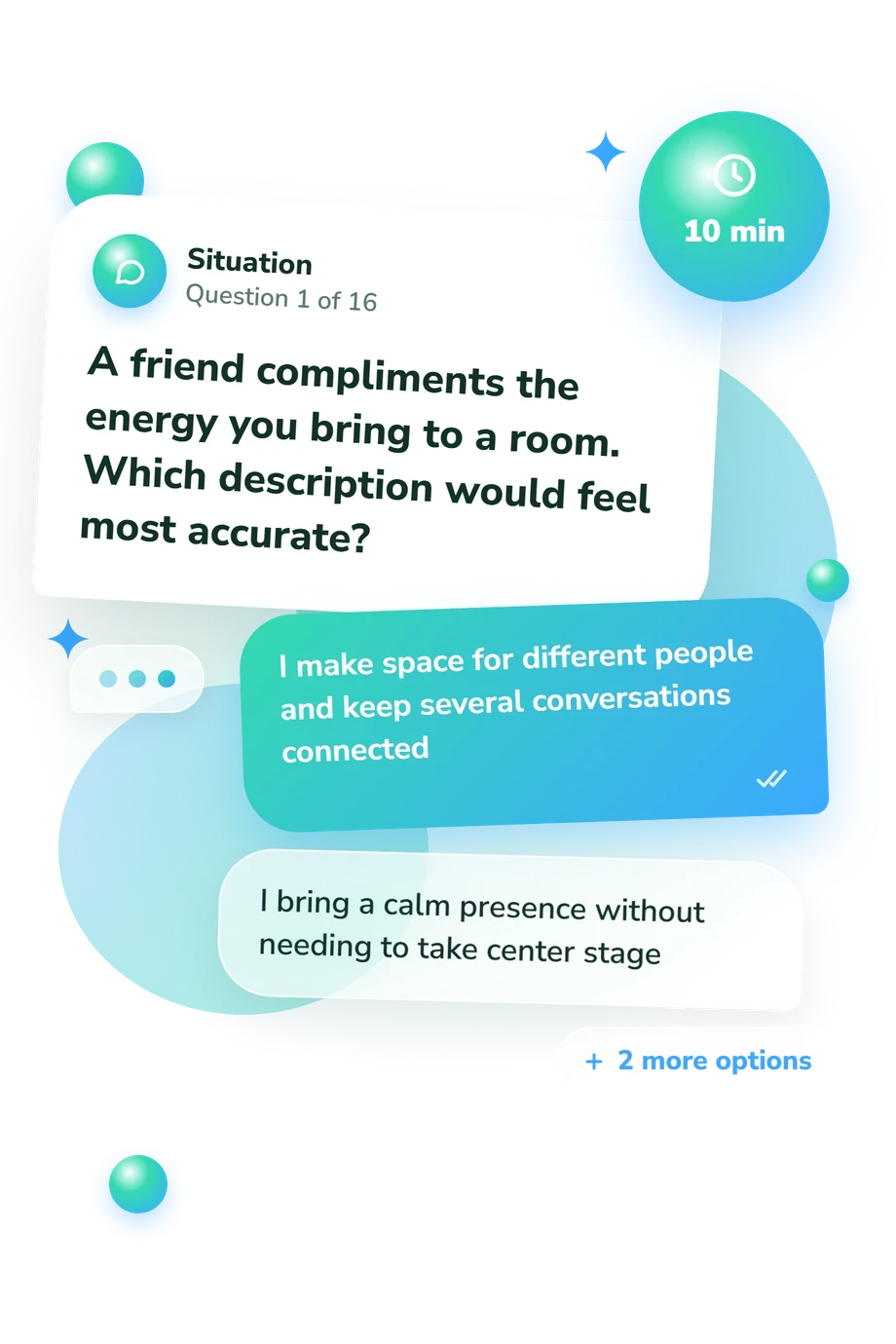
Example Questions From the Test
- A customizable dish with several components for different tastes
- A classic favorite that disappears quickly
- A simple specialty made with a few excellent ingredients
- A conversation-starting dish with an unusual sweet-savory twist
- I ask questions first and reveal my view gradually
- I state my position plainly and enjoy a lively exchange
- I connect several viewpoints before explaining where I land
- I keep my contribution brief unless the issue feels important
- A full day with a clear plan, good company, and plenty of energy
- A quiet ritual built around one or two favorite places
- A flexible schedule with several different stops and interests
- A spontaneous activity that none of us has tried before
Pizza Quiz - Description and methodology of the test
People seeking a structured way to reflect on their preferences can use this assessment to see which style of choosing, combining, simplifying, or standing out feels most characteristic. The pizza quiz uses everyday situations to help you reflect on options, groups, projects, and experiences rather than assigning a single label. It turns pizza preferences into a prompt for noticing how you decide.
What This Assessment Explores
Four topping styles turn pizza topping choices into broader preferences. The situations cover variety, simplicity, impact, and combination, showing how you approach options without treating any preference as a fixed identity.
The dimensions are:
- Hawaiian (0-12) reflects contrast, openness to unconventional choices, optimism, and standing apart: Familiar Ground (0-4), Curious Contrast (5-8), Unexpected Spark (9-12).
- Margherita (0-12) reflects intentional simplicity, authenticity, calm focus, and appreciation for essentials: More Is More (0-4), Selective Simplicity (5-8), Classic Balance (9-12).
- Pepperoni (0-12) reflects boldness, momentum, directness, and comfort making an impact: Subtle Flavor (0-4), Confident Kick (5-8), Bold Slice (9-12).
- Veggie Supreme (0-12) reflects versatility, layered curiosity, inclusion, and bringing different elements together: Focused Mix (0-4), Flexible Blend (5-8), Full Spectrum (9-12).
Compare all topping scores: the highest individual score is your strongest affinity, and scores within one point form a blended result.
Methodology and Interpretive Model
Each item presents a familiar situation with four possible responses about projects, travel, social energy, disagreement, hosting, or personal space. The options describe preferences rather than right answers, so the respondent chooses the response closest to their usual pattern. Responses are organized into four descriptive style scores for comparison.
The approach is thematic and comparative rather than a mapped personality inventory. Four styles organize recurring contrasts in the scenarios: unconventional versus familiar choices, restraint versus intensity, and focused versus inclusive combinations. In this sense, the questionnaire explores personality through pizza rather than through a published trait framework.
Because the format is self-report, self-presentation, current mood, and context can influence the choices. Results are best treated as a structured snapshot of how these situations feel to you at this moment, useful for reflection rather than a fixed or lasting account of personality.
- Soto, C. J., & John, O. P. (2017). The next Big Five Inventory (BFI-2): Developing and assessing a hierarchical model with 15 facets to enhance bandwidth, fidelity, and predictive power. Journal of Personality and Social Psychology, 113(1), 117-143. 10.1037/pspp0000096
- DeYoung, C. G., Quilty, L. C., & Peterson, J. B. (2007). Between Facets and Domains: 10 Aspects of the Big Five. Journal of Personality and Social Psychology, 93(5), 880-896. 10.1037/0022-3514.93.5.880
- Paulhus, D. L. (1991). Measurement and Control of Response Bias. In J. P. Robinson, P. R. Shaver, & L. S. Wrightsman (Eds.), Measures of Personality and Social Psychological Attitudes (pp. 17-59). Academic Press. 10.1016/B978-0-12-590241-0.50006-X
Updated: