
Phrases Quiz
How the Scales are Structured
Who Usually Takes This Test?
See How You Compare
Below is a preview of how scores are typically distributed across each scale.
Example Questions From the Test
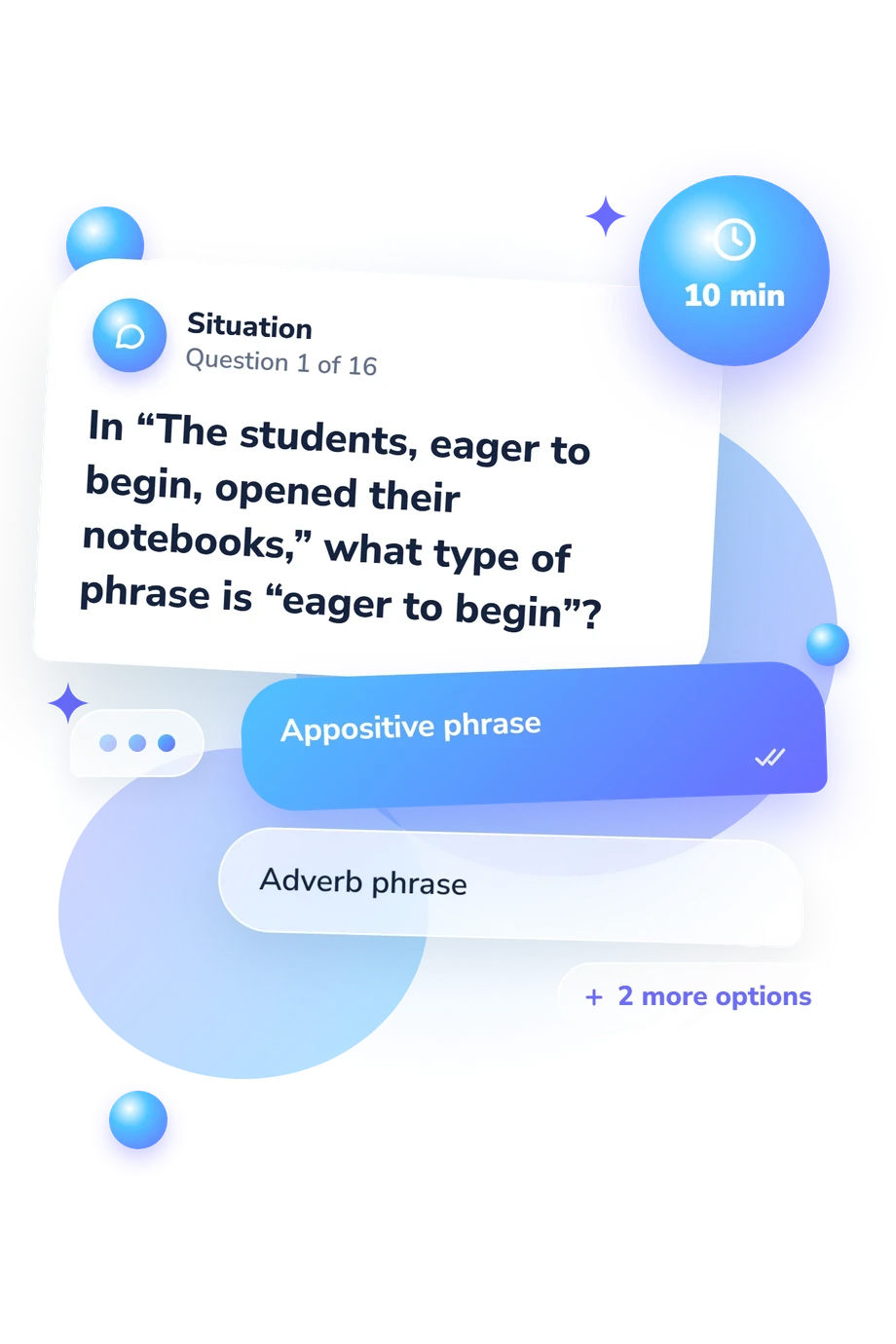
- Appositive phrase
- Adverb phrase
- Noun phrase
- Adjective phrase
- By noon
- the team
- will have completed
- the survey
- Noun phrase
- Adjective phrase
- Prepositional phrase
- Verb phrase
Phrases Quiz - Description and methodology of the test
Students, teachers, and independent learners who want to check their knowledge of English phrase types can use this assessment to distinguish phrase forms and functions. The phrases quiz shows whether the respondent recognizes phrase patterns, separates form from grammatical function, and identifies major phrase types in sentences. For anyone wanting a quiz on English phrases, it offers focused practice and can guide grammar revision.
What This Assessment Measures
Phrase structure is tested through both form and function. Questions cover complete noun and verb phrases, modifiers, non-finite phrases, and the difference between a phrase and a clause. It serves as a practical quiz on types of phrases because each answer depends on how a word group operates in its sentence, not on isolated vocabulary.
The main areas represented by the questions are:
- Noun phrases identify subjects or objects.
- Verb phrases include auxiliaries and the main verb.
- Adjective and adverb phrases show description or manner.
- Prepositional, infinitive, gerund, participial, and appositive phrases connect form with function.
Results use English Phrase Types Knowledge (0-16): Foundational (0-6) reflects partial recognition and a need to distinguish structure from function; Developing (7-12) shows growing ability to separate related types; Strong (13-16) indicates reliable command of major phrase types and how they operate in sentences.
Methodology and Evidence Base
Each item gives a sentence or quoted group with four answer choices. It may ask for a label, the verb or noun phrase, the difference between a phrase and a clause, or why an -ing group is gerund rather than participial. This quiz for identifying phrases treats function as important as form.
Methodologically, the exercise uses sentence-level multiple-choice classification with traditional school-grammar labels. The tested distinctions are conceptually consistent with traditional school-grammar descriptions, but the questionnaire is an online classification exercise rather than a published standardized instrument or adaptation. This is a conceptual relationship, not a claim that an external framework supplied the questionnaire.
The displayed result is presented as a score and band, but the questionnaire does not state how responses are converted. It has no stated norms, reliability coefficients, or diagnostic cutoffs. The result describes performance on sampled grammar distinctions. As a quiz for identifying types of phrases, it can guide editing practice, yet terminology, wording, and the constructions included can affect the score. Read it alongside writing performance rather than as a complete measure of English ability.
- Killgallon, Donald, and Jenny Killgallon. Grammar for High School: A Sentence-Composing Approach-A Student Worktext. Heinemann, 2007. ISBN 978-0-325-01046-5.
- Huddleston, Rodney, Geoffrey K. Pullum, and Brett Reynolds. A Student's Introduction to English Grammar. 2nd ed. Cambridge University Press, 2022. 10.1017/9781009085748.
- Huddleston, Rodney, and Geoffrey K. Pullum. The Cambridge Grammar of the English Language. Cambridge University Press, 2002. 10.1017/9781316423530.
Updated: