
Periodic Trends Quiz
How the Scales are Structured
Who Usually Takes This Test?
See How You Compare
Below is a preview of how scores are typically distributed across each scale.
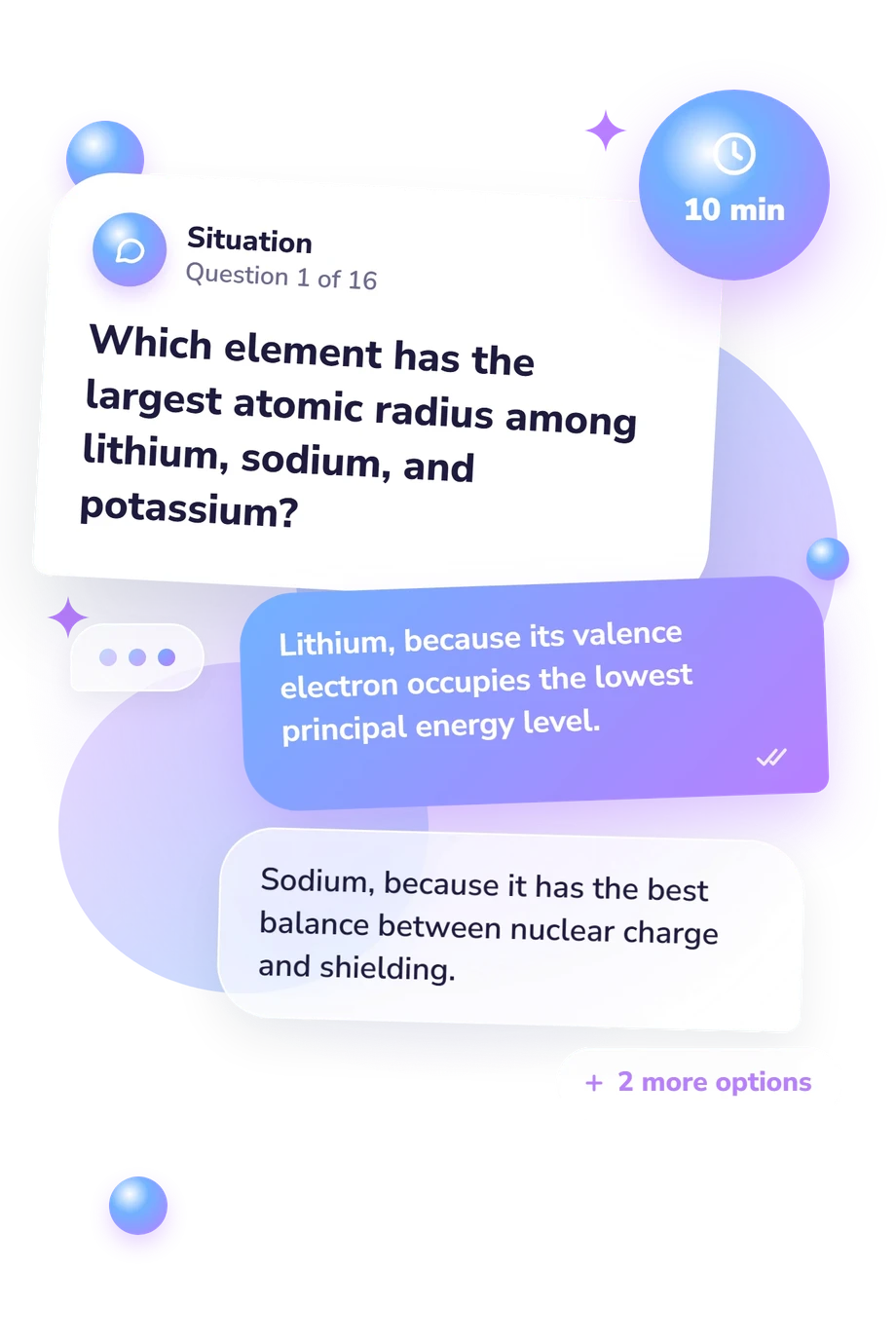
Example Questions From the Test
- Nitrogen
- Oxygen
- Fluorine
- Carbon
- Na2O is acidic, while SiO2 is basic.
- MgO is amphoteric, while Al2O3 is strongly basic only.
- Al2O3 is acidic only, while phosphorus oxides are basic.
- Na2O is basic, while Al2O3 is amphoteric.
- H–F
- N–H
- O–H
- C–H
Periodic Trends Quiz - Description and methodology of the test
Designed for learners who want to check their reasoning about recurring patterns in the periodic table, the Periodic Trends Quiz turns familiar chemistry comparisons into a focused knowledge check. As a periodic table trends quiz, it asks you to explain patterns rather than recall isolated facts and places the result in a broad understanding band. Its questions cover electron shielding, ionic size, and related patterns.
What This Assessment Explores
These questions examine whether you can connect an element’s position with forces that shape its behavior. As a quiz about chemistry trends, this assessment covers atomic and ionic radius, ionization energy, electronegativity, metallic character, reactivity, and oxide acid-base character. The emphasis is on explaining patterns and recognizing exceptions, not recalling definitions.
The items sample four dimensions:
- Atomic and ionic size shows how shells, shielding, and nuclear charge change radius.
- Ionization energy shows how removal difficulty and large jumps reveal valence structure.
- Electronegativity and reactivity show how electron attraction shapes bonding and group behavior.
- Metallic character and oxide behavior show how position relates to metal-like and acid-base properties.
The result is reported on the Periodic Trends Knowledge scale (0-16). Foundations to review covers 0-6, Developing understanding covers 7-12, and Strong understanding covers 13-16. These bands show understanding demonstrated by responses.
Methodology and Scientific Basis
Each item in this quiz on periodic table trends offers four answer choices, and each selected answer shows which explanation you favor. Plausible distractors test mechanism as well as trend direction.
Scoring condenses responses into one overall knowledge result rather than separate subscores. For this quiz on trends in the periodic table, the result is a snapshot of conceptual performance across the sampled comparisons. The quiz reports one 0-16 result through the displayed bands.
Its conceptual focus is consistent with Larson, Long, and Briggs (2012) on student mental models of periodic properties and with Salame, Sarowar, Begum, and Krauss (2011) on alternative conceptions about atomic properties. Moore and Birnbaum (2014) add context for using effective nuclear charge carefully. These studies support the topic and reasoning emphasis; the questionnaire is not an adaptation of them.
Because performance depends on current preparation and interpretation of the questions, the score reflects this testing context rather than a complete account of chemistry knowledge.
- Kathleen G. Larson, George R. Long, and Michael W. Briggs. "Periodic Properties and Inquiry: Student Mental Models Observed during a Periodic Table Puzzle Activity." Journal of Chemical Education, 2012, 89(12), 1491-1498. 10.1021/ed200625e
- Issa I. Salame, Saira Sarowar, Sultana Begum, and Deborah Krauss. "Students’ Alternative Conceptions about Atomic Properties and the Periodic Table." The Chemical Educator, 2011, 16(1), 190-194. 10.1333/s00897112375a
- Preston Moore and Edward R. Birnbaum. "Are Slater’s Rules the Best Approach for Calculating Effective Nuclear Charge for Undergraduates?" The Chemical Educator, 2014, 19(1), 232-235. 10.1333/s00897142561a
Updated: