
Passover Quiz
How the Scales are Structured
Who Usually Takes This Test?
See How You Compare
Below is a preview of how scores are typically distributed across each scale.
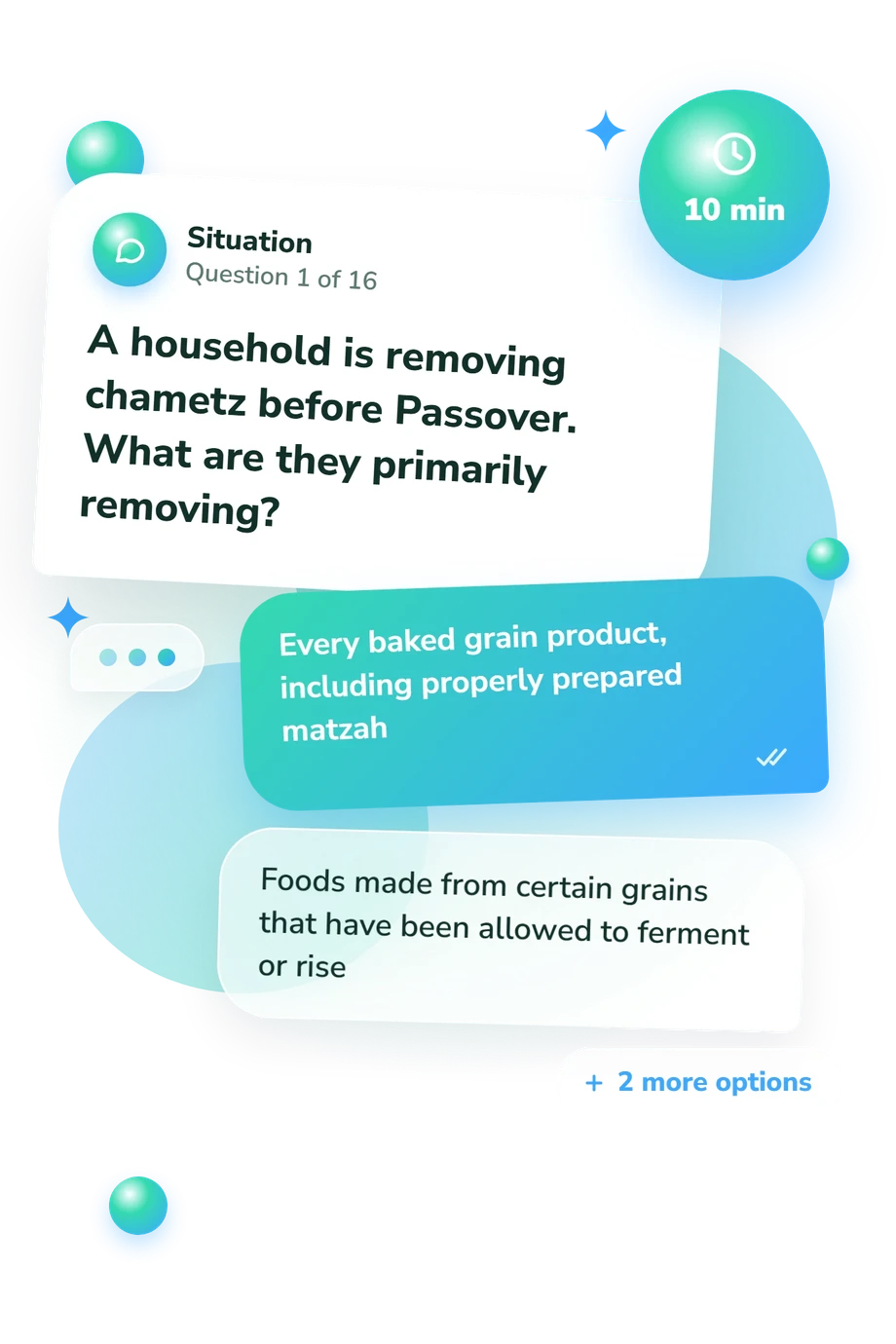
Example Questions From the Test
- The Israelites’ liberation from slavery in Egypt
- The giving of the Torah at Mount Sinai
- The rededication of the Temple in Jerusalem
- The deliverance described in the Book of Esther
- Their dough did not have time to rise before they left
- Matzah represents the manna gathered in the wilderness
- Matzah was burned as incense in ancient Egypt
- Their departure occurred at the end of the grain harvest
- The 25th of Nisan
- The 1st of Nisan
- The 10th of Nisan
- The 15th of Nisan
Passover Quiz - Description and methodology of the test
Readers who want to revisit Passover’s central story and customs can use this assessment for personal study, family preparation, or guided discussion. For a focused learning check, this passover quiz separates familiarity with the holiday’s key material from religious identity or observance. Questions about Passover in the quiz ask readers to connect events, symbols, terms, dates, and communal practices.
What This Assessment Explores
Rather than rating observance, this assessment checks whether readers recognize Passover ideas and connect practices or symbols with their traditional meanings. It suits personal reflection and family learning; families can use this questionnaire with children when an adult explains unfamiliar terms, making it a guided quiz about Passover for kids rather than an independent child assessment. It asks about knowledge, not a child's personal religious commitment.
Its themes include the Exodus, calendar dates, Seder sequence, symbolic foods, liturgical phrases, holiday customs, and differences among Jewish communities. The result is one Passover Knowledge score (0-16):
- 0-6, Foundations to build, marks core ideas that need review.
- 7-12, Developing knowledge, shows many traditions understood, with details to strengthen.
- 13-16, Strong knowledge, reflects broad familiarity with the covered story, practices, and symbols.
This score describes performance on this material only, not religious identity or observance.
Methodology and Evidence Base
Each item presents a direct prompt or short situation with four answer choices. Selecting the best answer combines factual recall with understanding why an object, date, phrase, or practice matters. The result is reported as one overall total; the thematic groups are descriptive, not separate subscale scores.
As a Passover knowledge test, the questionnaire is conceptually consistent with Tabory’s commentary, which provides context for the Haggadah references and traditions represented here. Klein’s work offers context for the educational value of prompting explanation and storytelling at the Seder. Karimi, Hjelm, and Äystö provide a religious-literacy context for distinguishing knowledge of traditions from personal belief. These works are contextual sources for the quiz’s content and educational framing; the displayed bands describe performance on this quiz and are not population norms or clinical cutoffs.
Interpret the result as a bounded snapshot of familiarity with the presented material. Prior learning, attention, guessing, uncertainty about terminology or wording, and unfamiliarity with community-specific customs can affect performance; the score cannot establish how someone observes Passover in practice. Further reading or discussion adds useful context.
- Tabory, Joseph. The JPS Commentary on the Haggadah: Historical Introduction, Translation, and Commentary. Philadelphia: Jewish Publication Society, 2008. ISBN 9780827608580.
- Klein, Reuven Chaim. "The Passover Seder as an Exercise in Piagetian Education Theory." Religious Education 118, no. 4 (2023): 312-324. 10.1080/00344087.2023.2228189
- Karimi, Zeinab, Titus Hjelm, and Tuomas Äystö. "Measuring Religious Literacy: Towards Building an Instrument." British Journal of Religious Education (2026): 1-18. 10.1080/01416200.2026.2706081
Updated: