
Palindrome Quiz
How the Scales are Structured
Who Usually Takes This Test?
See How You Compare
Below is a preview of how scores are typically distributed across each scale.
Example Questions From the Test
- Two pairs
- Four pairs
- Three pairs
- Seven pairs
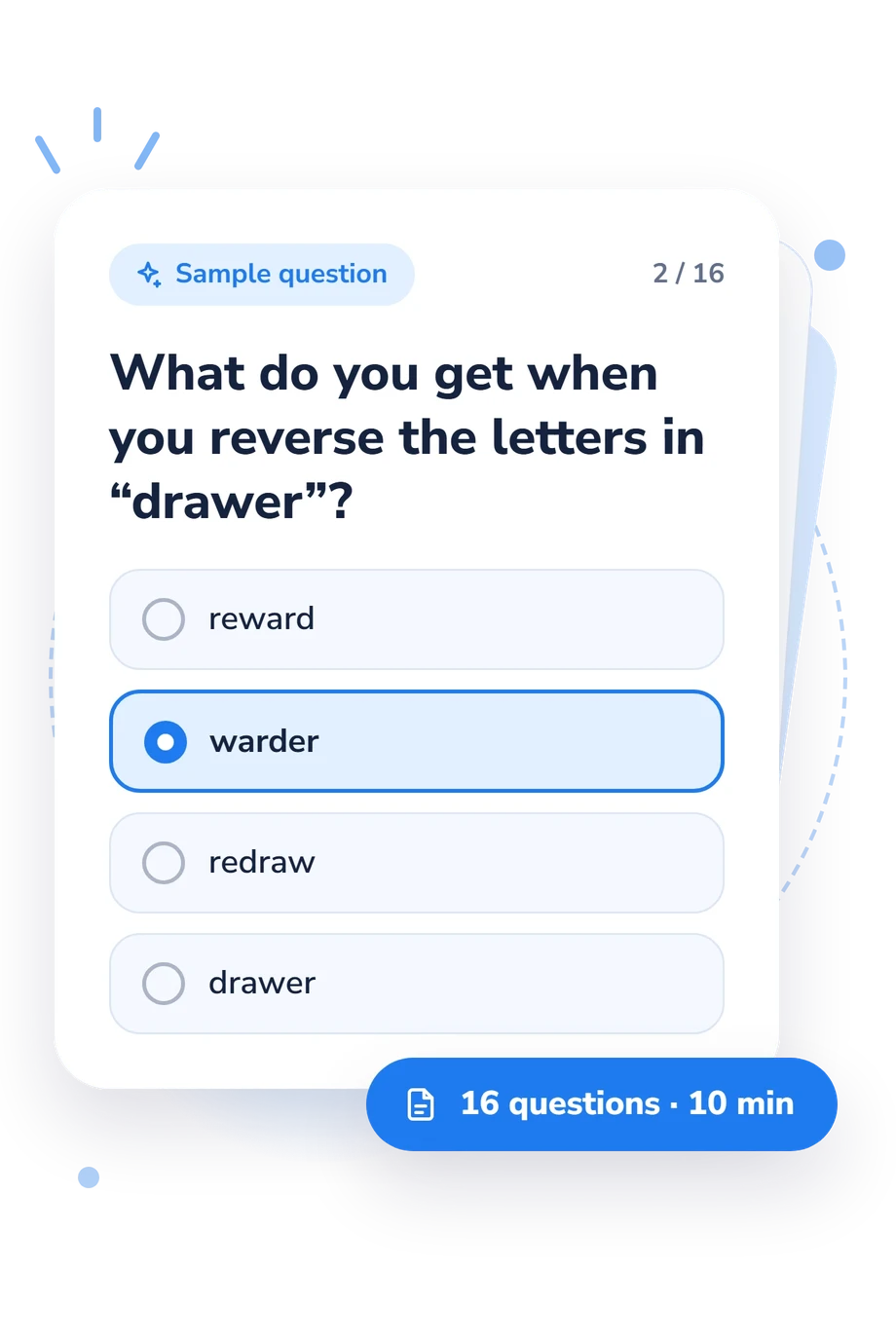
- reward
- warder
- redraw
- drawer
- Garden
- Candle
- Rotor
- Silver
Palindrome Quiz - Description and methodology of the test
Readers who enjoy language puzzles, programming logic, or pattern checking can use this assessment to examine mirrored sequences and comparison rules. The palindrome quiz is intended for learners and problem-solvers who want a picture of their understanding, not a measure of general verbal ability. The result gives an overall performance indication rather than a detailed concept profile. The palindrome question set requires applying normalization, reversal, and exact-character comparison rules.
What This Assessment Explores
At its core, the assessment examines whether you apply the definition of a palindrome consistently as material changes from familiar words to less obvious strings. It covers words, phrases, numbers, and rule-based strings, making the result useful for learners, puzzle enthusiasts, and readers exploring computational thinking. As a palindrome test, it focuses on recognizing structure rather than measuring general intelligence or language ability.
The result is organized around one scale. It records performance across these tasks and places it into three bands:
- Palindrome Knowledge (0-16) gives one point for each correct answer; Foundations (0-6) indicates emerging command of normalization and mirrored patterns, Developing (7-12) reflects solid working knowledge with less obvious cases to sharpen, and Palindrome Pro (13-16) indicates consistent analysis across words, phrases, numbers, and rule-based examples.
A higher band reflects performance on these concepts, not general intelligence.
Methodology and Evidence Base
Each item presents a prompt with several answer choices, and the correct option depends on the rule stated or implied by the task. The items may ask you to reverse a word, compare mirrored positions, complete a sequence, or decide whether normalization changes the outcome. This palindrome reasoning assessment awards one point for each correct answer and places the displayed total into the stated performance bands.
Bergerson (1973) provides the closest conceptual reference for the examples and terminology used here. Galil and Seiferas (1978) and Manacher (1975) describe formal approaches to recognizing palindromic strings and locating palindromic structure efficiently. The questionnaire is conceptually consistent with these works, but it is not an adaptation of any one published instrument.
The displayed bands describe performance on these tasks rather than a comparison with a reference group. Familiarity with puzzles, attention to wording, and the selected comparison rule can affect performance. Read the result as focused educational feedback that indicates your overall level and can suggest topics for further practice.
- Bergerson, Howard W. (1973). Palindromes and Anagrams. New York: Dover Publications. ISBN 0-486-20664-5.
- Galil, Zvi, and Joel I. Seiferas. (1978). A Linear-Time On-Line Recognition Algorithm for "Palstar". Journal of the ACM, 25(1), 102-111. 10.1145/322047.322056.
- Manacher, Glenn. (1975). A New Linear-Time On-Line Algorithm for Finding the Smallest Initial Palindrome of a String. Journal of the ACM, 22(3), 346-351. 10.1145/321892.321896.
Updated: