
Ocean Quiz
How the Scales are Structured
Who Usually Takes This Test?
See How You Compare
Below is a preview of how scores are typically distributed across each scale.
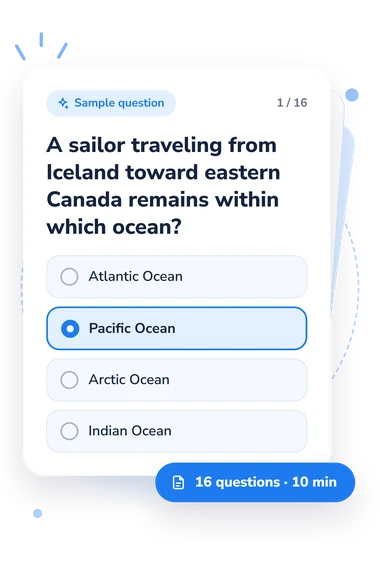
Example Questions From the Test
- Atlantic Ocean
- Pacific Ocean
- Arctic Ocean
- Indian Ocean
- Two plates slide horizontally past each other
- Two continental plates collide
- Two plates move apart
- One plate remains fixed while the other folds
- It speeds up and becomes lower
- It slows down, shortens, and can grow taller
- It stops before reaching the coast
- It speeds up while keeping the same wavelength
Ocean Quiz - Description and methodology of the test
Readers who want to check their understanding of marine geography can use this assessment as a focused knowledge exercise rather than a personality profile. The ocean quiz gives learners, travelers, and educators a broad knowledge band to guide further study. As a sea quiz about seas and oceans, it also suits curious readers who want to gauge their current foundation.
What This Assessment Explores
At its core, this assessment checks whether you can place ocean basins, identify passages and geographic and seafloor features, and connect them with processes shaping Earth’s waters. The questions cover the world's oceans, making this a world oceans quiz that relies on geographic reasoning rather than opinion.
Questions group the subject into four areas:
- Basin locations show whether you identify an ocean from a route, neighboring continents, or size.
- Geographic and seafloor features show whether you distinguish estuaries, trenches, ridges, and passages.
- Currents and gyres show whether you connect circulation with direction, temperature, and wind.
- Physical ocean processes show whether you understand salinity, upwelling, plate motion, and tsunami behavior.
Your result is Ocean Knowledge (0-16): Foundations to Build (0-6), Developing Navigator (7-12), or Strong Ocean Knowledge (13-16). Each band indicates whether understanding is emerging, developing, or strong, and points to topics worth revisiting.
Methodology and Evidence Base
Each item combines direct geography questions with physical-oceanography scenarios and offers four answer choices. Selecting an option tests relationships among places and processes. The sea quiz questions range from basin identification to estuaries, plate boundaries, salinity, waves, gyres, currents, and upwelling. This selected-response method measures knowledge, not personality.
The output condenses performance into one knowledge result. The questionnaire displays one 0-16 result with three catalogue bands; no weighting rule or population norms are stated. That result summarizes recognition of oceans, locations, and physical relationships in a profile.
The conceptual reference is the International Ocean Literacy Survey associated with Fauville and colleagues. This questionnaire is conceptually consistent with that work, not an adaptation. Work by Schoedinger and colleagues supports connecting ocean concepts across science standards, while Trujillo and Thurman supply a framework for gyres, salinity, plate boundaries, and wave transformation. These sources support content relevance, not validation of this online version.
This oceans of the world quiz directs study across the world's oceans, although results may shift with prior study, guessing, unfamiliar terminology, and concentration. Use it to guide review rather than claim comprehensive ocean literacy.
- Fauville, Géraldine, Craig Strang, Matthew A. Cannady, and Ying-Fang Chen. “Development of the International Ocean Literacy Survey: measuring knowledge across the world.” Environmental Education Research, 25(2), 238-263, 2019. 10.1080/13504622.2018.1440381.
- Schoedinger, Sarah, Francesca Cava, Craig Strang, and Peter Tuddenham. “Ocean literacy through science standards.” Proceedings of OCEANS 2005 MTS/IEEE, 736-740, 2005. 10.1109/OCEANS.2005.1639840.
- Trujillo, Alan P., and Harold V. Thurman. Essentials of Oceanography. 13th ed., Pearson, 2020.