
Navy Career Quiz
How the Scales are Structured
Who Usually Takes This Test?
See How You Compare
Below is a preview of how scores are typically distributed across each scale.
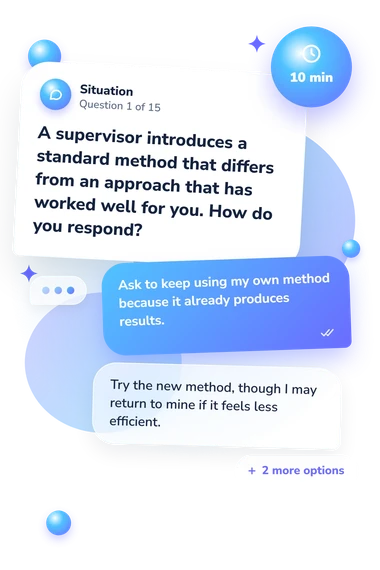
Example Questions From the Test
- Ask to keep using my own method because it already produces results.
- Try the new method, though I may return to mine if it feels less efficient.
- Adopt it after getting a brief explanation of why consistency matters.
- Use the standard method and raise improvement ideas through the appropriate channel.
- I would find the lack of private space difficult to sustain.
- I could manage briefly if I had reliable opportunities to step away.
- I could adapt by creating small routines and respecting shared boundaries.
- I generally adjust well to close shared settings and limited personal space.
- Start with the task I understand best so I can make visible progress.
- Choose the task that appears most urgent and revise if new information arrives.
- Quickly compare deadlines and consequences, then confirm my order if possible.
- Create a provisional order and seek clarification before making major commitments.
Navy Career Quiz - Description and methodology of the test
Coordinated work, changing schedules, and formal procedures call for different working preferences; this navy career quiz offers a structured way to examine which conditions feel more compatible. Applicants can use the navy job quiz to reflect on workplace fit, while career explorers and serving personnel can consider the duties and environments they may prefer. The result is a profile for reflection, not a prediction of performance.
What This Assessment Explores
Practical scenarios cover supervision, shared responsibility, feedback, changing demands, close quarters, documentation, training, and checklists. The result of this navy career assessment relates these preferences to operational conditions.
The result has three dimensions:
- Crew Coordination (0-15) reflects communication, shared responsibility, feedback, and continuity; bands are Independent contributor (0-5), Situational collaborator (6-10), and Crew-centered (11-15).
- Operational Adaptability (0-15) reflects fit with changing schedules, unfamiliar settings, competing demands, and recovery after disruption; bands are Stability-oriented (0-5), Adaptable with conditions (6-10), and Operationally flexible (11-15).
- Structured Execution (0-15) reflects how readily respondents learn and work within detailed procedures, documentation standards, and clear chains of responsibility; training is one setting where this preference may appear and bands are Autonomy-oriented (0-5), Selectively structured (6-10), and Structure-ready (11-15).
Together, the bands describe comfort with coordination, change, and formal systems; they do not measure technical seamanship or guarantee role fit.
Methodology and Scientific Basis
The questionnaire uses 15 short workplace scenarios with four ordered response choices. Situations cover supervision, handover, feedback, shared deadlines, changing assignments, training, documentation, and checklist use. The options appear to progress from personal autonomy or stability toward stronger coordination, adjustment, and procedural alignment, but exact point values should not be inferred from that order. The result displays three 0-15 scales and assigns the bands shown for each range; no point-by-point key or population norms are stated.
Conceptually, the structure is consistent with the Military Career Adaptability Questionnaire (MCAQ), which addresses adjustment demands in military career contexts. This questionnaire is not the MCAQ or an adaptation of that published instrument. It also connects with teamwork competencies described by Salas, Sims, and Burke, including communication, coordination, monitoring, and backup behavior.
Used alongside actual role requirements, this questionnaire can organize reflection on navy career fit across the coordination, adaptability, and procedural situations represented by its items. Self-report can shift with current goals, self-presentation, and familiarity with military work, and the cited work does not establish cutoffs for this questionnaire.
- Zhang, W., Xu, Y., Peng, L., Bian, C., Yu, Y., Li, Y., & Li, M. (2020). Military Career Adaptability Questionnaire in China: Development and Validation. Frontiers in Psychology, 11, 280. 10.3389/fpsyg.2020.00280
- Salas, E., Sims, D. E., & Burke, C. S. (2005). Is there a “Big Five” in teamwork? Small Group Research, 36(5), 555-599. 10.1177/1046496405277134
- Kirkendall, C., Bynum, B., Nesbitt, C., & Hughes, M. (2020). Validation of the TAPAS for predicting in-unit soldier outcomes. Military Psychology, 32(1), 24-35. 10.1080/08995605.2019.1652484