
Naked Quiz
How the Scales are Structured
Who Usually Takes This Test?
See How You Compare
Below is a preview of how scores are typically distributed across each scale.
Example Questions From the Test
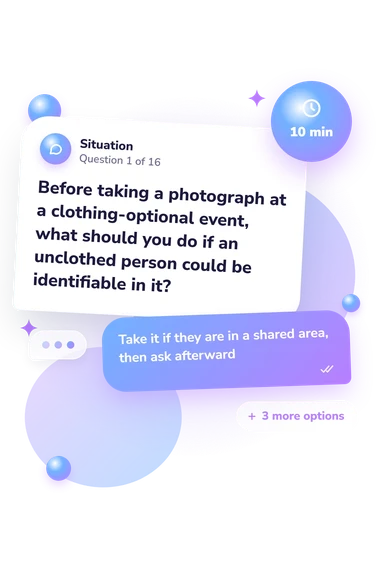
- Take it if they are in a shared area, then ask afterward
- Ask for their explicit permission before taking the photograph
- Take it as long as you do not post it publicly
- Assume entry to the event includes consent to photography
- Oil glands pulling the outer skin inward
- Sweat glands closing their surface openings
- Blood vessels filling the hair shafts
- Tiny muscles attached to hair follicles contracting
- To study visible form, proportion, posture, light, and movement
- To produce a medically exact record of one person’s anatomy
- To avoid making choices about fabric color and clothing style
- To create work that must communicate romantic attraction
Naked Quiz - Description and methodology of the test
People preparing for a clothing-optional visit, or anyone wanting an overall knowledge check, can use this nude quiz to gauge understanding without making personal comfort or appearance the subject. Questions relevant to nude social situations give readers a structured way to consider informed choices about boundaries and basic facts. The Naked Quiz is therefore a practical starting point for respectful decisions.
What This Assessment Explores
This assessment focuses on respectful behavior: requesting permission before photography, protecting privacy, separating nudity from sexual consent, and checking venue rules. It also covers skin function, melanin, ultraviolet exposure, goosebumps, body odor, variation, and cold-related danger.
As a nudist quiz, it addresses naturism and clothing-optional customs, not lifestyle identity.
The questions cover these content areas:
- Questions on consent and privacy ask how permission, image-sharing, and boundaries should be handled.
- Body-science items cover skin, sunlight, odor, and normal variation.
- Safety items examine responses to exposure, shared facilities, and emergencies.
- Etiquette items address naturist customs and public-nudity laws that differ by place.
Nudity Knowledge is the sole scale, scored 0-16: Foundations to build (0-6), Developing knowledge (7-12), or Strong knowledge (13-16). It reflects overall nudity-related knowledge, not separate subscale results.
Methodology and Evidence Base
Each item presents four answer choices, usually asking the reader to select the response that best fits a factual, ethical, or safety situation. As a nudity quiz, this questionnaire is a self-administered multiple-choice check of nudity-related knowledge. The result is reported through the displayed scale and bands; no rule for converting individual answers is stated. Guessing, prior knowledge, or interpreting a scenario differently can affect the outcome.
The content is conceptually consistent with research by West and Kukawska on naturism, undress-related behavior, and body-image experiences; this questionnaire is not an adaptation of their measure. The International Naturist Federation’s statutes support the distinction between naturism and inherently sexual conduct. World Health Organization guidance on ultraviolet exposure supports items on cloud cover, melanin, and sun protection, while guidance from Dow and colleagues supports the urgent response to cold-related danger.
The result is presented as educational, making it most useful for learning and reflection about the situations covered. Interpretation can be affected by guessing, prior knowledge, how a scenario is understood, local laws, and venue customs.
- West, Keon, and Eliza Kukawska. “Good Nudes and Bad Nudes: How Naturism, Casual Stripping, and Sexting Predict Social Physique Anxiety and Body Appreciation.” Sexuality & Culture 26 (2022): 2151-2170. 10.1007/s12119-022-09990-6
- International Naturist Federation. Statutes of the International Naturist Federation (INF-FNI). 2018.
- World Health Organization. “Ultraviolet Radiation.” Fact sheet, 21 June 2022.
- Dow, Jennifer, et al. “Wilderness Medical Society Clinical Practice Guidelines for the Out-of-Hospital Evaluation and Treatment of Accidental Hypothermia: 2019 Update.” Wilderness & Environmental Medicine 30, no. 4 Suppl. (2019): S47-S69. 10.1016/j.wem.2019.10.002