
Mythical Creature Quiz
How the Scales are Structured
Who Usually Takes This Test?
See How You Compare
Below is a preview of how scores are typically distributed across each scale.
Example Questions From the Test
- Strongly disagree
- Disagree
- Not sure
- Agree
- Strongly disagree
- Disagree
- Not sure
- Agree
- Strongly disagree
- Disagree
- Not sure
- Agree
Mythical Creature Quiz - Description and methodology of the test
Visitors who want to compare everyday choices with an imaginative result can use the mythical creature quiz as a structured way to notice patterns in familiar decisions. For someone considering a what mythical creature am i quiz, the assessment can clarify which preferences feel consistent, where the profile feels less convincing, and what the comparison suggests about personal style.
What This Assessment Explores
Three dimensions turn the statements into a profile of privacy, assertiveness, and curiosity. Items touch on solitude, boundaries, decision-making, protection, learning, and experimentation. By using a what mythical creature are you quiz to frame those patterns, the questionnaire links them to an imaginative archetype without treating one result as a complete identity.
The result uses these official dimensions:
- Mystique & Independence (0-30) measures privacy and self-reliance; higher bands indicate greater autonomy: Open & Collaborative (0-10), Balanced Boundaries (11-20), or Mysterious & Independent (21-30).
- Power & Boldness (0-30) measures assertiveness, ambition, and taking charge; higher bands indicate a more commanding style: Gentle Presence (0-10), Balanced Boldness (11-20), or Commanding Force (21-30).
- Wonder & Curiosity (0-30) measures openness to novelty and learning; higher bands indicate more exploratory openness: Comfort-Seeking (0-14), Balanced Explorer (15-23), or Wonder-Driven (24-30).
Methodology and Scientific Basis
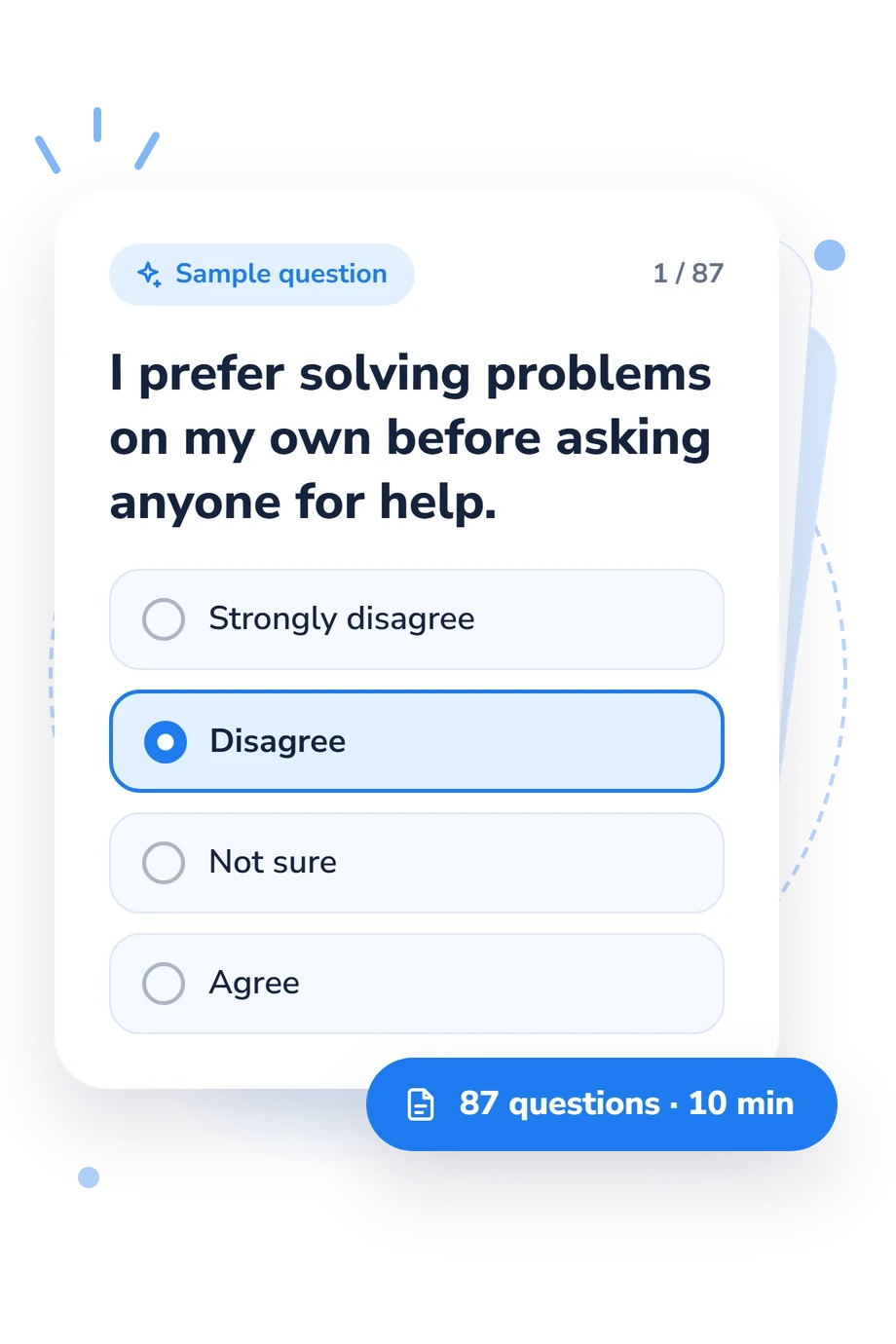
The sampled statements offer four responses-Strongly disagree, Disagree, Not sure, or Agree-so the task is a direct self-report of typical preferences and reactions. Responses are combined into the three displayed dimensions; the questionnaire does not specify per-answer weights, so its score ranges alone do not show how individual responses contribute.
As a mythical creature personality test, it uses a playful frame for interpreting trait patterns rather than assigning a permanent type. Its structure is conceptually consistent with the Six Factor Personality Questionnaire (Jackson, Paunonen, & Tremblay, 2000) and with Jackson, Ashton, and Tomes (1996), which describe broad factors alongside narrower facets. The online questionnaire has no stated norms or standardization; the six-factor sources are conceptual comparators, not evidence validating this online test.
Interpret the bands comparatively: higher placement means the named tendency is more characteristic of the answers, while lower placement means less endorsement. Mood, recent experiences, self-awareness, and socially desirable responding can affect self-report. It is a self-reflection tool rather than a diagnostic assessment, so broader personal context matters.
- Jackson, Douglas N., Sampo V. Paunonen, and Paul F. Tremblay. Six Factor Personality Questionnaire Technical Manual. Port Huron, MI: SIGMA Assessment Systems, 2000.
- Jackson, Douglas N., Michael C. Ashton, and Jennifer L. Tomes. "The six-factor model of personality: Facets from the Big Five." Personality and Individual Differences, 21(3), 391-402, 1996. 10.1016/0191-8869(96)00046-3
- Soto, Christopher J., and Oliver P. John. "The next Big Five Inventory (BFI-2): Developing and assessing a hierarchical model with 15 facets to enhance bandwidth, fidelity, and predictive power." Journal of Personality and Social Psychology, 113(1), 117-143, 2017. 10.1037/pspp0000096
Updated: