
Music Notes Quiz Game
How the Scales are Structured
Who Usually Takes This Test?
See How You Compare
Below is a preview of how scores are typically distributed across each scale.
Example Questions From the Test
- Lower the note by one semitone
- Raise the note by one semitone
- Hold the note for one extra beat
- Play the note one octave higher
- Bridge
- Verse
- Chorus
- Coda
- G
- B
- E
- D
Music Notes Quiz Game - Description and methodology of the test
Designed for learners who want a quick, practical check of their reading skills, the Music Notes Quiz Game focuses on whether familiar notation can be recognized and applied in common musical situations. As a music notation quiz, it suits beginners, returning players, and anyone building confidence before more formal study. The result gives a focused snapshot of strengths and topics to revisit.
What This Assessment Explores
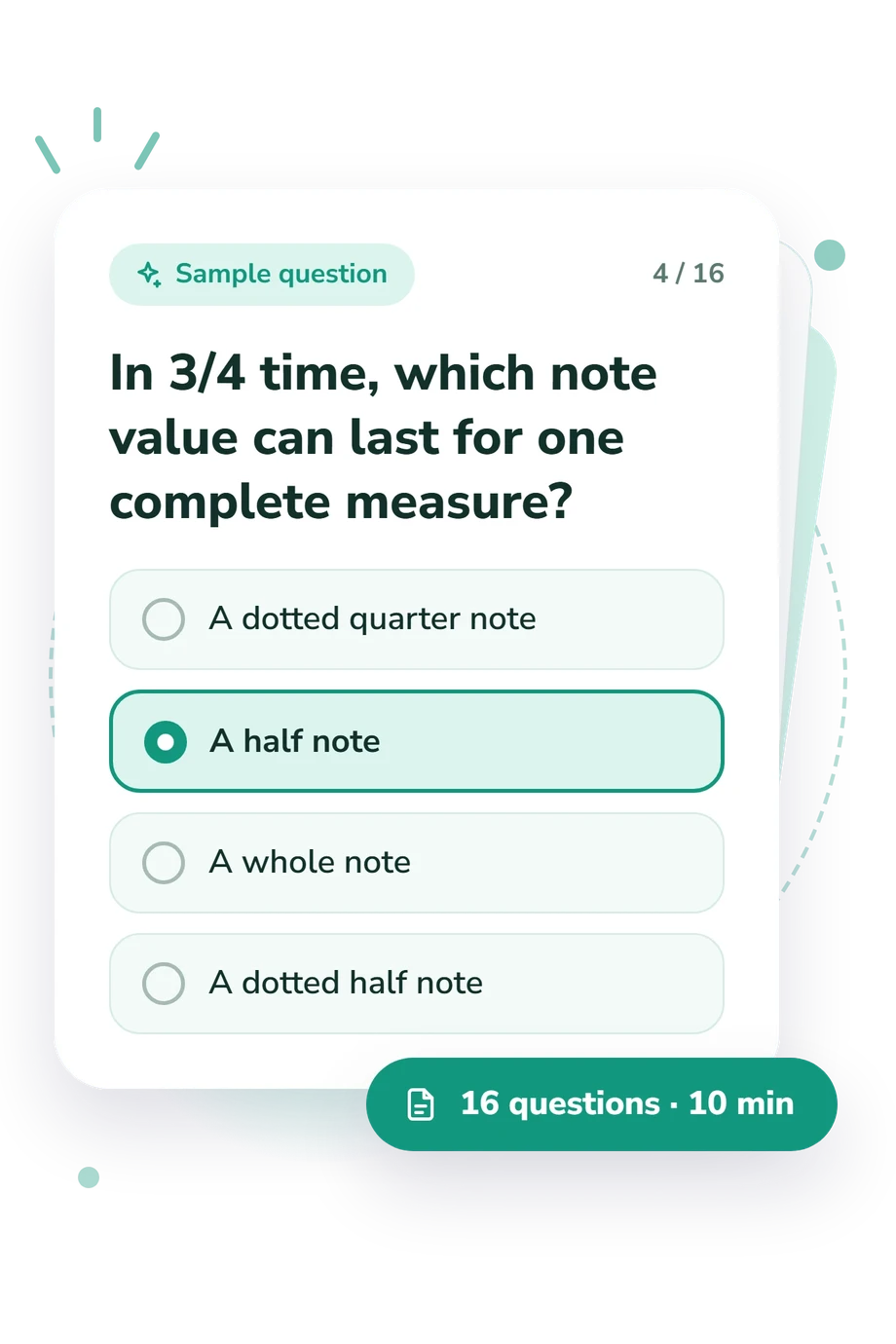
Questions cover symbols, staff positions, keyboard patterns, rhythm, and song structure, so the quiz samples practical music literacy rather than performance technique.
The single result, Music Notes Knowledge (0-16), summarizes command of core notation and related rules. Its displayed bands are:
- Building the Basics (0-6) shows that foundational note names, rhythm values, clefs, or symbols may need review.
- Developing Music Reader (7-12) indicates a useful foundation with some notation concepts still needing practice.
- Note Fluent (13-16) reflects strong command of notation, rhythm, keyboard patterns, and basic song structure.
In this note names quiz, staff, clef, accidental, and musical-alphabet questions test recognition of written pitches; other items cover intervals, transposition, pickups, ties, rests, and recurring song sections. The result maps practice needs rather than musical talent.
Methodology and Scientific Basis
Each question presents four answer choices, and the respondent selects the option that best fits the musical rule or example. Every correct answer adds one point. This direct method is easy to follow, but it cannot show partial knowledge or distinguish a gap from a guess or momentary inattention.
The closest source is the Elementary Music Achievement Test (EMAT), an achievement-testing approach to learnable music knowledge. This questionnaire is conceptually consistent with EMAT, not an adaptation or reproduction of its administration or norming. Its content also corresponds with Eric Taylor’s foundational theory explanations and Omar and colleagues’ account of music knowledge as related abilities. This music theory quiz provides a practical knowledge check, while the source relationship remains conceptual.
Read the result as an educational profile: a stronger score suggests command of the sampled rules, while a lower band identifies topics to revisit. The result is interpreted through the displayed score bands, and performance may vary with previous instruction, terminology familiarity, guessing, and attention. It describes the tested content, not musical ability as a whole.
- Colwell, Richard. Elementary Music Achievement Test Manual: EMAT. Follett Publishing Company, 1965.
- Colwell, Richard. The Development of the Music Achievement Test Series. Bulletin of the Council for Research in Music Education, no. 22, 1970, pp. 57-73.
- Omar, Rohani; Hailstone, Julia C.; Warren, Jane E.; Crutch, Sebastian J.; Warren, Jason D. The cognitive organization of music knowledge: a clinical analysis. Brain, 2010, 133(4), 1200-1213. DOI 10.1093/brain/awp345.
- Taylor, Eric. Music Theory in Practice, Grade 1. Revised edition. ABRSM Publishing, 2008.
Updated: