
Multiple Choice Quiz
How the Scales are Structured
Who Usually Takes This Test?
See How You Compare
Below is a preview of how scores are typically distributed across each scale.
Example Questions From the Test
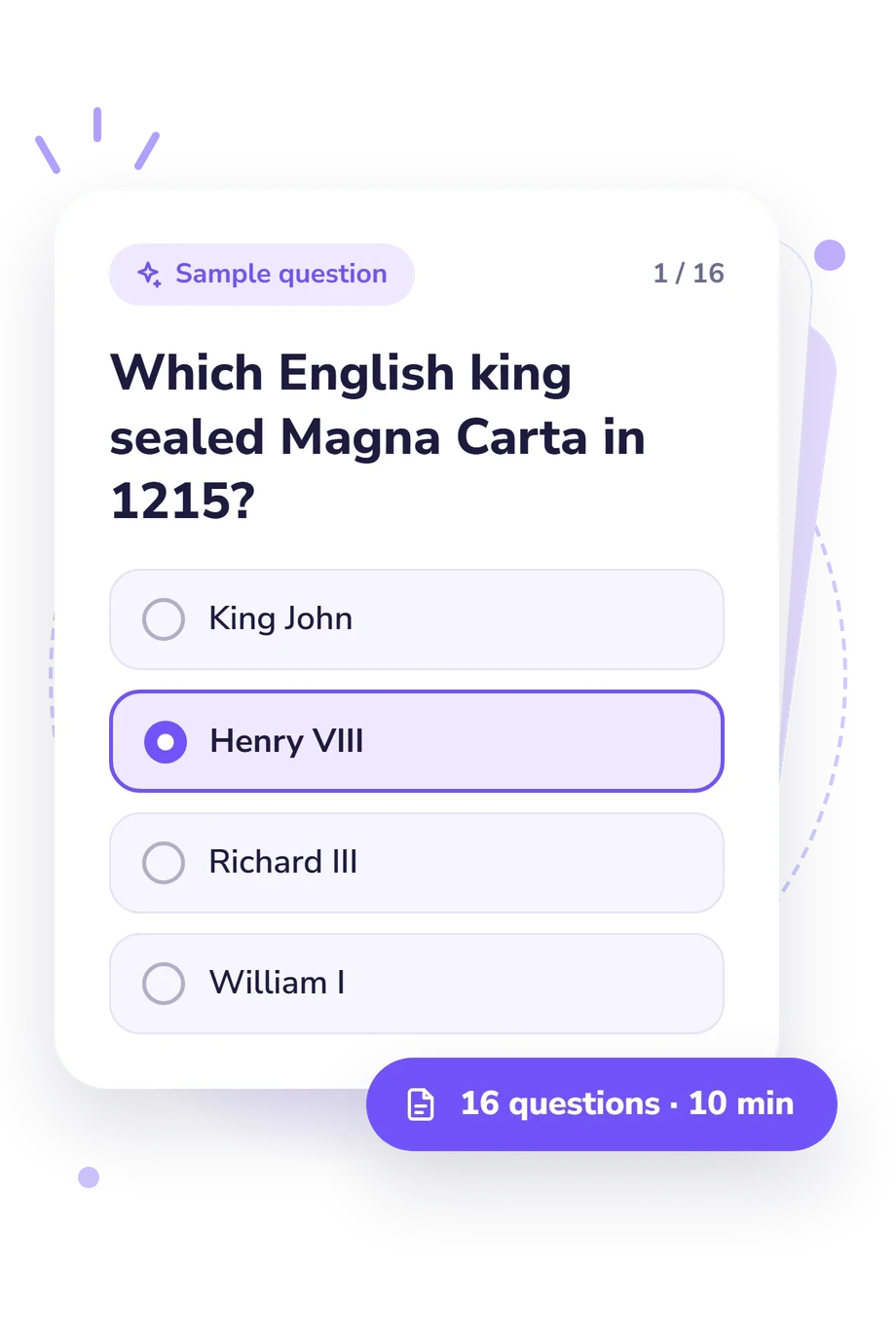
- King John
- Henry VIII
- Richard III
- William I
- $20
- $55
- $65
- $60
- Bronchi
- Alveoli
- Diaphragm
- Trachea
Multiple Choice Quiz - Description and methodology of the test
People seeking broad factual knowledge can use this multiple choice quiz to explore recall, everyday reasoning, and understanding across unrelated subjects. As a multiple-choice trivia quiz, it suits curious learners and adults who want to see which areas feel secure or less familiar. The mixed subject matter broadens the exercise beyond one topic. A multiple-choice quiz with answers selected from four options gives a compact profile of performance.
What This Assessment Explores
The questionnaire spans school- and everyday-knowledge domains rather than a single subject. Items touch history, geography, literature, science, mathematics, language, music, civics, technology, and ecology, so the result reflects how consistently a respondent retrieves or applies widely encountered information.
The result is organized under one overall dimension:
- General Trivia Knowledge runs from 0-16 and summarizes correct answers across the mixed set. Foundations to build (0-6) indicates some core facts with room to widen coverage; Developing range (7-12) indicates useful knowledge across several areas; Strong trivia knowledge (13-16) indicates accurate performance across factual and reasoning-based questions.
Reviewing questions in this multiple-choice quiz can show whether weaker performance clustered around a topic or arose from isolated slips. The result describes performance on this sample, while unfamiliar wording or cultural knowledge can influence it.
Methodology and Evidence Base
Each item presents four answer choices and asks the respondent to select the best option rather than write an explanation. The set combines factual recall with arithmetic, probability, grammar, classification, and causal reasoning. The distractors are designed to make alternatives plausible, but choosing one does not reveal why an answer was selected.
The method is conceptually consistent with General Knowledge Test (Irwing et al., 2001), which connects general knowledge with semantic memory; this online questionnaire is not presented as an adaptation of that instrument. Furnham and Chamorro-Premuzic (2006) provide context for considering general knowledge alongside individual differences. Gierl, Bulut, Guo, and Zhang (2017) support careful attention to distractor design in multiple-choice assessment.
In practice, the score is the number of correct responses, and the displayed bands describe performance on this questionnaire rather than a population norm. Reviewing the multiple-choice quiz and its answers can help separate a topic-specific gap from an isolated mistake. Guessing, prior exposure, language familiarity, and momentary concentration can affect test performance, so the result is not a standardized intelligence estimate.
- Paul Irwing, Thomas Cammock, and Richard Lynn. (2001). Some evidence for the existence of a general factor of semantic memory and its components. Personality and Individual Differences, 30(5), 857-871. 10.1016/S0191-8869(00)00078-7
- Adrian Furnham and Tomas Chamorro-Premuzic. (2006). Personality, intelligence and general knowledge. Learning and Individual Differences, 16(1), 79-90. 10.1016/j.lindif.2005.07.002
- Mark J. Gierl, Okan Bulut, Qi Guo, and Xinxin Zhang. (2017). Developing, Analyzing, and Using Distractors for Multiple-Choice Tests in Education: A Comprehensive Review. Review of Educational Research, 87(6), 1082-1116. 10.3102/0034654317726529
Updated: