
Mother's Day Quiz
How the Scales are Structured
Who Usually Takes This Test?
See How You Compare
Below is a preview of how scores are typically distributed across each scale.
Example Questions From the Test
- Presenting flowers to the oldest mother in each village
- Marking the beginning of the spring school term
- Returning to one's “mother church” during Lent
- Commemorating the founding of modern Mother's Day in America
- The second Sunday in February
- The fourth Sunday of Lent
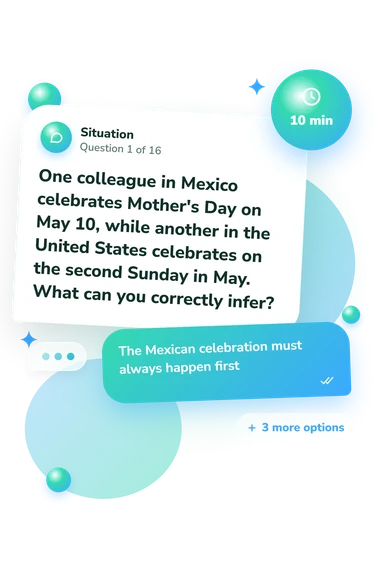
- May 10 every year
- The second Sunday in May
- The final Sunday in May coincides with Pentecost
- May has five Sundays that year
- Labour Day falls during the same week
- The date must follow the summer solstice
Mother's Day Quiz - Description and methodology of the test
For readers who want to test factual knowledge of Mother's Day across countries and historical periods, the Mothers Day Quiz offers a focused way to examine dates, customs, people, symbols, and language. As a mothers day trivia quiz, it connects familiar holiday details with less obvious variations. The result shows which areas of holiday history and global tradition are already familiar.
What This Assessment Explores
This assessment suits curious learners who want to test factual knowledge of Mother's Day as an international observance. It covers movable and fixed dates, Mothering Sunday, historical figures, flowers, wording, and national customs. The result shows which areas of holiday history and global tradition are already familiar.
Each item gives a short prompt and four choices. In the mother day quiz and answers format, several scenarios ask you to apply information about a date, custom, or source rather than recall a name alone. Performance is reported on Mother's Day Knowledge, 0-16:
- Budding Knowledge (0-6) reflects familiarity with some ideas but limited historical or international detail.
- Growing Knowledge (7-12) reflects understanding of major customs and several related observances.
- Flourishing Knowledge (13-16) reflects strong knowledge of history, calendars, language, and global traditions.
These bands describe content performance, not personality or family relationships.
Methodology and Evidence Base
Methodologically, this is an online knowledge questionnaire, not a published standardized psychometric instrument. Its four-option items combine factual recall, calendar comparison, and short scenarios. The displayed total is placed in the supplied performance band; the questionnaire does not claim a norm-based cutoff or clinical interpretation.
The historical frame is conceptually consistent with Antolini (2014), whose study examines Anna Jarvis, the American campaign, and disputes over the holiday's meaning. It is not an adaptation of that work. Jones (1980) provides context for the holiday's creation and promotion in the Progressive Era, while the 1914 United States congressional resolution supports the question about federal recognition. Capdevila et al. (2022) adds a contemporary perspective on motherhood and femininity in social-media communication rather than validation of this questionnaire.
As a Mother's Day history quiz, it works best for self-testing and targeted learning. A score can be affected by guessing, wording, current attention, cultural familiarity, and prior exposure to particular traditions. Treat it as a snapshot of performance on these items, not as a complete measure of historical expertise or a basis for conclusions about personal values.
- Katharine Lane Antolini. Memorializing Motherhood: Anna Jarvis and the Struggle for Control of Mother's Day. West Virginia University Press, 2014.
- Kathleen W. Jones. Mother's Day: The Creation, Promotion and Meaning of a New Holiday in the Progressive Era. Texas Studies in Literature and Language, 22(2), 175-196, 1980. 10.1515/9783110971095.503
- Rose Capdevila, Charlotte Dann, Lisa Lazard, Sandra Roper, and Abigail Locke. #mothersday: Constructions of Motherhood and Femininity in Social Media Posts. Feminism & Psychology, 32(3), 336-356, 2022. 10.1177/09593535221107832
- United States Congress. Joint Resolution of May 8, 1914, Designating the Second Sunday in May as Mother's Day, 38 Stat. 770.