
Mineral Identification Quiz
How the Scales are Structured
Who Usually Takes This Test?
See How You Compare
Below is a preview of how scores are typically distributed across each scale.
Example Questions From the Test
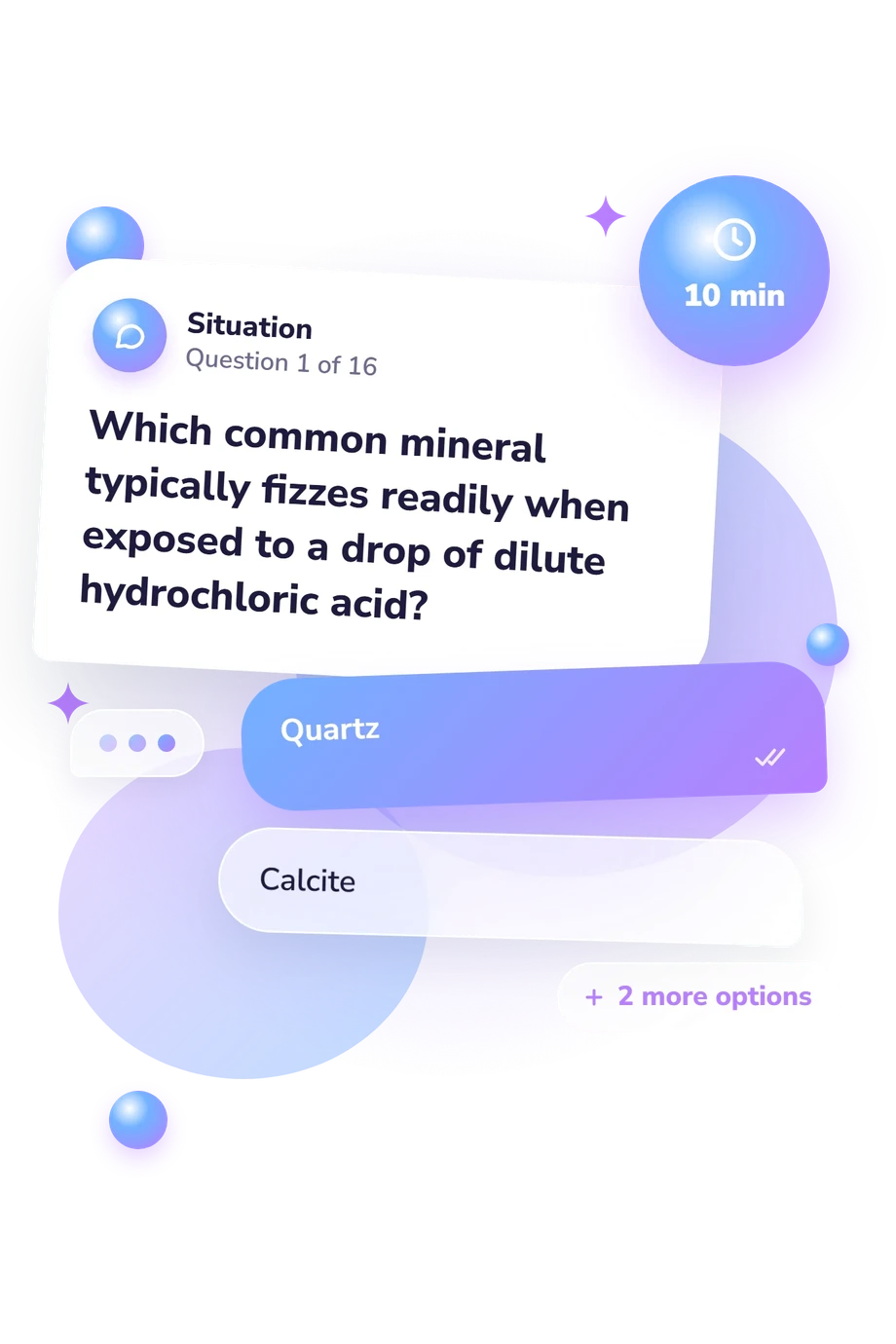
- Quartz
- Calcite
- Feldspar
- Gypsum
- The color reflected from the mineral's outer surface
- The direction in which the mineral grows
- The pattern of scratches left by another object
- The color of the mineral in powdered form
- Gypsum
- Calcite
- Fluorite
- Quartz
Mineral Identification Quiz - Description and methodology of the test
Designed for students, hobbyists, and anyone building practical observation skills, this mineral identification quiz asks you to connect visible and testable properties with likely mineral identities. For classroom review, this mineral quiz checks how well you apply identification concepts before examining real specimens or deciding which areas deserve more practice.
What This Assessment Measures
The assessment asks whether you can use diagnostic properties rather than rely on color alone. Its scenarios cover minerals and observations including scratch resistance, cleavage, fracture, streak, luster, specific gravity, magnetism, and dilute hydrochloric acid reaction. It suits learners refreshing introductory geology, preparing for specimen work, or building recognition skills.
The question themes are:
- Hardness shows how scratch resistance narrows possible identities.
- Cleavage and fracture distinguish repeated planes from irregular or shell-like breaks.
- Streak, color, and luster separate surface appearance from powdered-color evidence.
- Specific gravity, magnetism, and acid reaction help distinguish visually similar specimens.
The displayed scale is Mineral Identification Knowledge (0-16). Its bands are Foundations to build (0-6), Developing identifier (7-12), and Strong identification knowledge (13-16). As a mineral ID quiz, it offers a snapshot of current knowledge and comparison skill.
Methodology and Evidence Base
Each item gives a brief specimen description or testing situation with four answer choices. You must match the best-supported mineral or property to the evidence, combining clues such as hardness, cleavage, streak, or acid reaction rather than relying on a name-recognition guess.
The displayed score summarizes performance across the item set. Its bands describe increasing command of the tested skills and reflect performance on these items. Read them as a guide to targeted review, since the result covers only the properties and scenarios included here.
The scientific reference point is the Federal Highway Administration’s 1991 identification manual, which organizes practical identification around observable properties and simple tests. Klein and Philpotts’ 2012 textbook provides the mineralogical framework for connecting hardness, cleavage, fracture, specific gravity, streak, luster, magnetism, and acid reaction with mineral recognition. The questionnaire is conceptually consistent with these identification materials.
For practical study, the mineral identification test supports focused review, but results can be affected by prior instruction, terminology familiarity, guessing, and the limited range of specimens represented. Precise identification still depends on examining physical samples in appropriate conditions.
- Federal Highway Administration. Rock and Mineral Identification for Engineers. FHWA-HI-91-025. Washington, DC: U.S. Department of Transportation, November 1991.
- Klein, Cornelis, and Anthony R. Philpotts. Earth Materials: Introduction to Mineralogy and Petrology. Cambridge: Cambridge University Press, 2012. 10.1017/CBO9781139028028
Updated: