
Microeconomics Quiz
How the Scales are Structured
Who Usually Takes This Test?
See How You Compare
Below is a preview of how scores are typically distributed across each scale.
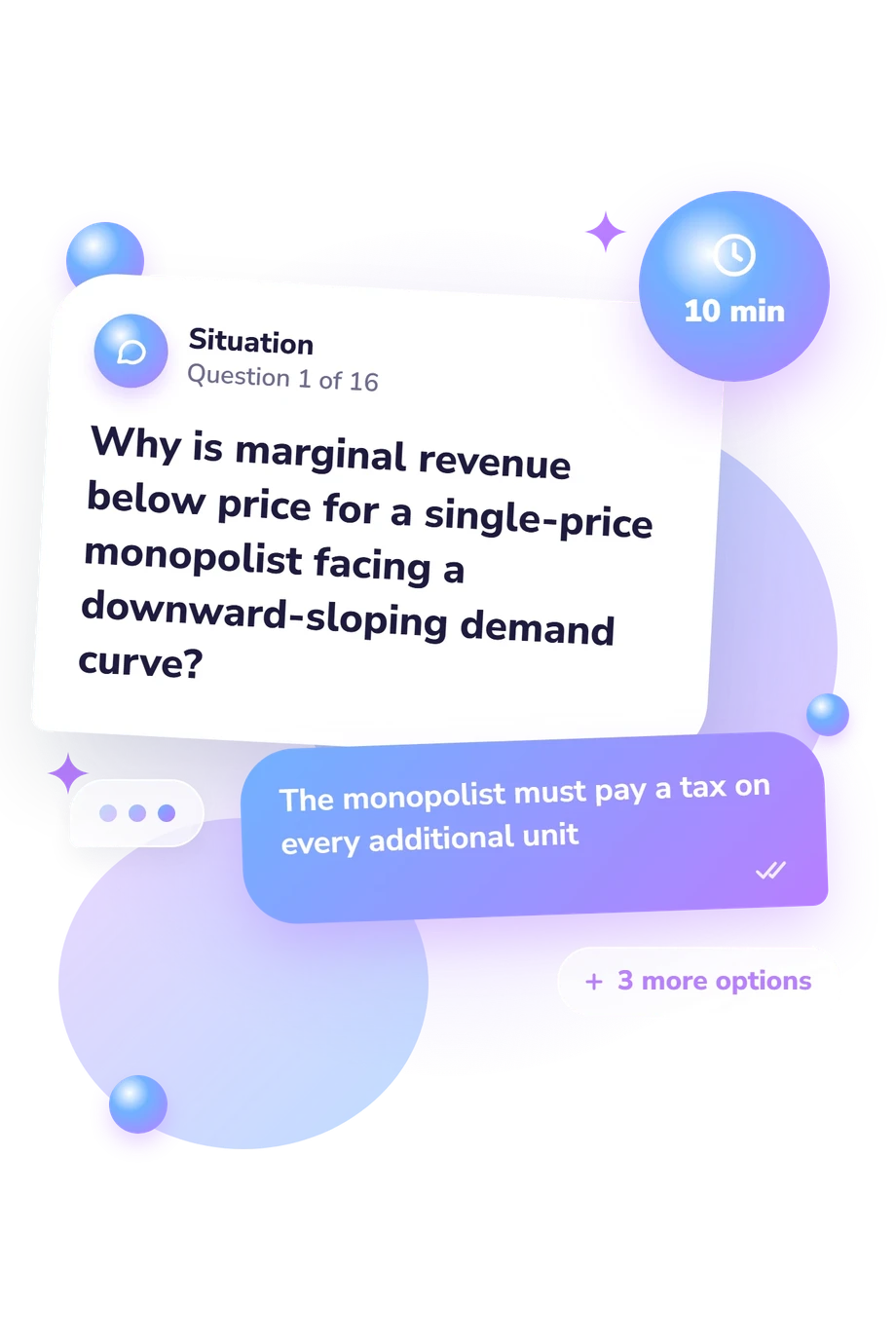
Example Questions From the Test
- A mixed strategy
- A Nash price
- A dominant strategy
- A socially optimal strategy
- Perfectly elastic supply
- Increasing returns to scale
- Diminishing marginal utility
- Comparative advantage
- Rival and excludable
- Rival and non-excludable
- Non-rival and excludable
- Non-rival and non-excludable
Microeconomics Quiz - Description and methodology of the test
For students, instructors, and curious learners who want to check how they reason about everyday markets, this microeconomics quiz offers a focused educational snapshot. Its role as a microeconomics knowledge test is reflected in short scenarios, economic principles, and selected responses. Results place the respondent in an overall educational band that can indicate whether broad review of foundational concepts may be useful.
What This Assessment Explores
This assessment combines concept recognition, economic scenarios, decision rules, and simple calculations involving incentives, exchange, and markets. Learners checking their reasoning independently or alongside coursework may use it as an introductory microeconomics assessment.
It examines:
- Opportunity cost and marginal reasoning show whether you compare benefits, costs, and next-best alternatives.
- Demand, supply, and elasticity show whether you predict price, quantity, and tax-burden changes.
- Market structure and strategy show whether you distinguish competition, monopoly, dominant actions, and firm decisions.
- Externalities, public goods, and information problems show whether you recognize wider effects and hidden information.
The result is Microeconomics Knowledge (0-16): Foundations to Review (0-6) signals a need to revisit definitions, graphs, and decision rules; Developing Knowledge (7-12) reflects understanding with distinctions to reinforce; Strong Knowledge (13-16) reflects reliable command in scenarios. It is an educational result, not a measure of academic proficiency.
Methodology and Scientific Basis
For learners using it as a microeconomics practice test, each item uses a selected-response format: a short economics scenario or principle is followed by four answer choices, and the respondent chooses the best explanation or decision. The questionnaire reports one displayed Microeconomics Knowledge score rather than a profile of separate trait scores.
The questions cover concepts also represented in the Test of Understanding in College Economics (Walstad & Rebeck, 2008), a relevant measure of economics concept knowledge. They also cover topics represented in the Council for Economic Education’s national content standards and in economic-literacy themes examined by Walstad, Rebeck, and Butters (2013). This overlap does not establish that the online questionnaire is an adaptation or validated replica of those sources, or that its administration is standardized.
Interpret the result as a guide to broad review, not as a complete estimate of economic ability. Performance can vary with recent study, wording, attention, guessing, and familiarity with classroom examples. The bands describe educational performance rather than formal academic proficiency.
- Walstad, William B., and Ken Rebeck. 2008. "The Test of Understanding of College Economics." American Economic Review 98 (2): 547-551. 10.1257/aer.98.2.547
- Council for Economic Education. 2010. Voluntary National Content Standards in Economics. 2nd ed. New York, NY: Council for Economic Education.
- Walstad, William B., Ken Rebeck, and Roger B. Butters. 2013. "The Test of Economic Literacy: Development and Results." The Journal of Economic Education 44 (3): 298-309. 10.1080/00220485.2013.795462
Updated: