
Meiosis Quiz
How the Scales are Structured
Who Usually Takes This Test?
See How You Compare
Below is a preview of how scores are typically distributed across each scale.
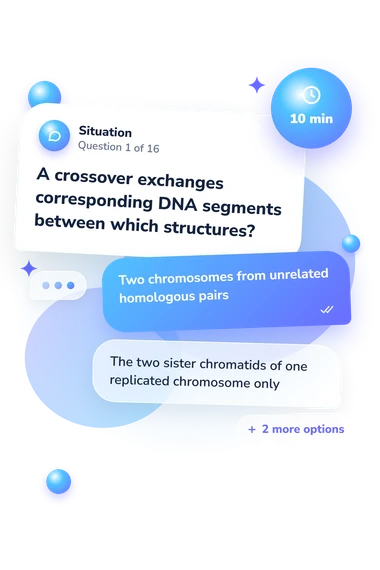
Example Questions From the Test
- Two chromosomes from unrelated homologous pairs
- The two sister chromatids of one replicated chromosome only
- Two chromosomes located in different cells
- Nonsister chromatids of homologous chromosomes
- DNA replication and cytokinesis
- Chromosome condensation and spindle formation
- Crossing over and independent assortment
- Centromere duplication and nuclear-envelope formation
- To double chromosome number before fertilization
- To produce genetically identical diploid cells for growth
- To repair damaged chromosomes without cell division
- To produce haploid cells while generating genetic variation
Meiosis Quiz - Description and methodology of the test
Students reviewing cell biology can use this cell division quiz to organize what they know before classwork, revision, or a lab discussion. Taking the meiosis quiz can show whether chromosome behavior, meiotic stages, genetic variation, and chromosome-number changes are secure or need closer attention. The result is most useful as a focused snapshot of understanding.
What This Assessment Explores
Used as a meiosis practice quiz, this assessment suits learners who want to check concepts rather than memorize isolated labels. The items cover chromosome structure, ploidy, DNA replication, meiotic stages, genetic variation, and segregation errors, so the result reflects connected understanding of the process.
The result appears on the Meiosis Knowledge scale, from 0-16: Foundation to build (0-6), Developing knowledge (7-12), and Strong knowledge (13-16). These bands describe the level shown across the tested concepts.
The main areas represented by the questions are:
- Chromosome structure and ploidy show whether you distinguish homologues, chromatids, and chromosome-set number.
- Meiotic stages and sequence show whether you can place replication, separation, and division events correctly.
- Variation mechanisms show whether crossing over and independent assortment are understood as sources of new allele combinations.
- Segregation errors show whether you can predict nondisjunction outcomes and altered chromosome numbers.
Methodology and Scientific Basis
Each item presents a definition, comparison, biological situation, or chromosome-count problem with four answer choices. The respondent selects the best option, so the format tests both recall and application: some prompts ask for a stage or term, while others require tracing chromosome behavior through meiosis. Used for review, the assessment also works as a meiosis review quiz, with one result summarizing performance across the full set rather than producing separate trait profiles.
Conceptually, the questionnaire aligns with Gerton and Hawley (2005) on homologous chromosome interactions and crossover, and with Marston and Amon (2004) on the cell-cycle controls that organize meiotic divisions. Creighton and McClintock (1931) provide classical support for connecting cytological crossing-over with genetic recombination, while Hassold and Hunt (2001) help frame the nondisjunction and aneuploidy items.
These sources support the biological framework, but the online questionnaire is not presented as an adaptation of any one published instrument. Its result bands are descriptive learning levels; no population norms or reliability estimates are supplied, and performance can be influenced by self-report conditions, guessing, and recent classroom exposure. The score is therefore best used as an indicator of current understanding.
- Gerton, Jennifer L., and R. Scott Hawley. "Homologous chromosome interactions in meiosis: diversity amidst conservation." Nature Reviews Genetics 6, no. 6 (2005): 477-487. 10.1038/nrg1614
- Marston, Adèle L., and Angelika Amon. "Meiosis: cell-cycle controls shuffle and deal." Nature Reviews Molecular Cell Biology 5 (2004): 983-997. 10.1038/nrm1526
- Creighton, Harriet B., and Barbara McClintock. "A Correlation of Cytological and Genetical Crossing-Over in Zea Mays." Proceedings of the National Academy of Sciences 17, no. 8 (1931): 492-497. 10.1073/pnas.17.8.492
- Hassold, Thomas J., and Patricia A. Hunt. "To err (meiotically) is human: the genesis of human aneuploidy." Nature Reviews Genetics 2, no. 4 (2001): 280-291. 10.1038/35066065