
MAT 144 Quiz 1
How the Scales are Structured
Who Usually Takes This Test?
See How You Compare
Below is a preview of how scores are typically distributed across each scale.
Example Questions From the Test
- The square root of 194 inches
- 8 inches
- 18 inches
- 12 inches
- The perimeter equation: 2a + 2b = c
- The unsquared sum: a + b = c squared
- The difference equation: a squared minus b squared = c squared
- The sum-of-squares equation: a squared + b squared = c squared
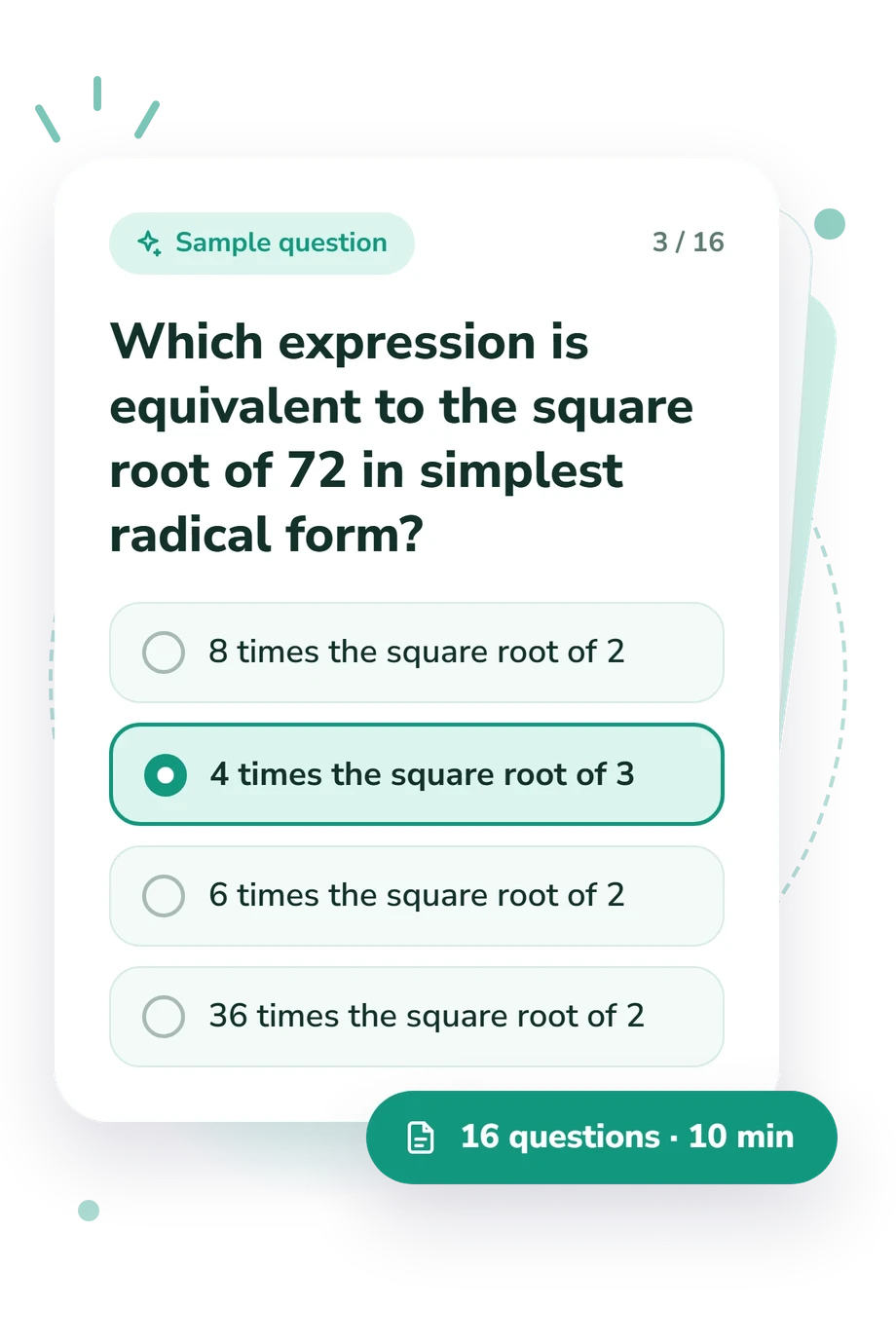
- 8 times the square root of 2
- 4 times the square root of 3
- 6 times the square root of 2
- 36 times the square root of 2
MAT 144 Quiz 1 - Description and methodology of the test
Students preparing for an introductory mathematics course can use this assessment to check how confidently they apply right-triangle relationships in familiar and practical settings. MAT 144 Quiz 1 samples interpreting situations, choosing equations, and carrying out arithmetic. For students preparing for Math 144 Quiz 1, those sampled skills can suggest which Pythagorean-theorem topics to revisit; the result remains separate from a course grade.
What This Assessment Explores
Questions sample skills rather than formula recall. They ask you to identify the hypotenuse, find missing sides, simplify radicals, and apply distance reasoning to coordinate planes and practical settings. A MAT 144 practice quiz checks conceptual recognition alongside procedural accuracy.
The result is reported on Pythagorean Theorem Knowledge, scored from 0-16: Foundation (0-6) indicates essential ideas need review; Developing (7-12) reflects success on problems with room to strengthen exact forms, coordinate applications, or multi-step reasoning; Strong (13-16) indicates consistent command of the theorem and common applications. The score describes this practice set only.
These recurring question themes show the skills covered:
- Triangle structure shows whether you can identify the hypotenuse and form an equation.
- Missing-side reasoning shows whether you can isolate an unknown from known lengths.
- Exact and applied work shows whether you can simplify radicals and use distance formulas.
Methodology and Evidence Base
Each item presents a situation or statement with four answer choices. Responses may require recognizing a relationship, selecting an equation, calculating exact values, simplifying a radical, finding a distance, or classifying an angle. This format tests interpretation and execution; the platform reports one knowledge scale, not separate subskills.
The question content is conceptually consistent with the geometry-instruction focus discussed by Lipowsky, Rakoczy, Pauli, Drollinger-Vetter, Klieme, and Reusser (2009), which connects geometry instruction with Pythagorean-theorem understanding. It also reflects obstacles described by Hutapea, Suryadi, and Nurlaelah (2015), including difficulty connecting symbolic procedures with geometric meaning. Euclid's Elements supplies theorem context through Heath's translation; this questionnaire is not an adaptation of that book or either study, and it has no stated published validation or norming.
A Pythagorean theorem practice test can indicate whether review of the theorem and its applications may be useful. Item-level inspection supports more targeted review when missed items are available. Scores can shift with preparation, notation familiarity, arithmetic slips, and guessing, so interpret the result as evidence from this practice set and use coursework to judge broader mathematics achievement.
- Lipowsky, Frank, Katrin Rakoczy, Christine Pauli, Christine Drollinger-Vetter, Eckhard Klieme, and Kurt Reusser. 2009. "Quality of geometry instruction and its short-term impact on students' understanding of the Pythagorean Theorem." Learning and Instruction 19(6): 527-537. 10.1016/j.learninstruc.2008.11.001
- Hutapea, Maya L., Didi Suryadi, and Elah Nurlaelah. 2015. "Analysis of Students' Epistemological Obstacles on the Subject of Pythagorean Theorem." Jurnal Pengajaran MIPA 20(1): 1-10. 10.18269/jpmipa.v20i1.555
- Euclid. 1925. The Thirteen Books of Euclid's Elements, Volume 1: Books I and II. 2nd ed. Translated and commented by Sir Thomas Little Heath. Cambridge University Press.
Updated: