
Mahabharata Quiz
How the Scales are Structured
Who Usually Takes This Test?
See How You Compare
Below is a preview of how scores are typically distributed across each scale.
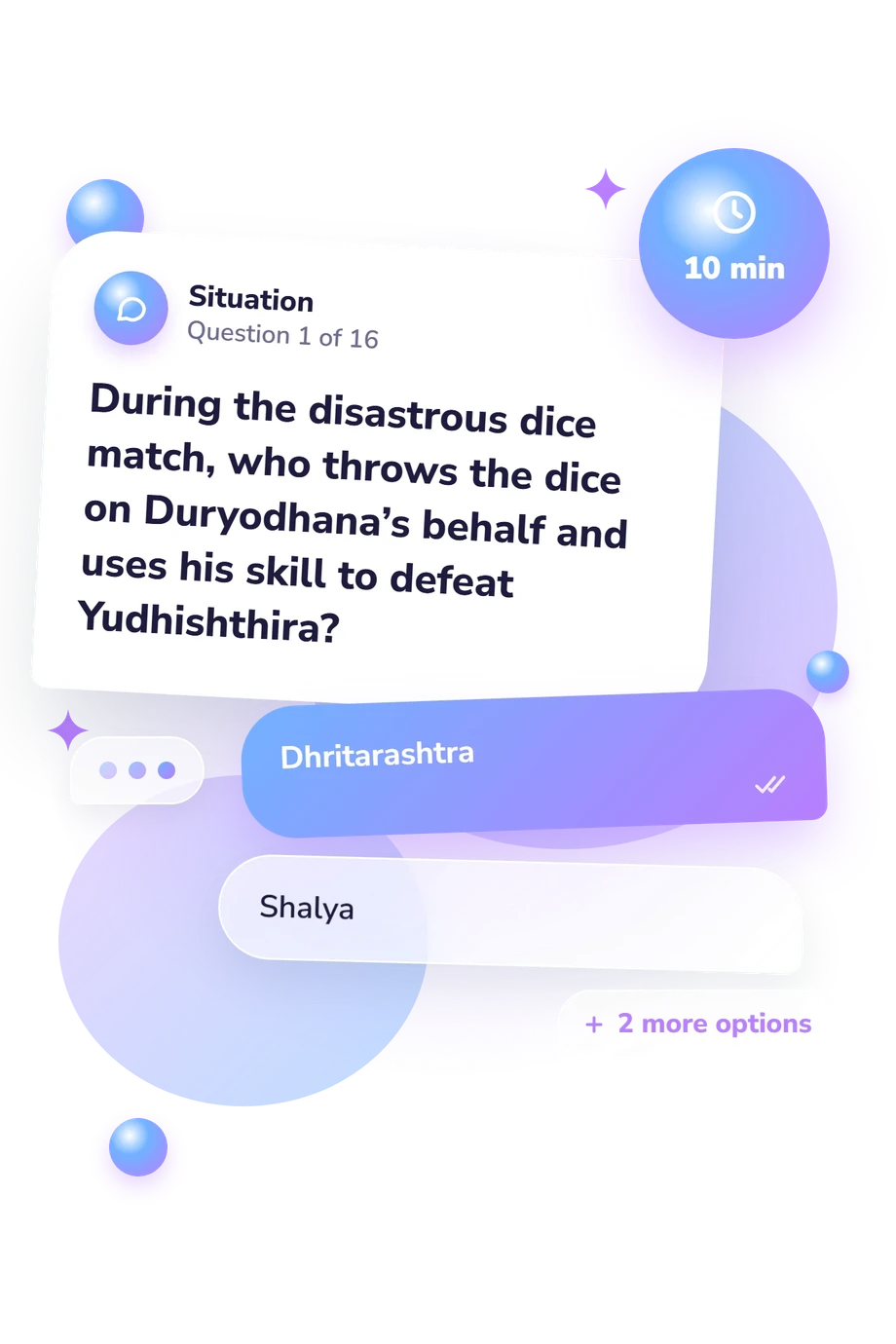
Example Questions From the Test
- Dhritarashtra
- Shalya
- Vidura
- Shakuni
- Ashwatthama
- Abhimanyu
- Karna
- Satyaki
- Kurukshetra
- Dvaraka
- Magadha
- Panchala
Mahabharata Quiz - Description and methodology of the test
For readers who want to check how securely they remember the epic’s people, alliances, moral conflicts, and turning points, the Mahabharata Quiz offers a focused recall exercise. It suits learners, literature readers, and anyone revisiting the story after an adaptation. Its overall result indicates how well you recall the material covered by this Mahabharata question set, without separating performance into individual story topics.
What This Assessment Explores
The questions test characters, kinship, loyalties, disguises, weapons, exile, and decisions leading to the Kurukshetra war. They suit readers checking recall of the epic’s central narrative.
Several episodes in these Mahabharata recall questions include the dice match, burning palace, Chakravyuha, Bhagavad Gita, and final duel, linking names with consequences.
The question themes cover these areas:
- Characters and relationships place major figures within the family and political drama.
- Episodes and settings test recall of exile, contests, disguises, formations, and locations.
- Choices and consequences show how well you remember vows, dharma, counsel, and tactics.
The result uses the Mahabharata Knowledge scale (0-16): Foundational (0-6) indicates recognition of major elements; Developing (7-12) indicates the central narrative and important characters; Legendary (13-16) indicates strong command of the epic’s pivotal relationships and events. Versions and adaptations may differ.
Methodology and Evidence Base
The four-option format asks readers to identify characters, places, relationships, actions, and events, testing narrative knowledge through one total rather than separate psychological traits. That total describes performance on these recall questions.
Each item presents one prompt with four possible answers, so the task asks for recognition of a specific narrative detail rather than a rating of attitude, belief, or personality.
Conceptually, its content aligns with the Mahabharata Critical Edition, a scholarly reference for the epic’s textual tradition, but this questionnaire is not presented as its adaptation. It selects widely recognized narrative facts for online recall.
Different editions and translations, such as Van Buitenen’s rendering and the versions discussed in Sullivan’s overview, can affect which narrative details a reader knows.
Reading history, translation, current familiarity, and confidence with names can affect recall, so the result is an overall indication of performance on this question set rather than a broader measure of literary knowledge.
- Vishnu Sitaram Sukthankar, Shripad Krishna Belvalkar, Sushil Kumar De, Parashuram Lakshman Vaidya, Hari Damodar Velankar, and Ramachandra Narayan Dandekar, eds. The Mahabharata: For the First Time Critically Edited. 19 vols. Poona: Bhandarkar Oriental Research Institute, 1933-1966.
- J. A. B. van Buitenen, ed. and trans. The Bhagavadgita in the Mahabharata. Chicago: University of Chicago Press, 1981.
- Bruce M. Sullivan. “An Overview of Mahabharata Scholarship: A Perspective on the State of the Field.” Religion Compass 10, no. 7 (2016): 165-175. 10.1111/rec3.12200.
Updated: