
Macromolecules Quiz
How the Scales are Structured
Who Usually Takes This Test?
See How You Compare
Below is a preview of how scores are typically distributed across each scale.
Example Questions From the Test
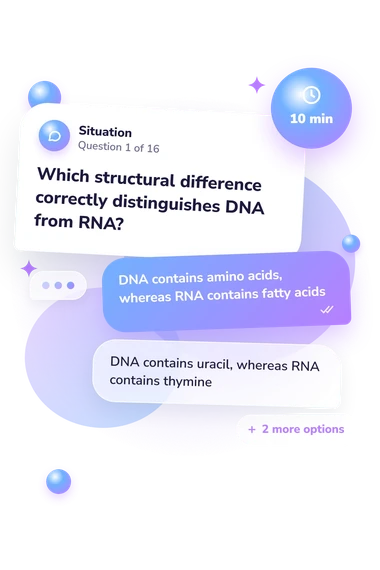
- DNA contains amino acids, whereas RNA contains fatty acids
- DNA contains uracil, whereas RNA contains thymine
- DNA contains deoxyribose, whereas RNA contains ribose
- DNA contains peptide bonds, whereas RNA contains glycosidic bonds
- DNA
- Triglyceride
- Polysaccharide
- Protein
- Starch
- Glucose
- Glycogen
- Cellulose
Macromolecules Quiz - Description and methodology of the test
For learners revising introductory biology, this macromolecules quiz offers a focused way to check whether core relationships among molecular structure, function, and laboratory identification are secure. Answers on the quiz about macromolecules indicate present understanding of tested concepts, while the overall result gives a concise picture of performance across these introductory areas, from terminology and reactions to familiar laboratory tests.
What This Assessment Explores
The questions examine whether you can connect molecular structure with roles in cells, digestion, inheritance, energy use, and simple laboratory tests. They suit learners checking foundational biochemistry, and this macromolecule quiz offers direct review of introductory biology, including high school-level material.
The questions cover four content groups:
- Carbohydrates show whether you identify sugars, polysaccharides, and their fuel-related roles.
- Lipids show whether you apply ideas about nonpolarity, phospholipids, fatty acids, and saturation.
- Proteins show whether you connect amino acids and peptide bonds with folding, enzymes, and function.
- Nucleic acids show whether you distinguish DNA, RNA, and nucleotides by structure and information roles.
The single Macromolecules Knowledge scale (0-16) reflects correct-answer knowledge across these areas and is interpreted as Foundations to Review (0-6), Developing Knowledge (7-12), or Strong Knowledge (13-16). The bands describe increasing command of structure, function, subunits, reactions, and common applications.
Methodology and Scientific Basis
Each item uses a best-answer format with four choices. The questions ask for distinctions such as DNA versus RNA, monomers and polymers, dehydration synthesis, saturation, denaturation, and the interpretation of iodine, Benedict’s, and Biuret tests. This makes the task a content-recall and concept-application exercise rather than a measure of attitudes or personality.
Scoring is straightforward: the result is the number of correct responses, and the bands classify that total. This macromolecules test can support review of the concepts represented by missed items, including links among structure, function, and chemical evidence.
Bledsoe’s study of biological-molecule conceptions offers relevant conceptual context because it examines how students reason about biological molecules and how misconceptions connect unlike properties or substances. The content also aligns with Wright’s molecular-life-science concept-inventory research, while Zeidan’s work on core concepts and Clark, Douglas, and Choi’s textbook study provide broader educational context. These studies situate the tested distinctions within introductory biology without determining the meaning of an individual score.
Performance may vary with prior instruction, current revision, guessing, and how confidently a learner recognizes the underlying chemistry, so the result describes current performance on the tested concepts rather than overall biological expertise.
- Bledsoe, Karen E. (2013). “Starch is Very Fatty”: Understanding the Logic in Undergraduate Student Conceptions about Biological Molecules. Electronic Journal of Science Education, 17(2), 1-35.
- Wright, Tony, Susan Hamilton, Mary Rafter, Susan Howitt, Trevor Anderson, and Manuel Costa. (2009). Assessing Student Understanding in the Molecular Life Sciences Using a Concept Inventory. FASEB Journal, 23(Supplement 1), LB307. 10.1096/fasebj.23.1_supplement.LB307
- Zeidan, Quira, Jennifer Loertscher, Adele J. Wolfson, John T. Tansey, Erika G. Offerdahl, Peter J. Kennelly, Daniel R. Dries, Victoria Del Gaizo Moore, Diane M. Dean, L. Michael Carastro, Sachel M. Villafañe, and Ludmila Tyler. (2021). Development of a Certification Exam to Assess Undergraduate Students’ Proficiency in Biochemistry and Molecular Biology Core Concepts. CBE-Life Sciences Education, 20(2), es6, 1-13. 10.1187/cbe.19-12-0265
- Clark, Mary Ann, Matthew Douglas, and Jung Choi. (2018). Biology 2e. Houston, TX: OpenStax.