
Lyrics Quiz
How the Scales are Structured
Who Usually Takes This Test?
See How You Compare
Below is a preview of how scores are typically distributed across each scale.
Example Questions From the Test
- “I Will Always Love You” — Dolly Parton
- “Jolene” — Dolly Parton
- “Before He Cheats” — Carrie Underwood
- “9 to 5” — Dolly Parton
- “Let It Be” — The Beatles
- “Yesterday” — The Beatles
- “Hey Jude” — The Beatles
- “Eleanor Rigby” — The Beatles
- “Telephone” — Lady Gaga featuring Beyoncé
- “Call Me Maybe” — Carly Rae Jepsen
- “Hello” — Adele
- “Payphone” — Maroon 5 featuring Wiz Khalifa
Lyrics Quiz - Description and methodology of the test
Listeners who enjoy identifying music from narrative clues can use this lyrics quiz to examine how readily they connect paraphrased scenes with familiar songs. It is intended for anyone curious about recognition through meaning, imagery, and story rather than exact verbal recall. Presented as a quiz about song lyrics, it offers a concise profile of how consistently a listener links memorable lyrical situations to the right track, artist, and title.
What This Assessment Explores
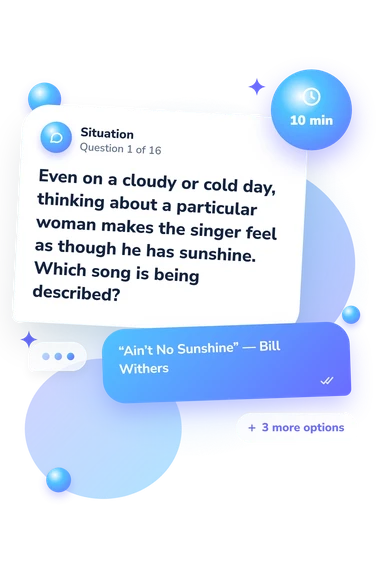
The questionnaire turns lyrical meaning into a recognition task. Each prompt describes a relationship, action, setting, object, or emotional turn, then offers four title-and-artist options. A quiz that asks listeners to guess the lyrics rewards connecting narrative details with stored song knowledge rather than reproducing exact wording.
The thematic groups below describe what can drive a correct answer:
- Emotional relationships show whether apologies, devotion, jealousy, promises, or conflict activate a particular song.
- Narrative episodes show whether a distinctive event, character, or decision identifies the intended track.
- Images and settings show how colors, weather, journeys, rooms, roads, and other concrete details cue recognition.
The displayed Lyrics Knowledge scale runs from 0-16. Emerging Recognition (0-6) means familiar themes may stand out while titles remain difficult to connect; Developing Recognition (7-12) reflects many successful links with some gaps across artists or genres; Strong Recognition (13-16) indicates consistent connections between paraphrased imagery, stories, and songs.
Methodology and Scientific Basis
Each item presents a paraphrased scene and four title-and-artist options. The respondent selects the best match; the displayed scoring awards one point for each correct identification, with no stated partial-credit or penalty rule. A quiz where listeners guess the song from lyrics therefore tests semantic recognition rather than singing or verbatim recall.
Conceptually, the task aligns with research on familiar songs as networks of verbal, melodic, and title cues. Peynircioğlu et al. (2008) is the closest source for lyrics and titles functioning as cues for one another. Johnson and Halpern (2012) addresses semantic activation around familiar songs, while Peretz, Radeau, and Arguin (2004) examines links between language and tune recognition. These studies support the questionnaire’s cue-based logic, but the online test is not presented as an adaptation of them.
For listeners asking whether they know the lyrics, the result is a descriptive snapshot under these answer choices. The bands are interpretive labels, not population norms; scores may vary with language, listening history, genre familiarity, attention, and uncertainty between plausible options. One total cannot explain every missed clue or establish broader musical memory.
- Peynircioğlu, Zehra F., Brian E. Rabinovitz, and Jennifer L.W. Thompson. "Memory and metamemory for songs: The relative effectiveness of titles, lyrics, and melodies as cues for each other." Psychology of Music, 36(1), 47-61 (2008). 10.1177/0305735607079722
- Johnson, Sarah K., and Andrea R. Halpern. "Semantic priming of familiar songs." Memory & Cognition, 40(4), 579-593 (2012). 10.3758/s13421-011-0175-z
- Peretz, Isabelle, Monique Radeau, and Martin Arguin. "Two-way interactions between music and language: Evidence from priming recognition of tune and lyrics in familiar songs." Memory & Cognition, 32(1), 142-152 (2004). 10.3758/BF03195827