
Love Language Test for Kids
How the Scales are Structured
Who Usually Takes This Test?
See How You Compare
Below is a preview of how scores are typically distributed across each scale.
Example Questions From the Test
- Not like me
- A little like me
- Mostly like me
- A lot like me
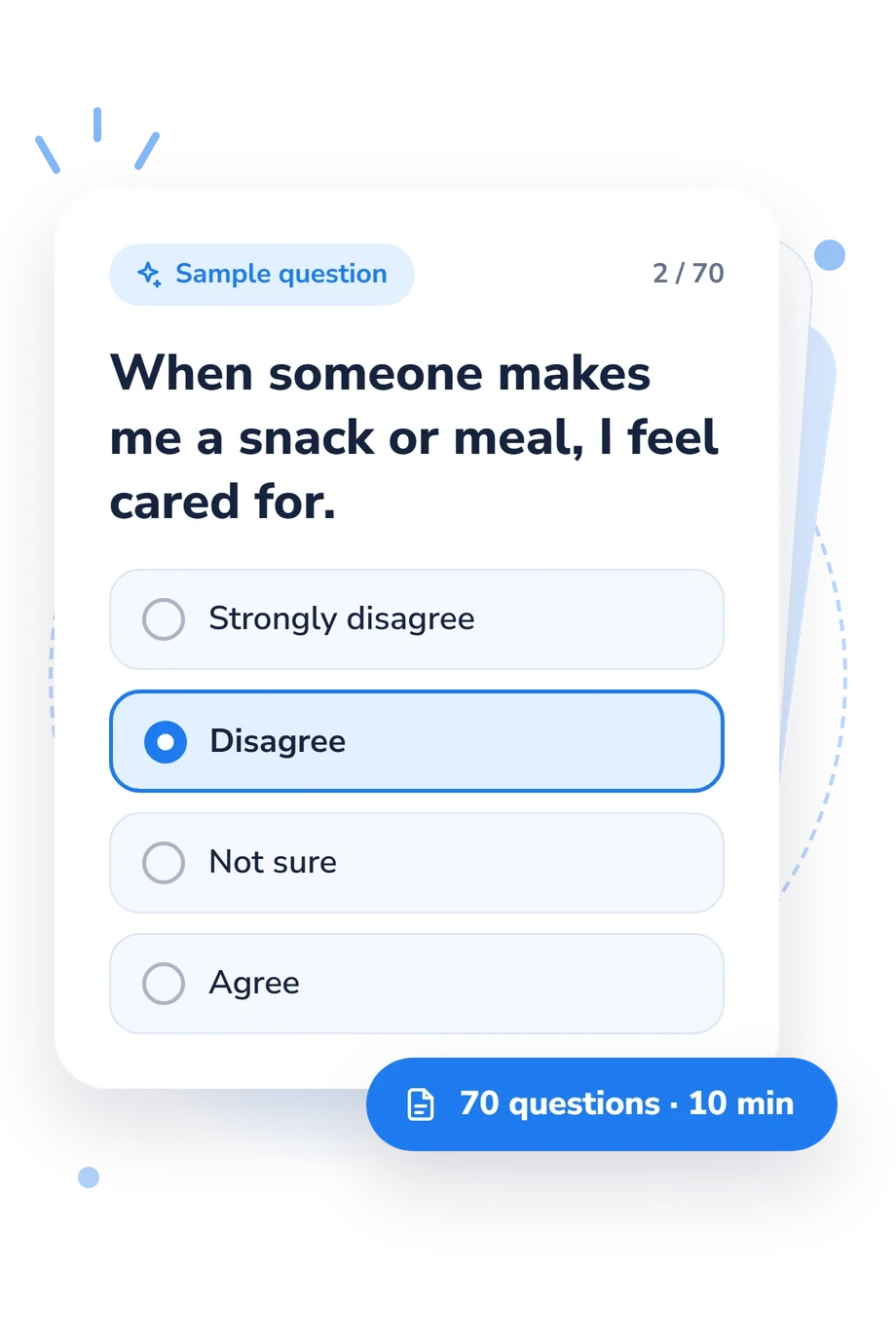
- Strongly disagree
- Disagree
- Not sure
- Agree
- Not like me
- A little like me
- Mostly like me
- A lot like me
Love Language Test for Kids - Description and methodology of the test
Parents, caregivers, and children who want to understand how support is most easily felt can use this love language test for kids as a guided self-reflection exercise. In this love language quiz for kids, familiar interactions-such as help with tasks, undivided attention, and encouraging words-become a starting point for discussing connection, care, and the ways a child feels supported. The result highlights relative preferences, not a fixed label.
What This Assessment Explores
Questions describe moments involving listening, promises, practical help, praise, and shared activities. Some focus on receiving care; others touch on giving kind words. The profile can help families notice which forms of support feel meaningful without reducing a child to one fixed type.
The three displayed dimensions are:
- Acts of Service (0-20) measures how strongly helpful actions feel like care; Lower 0-6, Moderate 7-13, and Higher 14-20 show the displayed bands.
- Quality Time (0-20) measures the importance of focused attention and shared activities; Lower 0-6, Moderate 7-13, and Higher 14-20 show the displayed bands.
- Words of Affirmation (0-20) measures the value of praise, encouragement, and kind messages; Lower 0-6, Moderate 7-13, and Higher 14-20 show the displayed bands.
For families using this child love language test, a higher result suggests that the corresponding support is more prominent in the child’s profile.
Methodology and Evidence
Items use child-friendly self-report choices. Some statements use Not like me, A little like me, Mostly like me, or A lot like me; others use Strongly disagree, Disagree, Not sure, and Agree. The questionnaire displays a score for each theme; higher scores indicate stronger alignment, but exact point assignment is unspecified.
The categories are conceptually consistent with the Five Love Languages framework, but this relationship neither establishes the questionnaire as an adaptation nor validates its scores. Al-Mohtadi et al. (2019) studied parents’ use of the categories, while Egbert and Polk (2006) examined their relationship to relational maintenance. Those studies provide context, not validation of this online form.
Impett et al. (2024) urge careful interpretation of claims about distinct love languages. As a kids love language assessment, it is most useful when caregivers compare the descriptive result with daily interactions and invite the child’s explanation. The result is descriptive, with no norm-referenced interpretation or stated reliability estimates; responses may reflect mood, recent experiences, comprehension, memory, or the child’s relationship with the adult.
- Chapman, Gary D., and Ross Campbell. The 5 Love Languages of Children. Chicago: Moody Press, 1997.
- Al-Mohtadi, Reham, Intisar Turki Al-darabah, and Khaled Mohamad Hamaden. "Which Love Language do You Speak With Your Child? What Are the Effects of your Age, Level of Education, Work Status, and the Number of Children in the Family on the Used Love Languages?" International Journal of Learning and Development, 9(2), 187-202, 2019. 10.5296/ijld.v9i2.15012
- Egbert, Nichole, and Denise Polk. "Speaking the Language of Relational Maintenance: A Validity Test of Chapman's (1992) Five Love Languages." Communication Research Reports, 23(1), 19-26, 2006. 10.1080/17464090500535822
- Impett, Emily A., Haeyoung Gideon Park, and Amy Muise. "Popular Psychology Through a Scientific Lens: Evaluating Love Languages From a Relationship Science Perspective." Current Directions in Psychological Science, 33(2), 87-92, 2024. 10.1177/09637214231217663
Updated: