
Listening Quiz
How the Scales are Structured
Who Usually Takes This Test?
See How You Compare
Below is a preview of how scores are typically distributed across each scale.
Example Questions From the Test
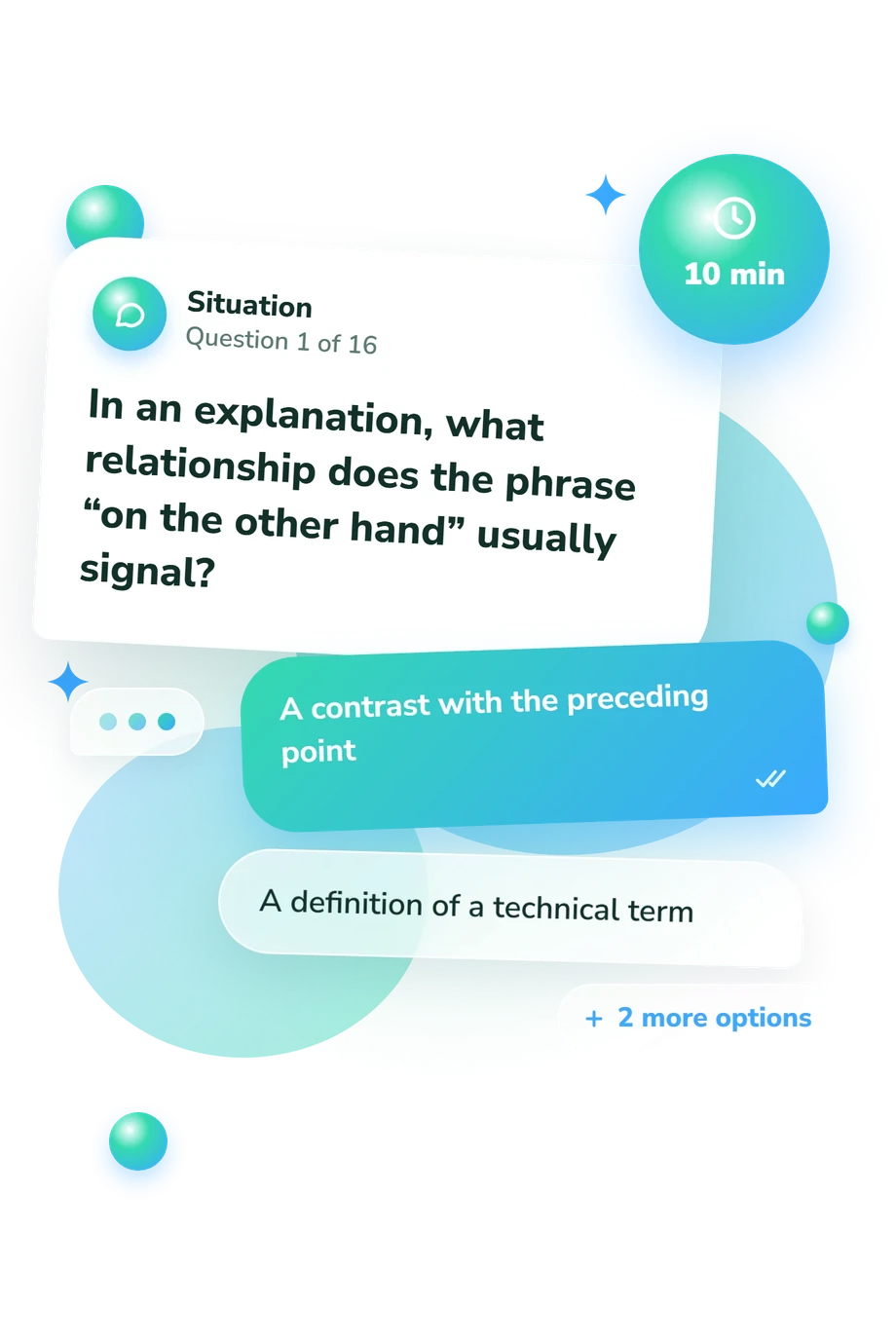
- A contrast with the preceding point
- A definition of a technical term
- A repetition with no change in viewpoint
- A chronological sequence
- “Friday usually works well for me.”
- “I thought the meeting was important.”
- “Could we meet sometime in the afternoon?”
- “Do you mean Friday the 12th or Friday the 19th?”
- The meeting should end immediately.
- Someone should close the window.
- Everyone should move outdoors.
- The room was warmer yesterday.
Listening Quiz - Description and methodology of the test
People who want to examine practical understanding of spoken communication can use this listening quiz to see which comprehension skills are already reliable. It suits learners, teachers, and anyone reflecting on how they follow explanations, instructions, announcements, and everyday conversations. An online listening assessment offers a focused self-check before further study, helping a reader decide which parts of comprehension deserve deliberate practice.
What This Assessment Explores
These items test practical meaning-making in short spoken exchanges: details, sequence, contrast, inference, ambiguity, clarification, paraphrasing, and indirect suggestions. The result concerns comprehension knowledge, not hearing acuity. The pattern can guide listening comprehension practice.
The questions represent three practical dimensions:
- Detail and sequence tracking shows whether dates, times, responsibilities, and action order are identified accurately.
- Inference and speaker intent show whether unstated conclusions or indirect requests are understood from context.
- Clarification and interaction knowledge show whether repair strategies and listening behaviours are recognized.
The displayed scale, Listening Comprehension Knowledge (0-16), reports text-based knowledge: Foundations to build (0-6) reflects difficulty distinguishing details, sequences, or listening terms; Developing comprehension (7-12) reflects understanding of many messages with possible difficulty in implied meaning, references, or multi-step instructions; Strong comprehension (13-16) reflects consistent interpretation of details, intent, sequence, and core listening concepts.
Methodology and Scientific Basis
Each item presents a short prompt and four answer choices. Situations include announcements, explanations, conversations, workplace exchanges, study instructions, and everyday requests. The task is to choose the meaning best supported by the wording.
The selected responses produce one descriptive result. No separate normed subtests, item weighting, or point-allocation rule is displayed, so interpret it through the supplied bands rather than as a percentage.
Becker (2016) is the closest named evidence for distinguishing local information, such as dates and details, from global understanding. Guan (2019) and Shimada (2001) support partly separable listening sub-skills, while Vandergrift and Goh (2012) provide a metacognitive framework for planning, monitoring, checking understanding, and repairing ambiguity. This questionnaire is conceptually consistent with those works, not an adaptation of any one of them.
For someone building English listening skills, the result is a practice guide. Performance may shift with attention, vocabulary, context familiarity, and honest self-report; no population norms are stated, so a lower band identifies targets without summarizing all real-world listening ability.
- Becker, Anthony. 2016. L2 Students' Performance on Listening Comprehension Items Targeting Local and Global Information. Journal of English for Academic Purposes, 24, 1-13. 10.1016/j.jeap.2016.07.004
- Guan, Yuanyuan. 2019. EFL Listening Development through Diagnosis: An Assessment-Based Study of Listening Sub-Skills Using Rasch Measurement. PhD thesis, James Cook University. 10.25903/5f079c1daaa29
- Shimada, Katsumasa. 2001. Skills Separability in a Listening Comprehension Test. ARELE: Annual Review of English Language Education in Japan, 12, 61-70. 10.20581/arele.12.0_61
- Vandergrift, Larry, and Christine Chuen Meng Goh. 2012. Teaching and Learning Second Language Listening: Metacognition in Action. New York: Routledge.
Updated: