
Lightworker Quiz
How the Scales are Structured
Who Usually Takes This Test?
See How You Compare
Below is a preview of how scores are typically distributed across each scale.
Example Questions From the Test
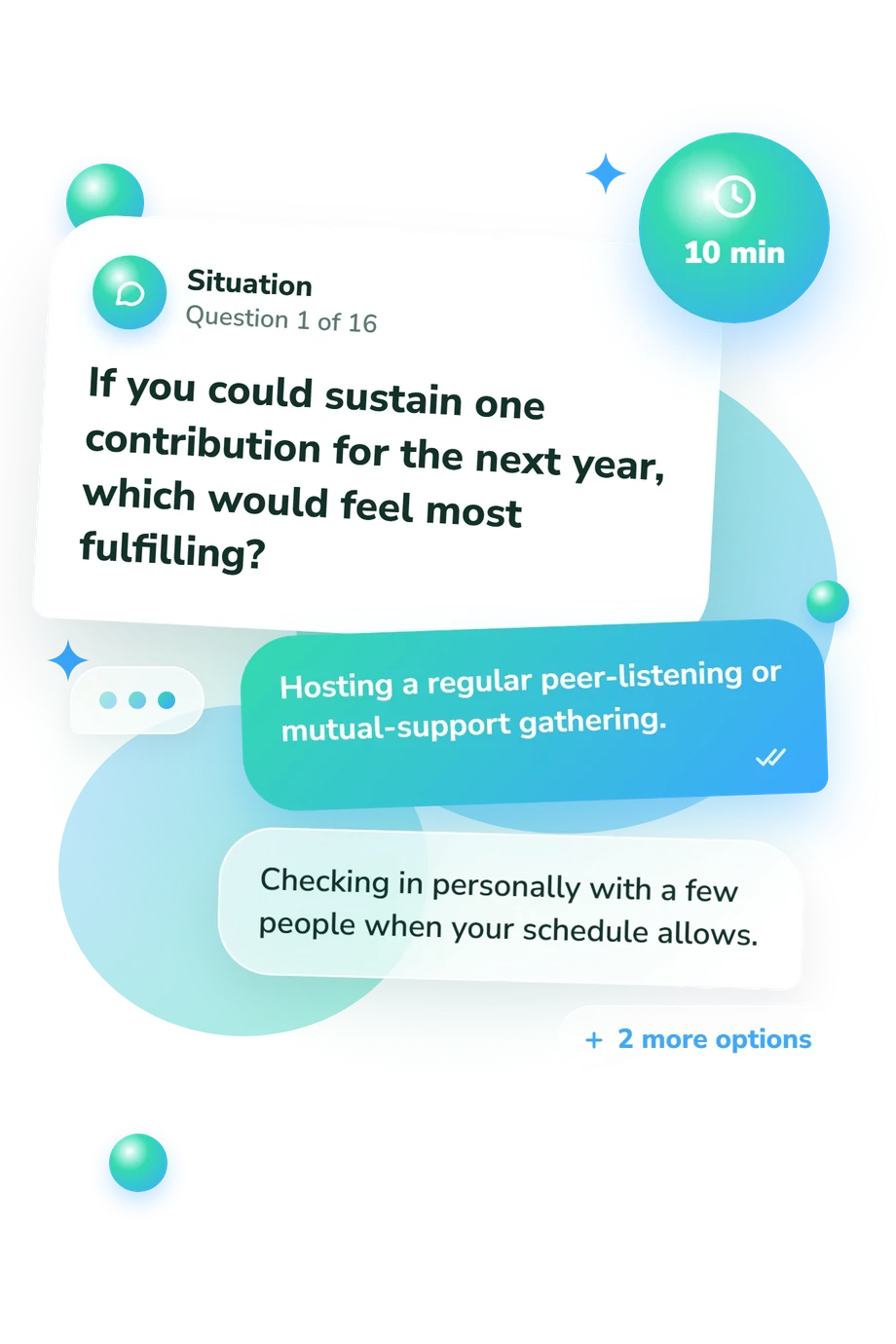
- Hosting a regular peer-listening or mutual-support gathering.
- Checking in personally with a few people when your schedule allows.
- Maintaining a list of helpful community resources.
- Concentrating your effort on creative, educational, or environmental work instead.
- Research the issue and prepare a concise background summary.
- Bring residents together to plan and sustain practical improvements.
- Help with one clearly defined improvement task.
- Support individuals affected by the issue rather than work on the space.
- Preparing materials and keeping the schedule organized.
- Creating a calming visual or musical experience.
- Welcoming people into quiet one-to-one conversations.
- Working on an outdoor improvement project nearby.
Lightworker Quiz - Description and methodology of the test
Readers exploring spiritual meaning, service, and personal strengths can use the lightworker quiz to consider which forms of contribution feel most natural. It is designed for curious readers who want a values-based profile rather than a verdict about spiritual status. For anyone using this quiz to consider whether they are a lightworker, the useful focus is how compassion, creativity, stewardship, and insight appear in everyday choices.
What This Assessment Explores
The questionnaire examines ways of expressing lightworker-inspired values in everyday choices, not supernatural ability. Situations cover emotional support, creative communication, environmental care, community action, study, and explanation. Results describe affinities, not a fixed identity or special authority.
The four displayed dimensions are:
- Compassionate Presence (0-12) reflects affinity for attentive, person-to-person emotional support.
- Creative Illumination (0-12) reflects affinity for expressing hope and meaning through art, writing, music, design, or storytelling.
- Earth and Community Stewardship (0-12) reflects affinity for environmental care, mutual aid, and sustained community action.
- Teaching and Insight (0-12) reflects affinity for studying ideas, finding patterns, and making concepts accessible without claiming special authority.
All four use Quiet fit (0-4), Growing fit (5-8), and Strong affinity (9-12). For readers considering which type of lightworker they are, the strongest area shows a current preference; close results suggest a blended profile.
Methodology and Evidence Base
Each item presents a brief everyday situation with four response choices. You select the option that best matches your likely contribution, so the format elicits preferences in context rather than abstract self-descriptions. Responses are grouped across four dimensions and aggregated into separate scale scores; the output is a comparative profile, not one total score.
As a lightworker self-assessment, this online questionnaire is conceptually consistent with Kavan (2013), whose analysis examines lightworker ideas within New Age spiritual reception. It also shares self-development vocabulary associated with Virtue (1997), while Heelas (1996) and Houtman, Aupers, and Heelas (2009) provide broader context for New Age spirituality. These sources support the interpretive vocabulary, but the questionnaire is not presented as an adaptation or validation of any one published instrument.
No standardized norms, reliability estimates, or clinical cutoffs are supplied for the displayed scores. Mood, recent social experience, self-awareness, and the wish to choose an appealing answer can shape self-report. Read the profile as a structured prompt for reflection on interests and constructive roles, not as evidence of special authority or a fixed spiritual status.
- Kavan, Heather. "Joan of Arc in New Age Spirituality." Relegere: Studies in Religion and Reception, 3(2), 2013, 285-305. 10.11157/rsrr3-2-581
- Virtue, Doreen. The Lightworker's Way: Awakening Your Spiritual Power to Know and Heal. Hay House, 1997.
- Houtman, Dick, Stef Aupers, and Paul Heelas. "Christian Religiosity and New Age Spirituality: A Cross-Cultural Comparison." Journal for the Scientific Study of Religion, 48(1), 2009, 169-179. 10.1111/j.1468-5906.2009.01435_2.x
- Heelas, Paul. The New Age Movement: The Celebration of the Self and the Sacralization of Modernity. Blackwell, 1996.
Updated: