
Kitchen Style Quiz
How the Scales are Structured
Who Usually Takes This Test?
See How You Compare
Below is a preview of how scores are typically distributed across each scale.
Example Questions From the Test
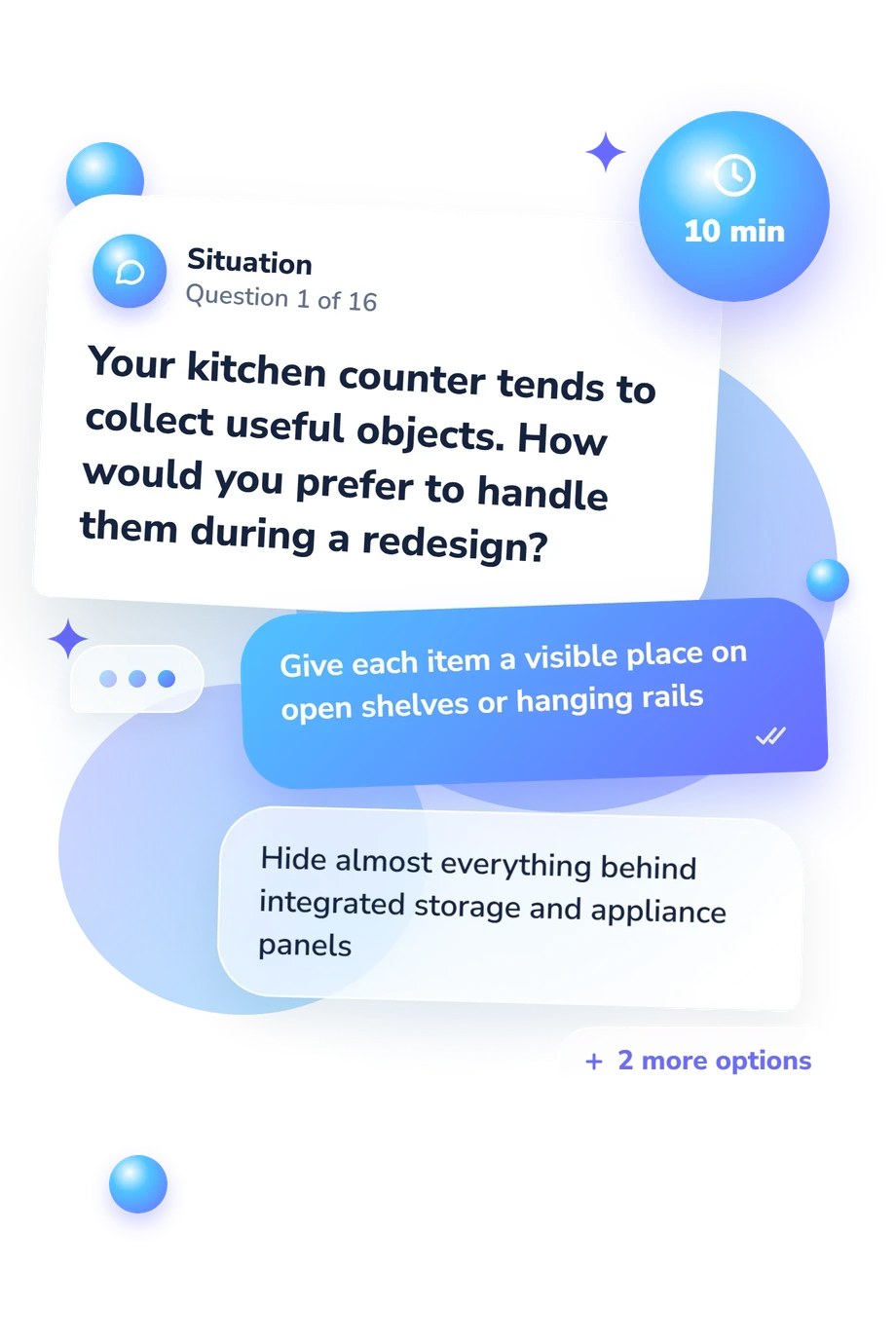
- Give each item a visible place on open shelves or hanging rails
- Hide almost everything behind integrated storage and appliance panels
- Keep a curated group out while storing the rest in simple closed cabinets
- Display objects in decorative containers that add color and personality
- Add a dark, sharply outlined island and repeat its finish in two precise accents
- Layer several warm woods, handmade ceramics, and softened textiles
- Introduce carved trim, aged brass, and a patterned window treatment
- Use one dark worktop with otherwise familiar, lightly detailed cabinetry
- Ornate framed doors with decorative knobs and cup pulls
- Rough-grained timber fronts with sturdy, visible iron handles
- Slim Shaker doors with understated bar pulls
- Smooth slab fronts with recessed channels or discreet edge pulls
Kitchen Style Quiz - Description and methodology of the test
For homeowners choosing finishes, fixtures, and storage, this assessment offers a structured way to notice which visual decisions feel most like home. The kitchen style quiz is intended for anyone planning a new kitchen, updating an existing room, or trying to make separate ideas feel coherent. As a kitchen design quiz, it turns preferences about materials, contrast, color, display, and detailing into a practical direction.
What This Assessment Explores
Questions contrast texture, variety, and restraint. Wondering what style kitchen quiz reveals? The profile shows a leading direction or blend.
These scales define the result:
- Clean Contemporary (0-12) measures visual clarity, integrated function, and controlled accents: 0-4 Detail-Oriented Alternative; 5-8 Contemporary Balance; 9-12 Clean Contemporary Affinity.
- Expressive Eclectic (0-12) measures personal collections, confident pattern, and surprising combinations: 0-4 Coordinated Calm; 5-8 Selective Expression; 9-12 Expressive Eclectic Affinity.
- Relaxed Rustic (0-12) measures tactile surfaces, honest materials, and an unfussy lived-in mood: 0-4 Polished Preference; 5-8 Natural Warmth; 9-12 Relaxed Rustic Affinity.
- Warm Traditional (0-12) measures enduring forms, layered warmth, and refined details: 0-4 Modern Lean; 5-8 Traditional Touches; 9-12 Warm Traditional Affinity.
The highest scale is strongest; scales within one point indicate a blend.
Methodology and Evidence Base
Each item presents a kitchen decision with four response directions covering storage, materials, patterns, lighting, cabinetry, and finishing touches. The self-report format asks you to choose what feels natural, not what seems fashionable or objectively correct. This kitchen style test compares response patterns across four dimensions; the highest scale score indicates strongest affinity, while scores within one point indicate a blend.
The cited studies provide conceptual context; they do not establish this questionnaire as a standardized or validated adaptation. Andaç Güzel (2025) links kitchen preferences with materials, color, layout, and design tendencies. Nasar and Kang (1999), Pedersen (1986), and Scott (1993) connect interior preference with visual organization, familiarity, complexity, and expressive detail. The questionnaire is conceptually consistent with these works, while its particular items and scoring remain specific to this online profile.
Displayed bands are taste categories, not population norms or clinical classifications. Self-report is sensitive to current circumstances and scenario interpretation, so the profile works best as a flexible planning prompt; it cannot settle budget, maintenance, lighting, or shared-household needs.
- Andaç Güzel, Tuğba. (2025). A Study on User Preferences and Kitchen Design Trends: The Case of Kayseri. Bab Journal of FSMVU Faculty of Architecture and Design, 6(2), 194-208. 10.61807/babdergisi.1573132
- Nasar, Jack L., and Junmo Kang. (1999). House Style Preference and Meanings Across Taste Cultures. Landscape and Urban Planning, 44(1), 33-42. 10.1016/S0169-2046(98)00109-1
- Pedersen, Darhl M. (1986). Perception of Interior Designs. Perceptual and Motor Skills, 63(2), 671-676. 10.2466/pms.1986.63.2.671
- Scott, Suzanne C. (1993). Visual Attributes Related to Preference in Interior Environments. Journal of Interior Design, 18(1-2), 7-16. 10.1111/j.1939-1668.1993.tb00067.x
Updated: