
Kitchen Safety Quiz
How the Scales are Structured
Who Usually Takes This Test?
See How You Compare
Below is a preview of how scores are typically distributed across each scale.
Example Questions From the Test
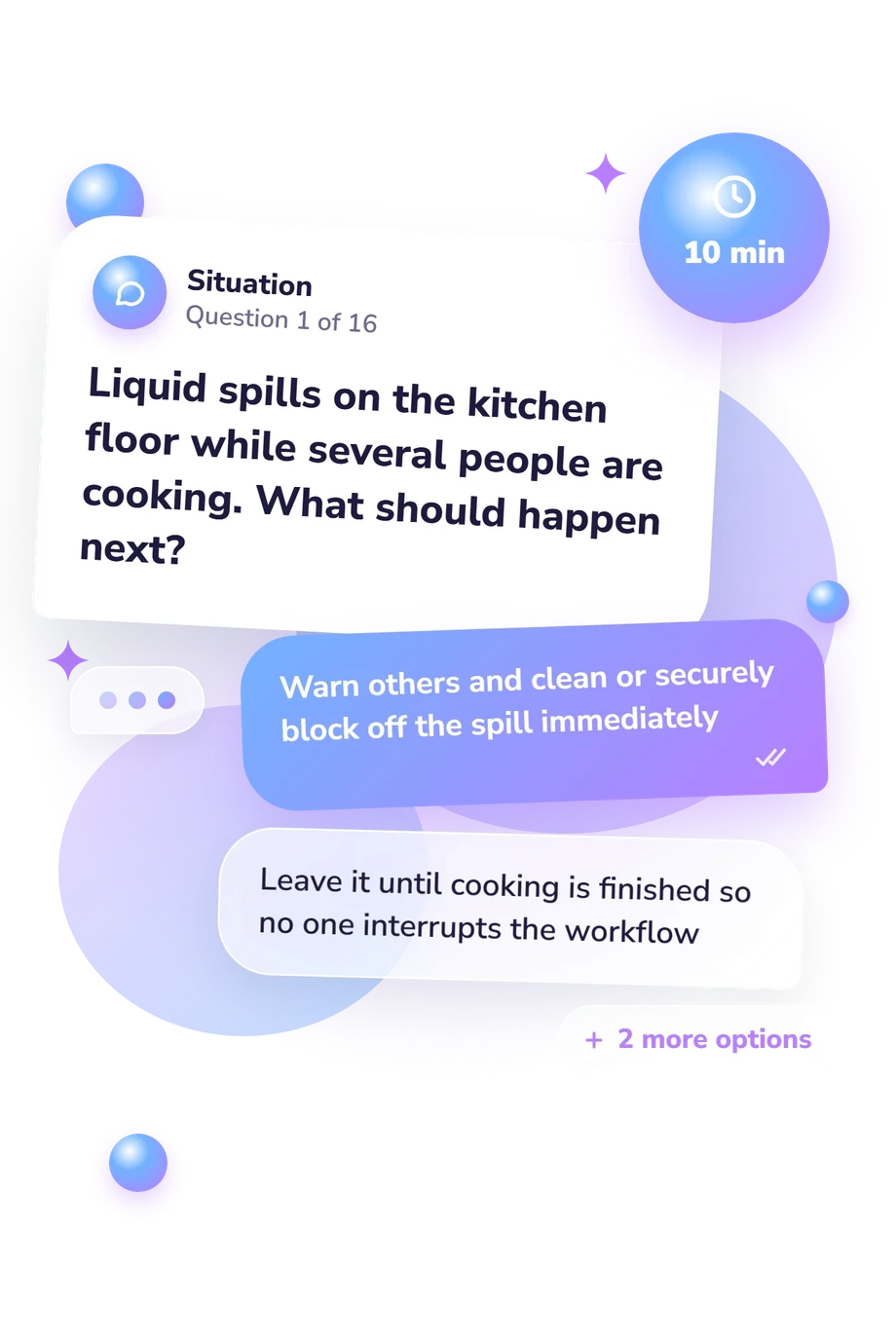
- Warn others and clean or securely block off the spill immediately
- Leave it until cooking is finished so no one interrupts the workflow
- Place a loose dish towel over it as a temporary marker
- Push the liquid toward a wall where fewer people will step
- Lift the near edge first so the steam escapes toward you
- Remove the lid quickly and hold it directly above your face
- Tilt the lid so steam escapes away from your face and hands
- Keep your face close to the pot so you can see when steam appears
- Pin it against the counter with your other hand
- Catch it by the handle before it reaches the floor
- Step back and let it fall before retrieving it carefully
- Stop it with your foot to protect the blade
Kitchen Safety Quiz - Description and methodology of the test
For home cooks and anyone responsible for preparing meals, the kitchen safety quiz offers a focused way to examine practical decisions around food, heat, equipment, and emergencies. A cooking safety quiz can help turn familiar routines into safer habits by showing where instinct matches recommended practice. The result gives a concise profile of strengths and topics that deserve a closer review.
What This Assessment Explores
The questionnaire examines choices that reduce common harm during food preparation. Situations address contamination, heat, fire, sharp tools, broken glass, gas, electricity, chemicals, hygiene, first aid, and movement in a busy workspace. This health and safety in the kitchen quiz suits home cooks and learners checking everyday judgment.
One educational scale is reported: Kitchen Safety Knowledge (0-16). Bands are Foundations to strengthen (0-6), Developing knowledge (7-12), and Strong knowledge (13-16). They describe recognized precautions, not whether a kitchen is hazard-free.
The main themes reflected in the questions are:
- Food and contamination control shows how you recognize risks from raw items, wounds, chemicals, and glass.
- Heat and equipment safety shows whether you respond safely to steam, oil fires, gas, knives, cords, and pans.
- Emergency judgment shows whether you know when to step away, seek help, or use first aid.
Methodology and Evidence Base
Each item presents a scenario with four response options, making this a self-report knowledge check. The alternatives test safer next actions, such as preventing cross-contamination, controlling an oil fire without water, or avoiding a falling knife. The total reflects responses; no separate weighting, norm table, or alternate formula is stated.
Conceptually, this online kitchen safety test is consistent with Song, Kee, and Kim (2018), whose study examines accident risks and prevention in catering kitchens. Its food-hygiene content aligns with Byrd-Bredbenner and colleagues (2007), while emergency and injury-prevention situations are compatible with NIOSH (2014). These sources support the subject matter, not authorship: this questionnaire is not presented as an adaptation of them.
The result is an unvalidated educational score, best read as a snapshot of recognized precautions rather than proof of competence. Attention, memory, current context, and the gap between knowing a rule and following it under pressure can affect self-report. In an immediate emergency, move to safety and contact local emergency services; suspected poisoning or chemical exposure calls for a poison service or qualified professional.
- Song, Young-Woong, Dohyung Kee, and Wook Kim. "Questionnaire Survey of Accidents Occurred in Catering Kitchens for Identification of Risk Factors and Preventing Measures." Journal of the Ergonomics Society of Korea 37, no. 4 (2018): 511-522. 10.5143/JESK.2018.37.4.511
- Byrd-Bredbenner, Carol, Virginia Wheatley, Donald Schaffner, Christine Bruhn, Lydia Blalock, and Jaclyn Maurer. "Development and Implementation of a Food Safety Knowledge Instrument." Journal of Food Science Education 6, no. 3 (2007): 46-55. 10.1111/j.1541-4329.2007.00029.x
- National Institute for Occupational Safety and Health. Caring for Yourself While Caring for Others. Cincinnati, OH: U.S. Department of Health and Human Services, Centers for Disease Control and Prevention, 2014. DHHS (NIOSH) Publication No. 2015-103.
Updated: