
Java Quiz for Beginners
How the Scales are Structured
Who Usually Takes This Test?
See How You Compare
Below is a preview of how scores are typically distributed across each scale.
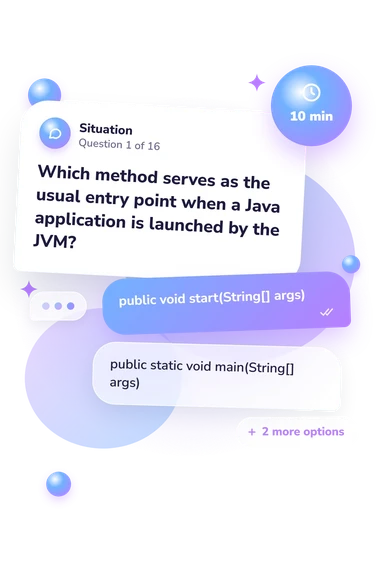
Example Questions From the Test
- public void start(String[] args)
- public static void main(String[] args)
- static int main(String args)
- public static void run()
- 8
- 9
- A compile-time error because methods cannot return calculations
- 10
- 10
- 20
- 30
- An array index exception is thrown
Java Quiz for Beginners - Description and methodology of the test
For learners who are moving from reading Java examples to tracing their own code, the Java Quiz for Beginners offers a focused check of essential programming understanding. It suits students, self-taught developers, and anyone returning to the language who wants a Java fundamentals quiz to see which concepts feel secure. The test turns familiar syntax and short code situations into a practical starting point for review.
What This Assessment Explores
These questions test whether a beginner can connect Java rules with program behavior. They cover syntax, types, control flow, methods, arrays, classes, exceptions, collections, strings, and primitive values. The intended reader is anyone building or refreshing a foundation; this assessment works as a core Java quiz online, supporting practice.
The areas are:
- Syntax and types cover declarations, primitives, boolean logic, integer division, and initialization.
- Control flow covers loops, switch fall-through, short-circuit evaluation, and statement order.
- Methods, classes, data, and errors cover entry points, returns, constructors, inheritance, arrays, ArrayList, String comparison, and catch blocks.
The Java Knowledge scale runs from 0-16: Building the basics (0-6) signals a need to review fundamentals; Developing foundation (7-12) reflects many beginner concepts; Strong beginner knowledge (13-16) indicates reliable command of common tasks. The result is an educational summary of beginner Java knowledge, not a certification of programming ability.
Methodology and Evidence Base
Each item presents a short concept question or code fragment with four options. This questionnaire is a Java programming quiz test that checks recognition and tracing rather than complete program construction.
The questionnaire does not state an answer-to-point conversion. It reports one overall result and shows no topic subscores, so the questions and answer choices can help locate review topics but do not measure advanced coding fluency.
Its content is conceptually consistent with Brown and Altadmri's 2017 study of errors made by novice Java programmers. The Java Language Specification describes the language behavior represented here, while the Java API Specification covers library behavior such as ArrayList; neither source validates this questionnaire.
It is an online educational questionnaire without published norms or standardization for this score.
Interpret the result as a learning signal: a lower band points to foundational review, while a higher band indicates stronger command of the sampled material. Performance can reflect recent study, guessing, familiarity with examples, and how the Java programming quiz questions and answers are presented; this question set cannot measure debugging, design, or larger-program skills.
- Brown, Neil C. C., and Amjad Altadmri. 2017. Novice Java Programming Mistakes: Large-Scale Data vs. Educator Beliefs. ACM Transactions on Computing Education 17(2), Article 7, 21 pages. 10.1145/2994154
- Gosling, James, Bill Joy, Guy Steele, Gilad Bracha, Alex Buckley, Daniel Smith, and Gavin Bierman. 2023. The Java Language Specification, Java SE 21 Edition. Oracle America, Inc.
- Oracle. 2023. Java Platform, Standard Edition Java API Specification, Version 21. Oracle America, Inc.