
Is He Flirting with Me Quiz
How the Scales are Structured
Who Usually Takes This Test?
See How You Compare
Below is a preview of how scores are typically distributed across each scale.
Example Questions From the Test
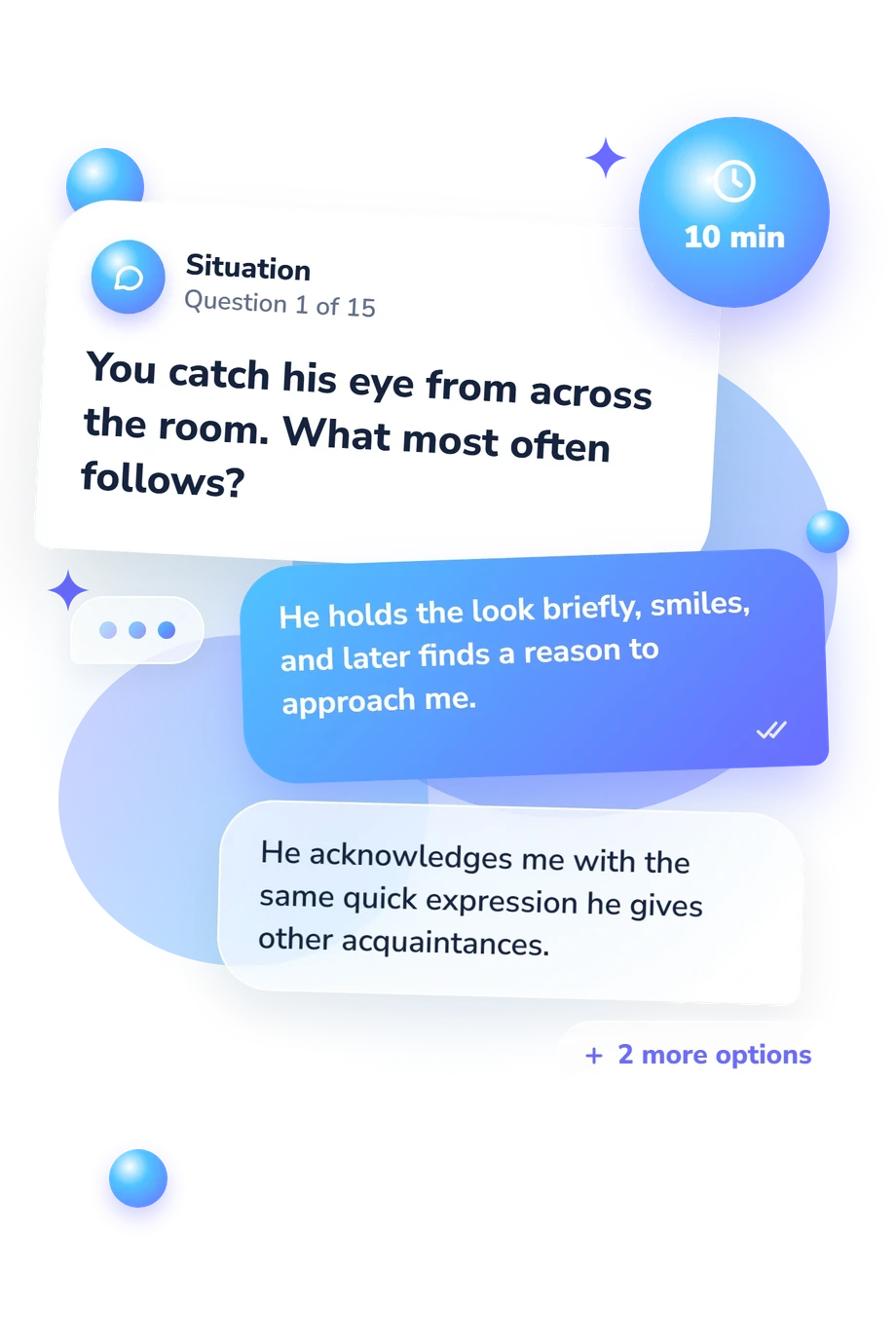
- He holds the look briefly, smiles, and later finds a reason to approach me.
- He acknowledges me with the same quick expression he gives other acquaintances.
- He smiles or holds eye contact a little longer, but nothing else usually follows.
- We make brief eye contact without a clear change in his behavior.
- He notices me if I join his immediate conversation.
- He acknowledges me much as he would anyone else arriving.
- He visibly brightens, makes room for me, or soon seeks me out.
- He gives me a warm acknowledgment and reconnects when there is an opening.
- He explains and actively offers another specific time.
- He lets me know but leaves any rescheduling for later.
- He usually follows through, so this situation rarely arises.
- The plan tends to fade without a clear attempt to revive it.
Is He Flirting with Me Quiz - Description and methodology of the test
People who are unsure whether a man’s warmth is friendly, social, or romantic can use the Is He Flirting with Me Quiz to organize repeated observations rather than rely on one charged moment. It suits someone who wants a calmer way to examine attention, effort, and initiative. An is he flirting quiz can turn an uneasy guess into a more specific reflection about patterns and context.
What This Assessment Explores
The questions focus on observable patterns: whether he initiates, follows through, remembers personal details, sustains conversation, seeks extra time, and treats you differently from others. They also touch on relationship talk, compliments, eye contact, humor, and personally suggestive tone.
That makes the question behind a does he flirt with me quiz more specific than a general impression of chemistry. The three displayed dimensions are:
- Consistent Connection-Building (0-15) reflects whether he follows through, initiates contact, and creates opportunities for connection: Limited signal (0-5), Mixed signal (6-10), or Stronger pattern (11-15).
- Focused Attention (0-15) reflects individualized curiosity and engagement: Limited signal (0-5), Mixed signal (6-10), or Stronger pattern (11-15).
- Personal and Playful Signals (0-15) captures whether his manner feels suggestive or distinct from ordinary friendliness: Limited signal (0-5), Mixed signal (6-10), or Stronger pattern (11-15).
Methodology and Evidence Base
Each item presents a familiar situation with four response options describing different behavior patterns. The situations include eye contact, changed plans, personal disclosures, messages, compliments, and invitations to spend time together. Choose the option that best matches the recurring pattern, not the most flattering possibility.
Selected responses are summarized under the three dimensions and placed in their displayed bands. The was he flirting with me quiz question is therefore handled as a pattern, not proof of one moment’s intent.
The approach is conceptually consistent with Hall et al. (2015), whose error-management perspective examines how people detect flirting when signals are ambiguous and errors are possible. Place et al. (2009) supports judging another person’s romantic interest, while Hall et al. (2010) describes individual differences in communicating romantic interest. This questionnaire is not an adaptation of those published instruments; it applies related ideas in an online self-report format.
The is he flirting with you quiz wording may invite a binary answer, yet the result is graded. It has no published norms or established probability of attraction, and self-report can be shaped by memory, emotion, selective attention, and limited knowledge of his usual style. Use it with context and direct, respectful communication.
- Hall, Jeffrey A., Chong Xing, and Seth Brooks. "Accurately Detecting Flirting: Error Management Theory, the Traditional Sexual Script, and Flirting Base Rate." Communication Research 42, no. 7 (2015): 939-958. 10.1177/0093650214534972
- Place, Skyler S., Peter M. Todd, Lars Penke, and Jens B. Asendorpf. "The Ability to Judge the Romantic Interest of Others." Psychological Science 20, no. 1 (2009): 22-26. 10.1111/j.1467-9280.2008.02248.x
- Hall, Jeffrey A., Steve Carter, Michael J. Cody, and Julie M. Albright. "Individual Differences in the Communication of Romantic Interest: Development of the Flirting Styles Inventory." Communication Quarterly 58, no. 4 (2010): 365-393. 10.1080/01463373.2010.524874
Updated: