
IRB Quiz
How the Scales are Structured
Who Usually Takes This Test?
See How You Compare
Below is a preview of how scores are typically distributed across each scale.
Example Questions From the Test
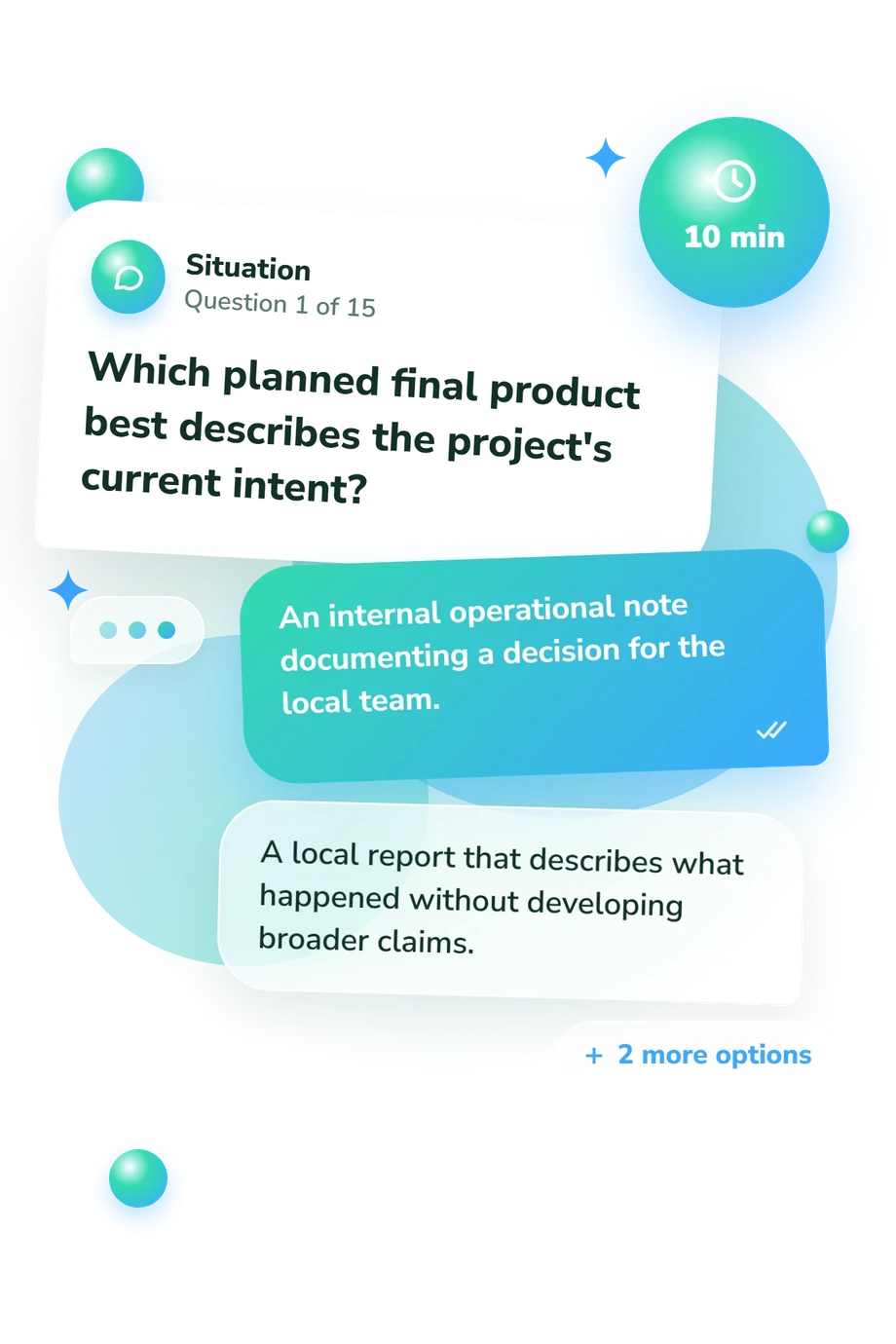
- An internal operational note documenting a decision for the local team.
- A local report that describes what happened without developing broader claims.
- A report for local use that also compares the findings with wider practice or evidence.
- A scholarly or public analysis designed to contribute a broadly relevant conclusion, model, or method.
- To generate conclusions intended to inform a broader population, practice, or body of knowledge.
- To understand one local experience and preserve a useful record of it.
- To make a specific internal operational decision, without drawing conclusions beyond it.
- To improve a local program while also identifying lessons that could apply in similar settings.
- We know the general type of summary we may use, but details will be chosen after seeing the information.
- An analysis plan connects defined variables, observations, or themes to the project question.
- We have identified the main information to examine and a broad method for comparing or organizing it.
- No analysis is intended beyond ordinary case review or informal discussion.
IRB Quiz - Description and methodology of the test
Project teams, educators, clinicians, and administrators can use the IRB Quiz to organize an early review of whether an activity may be research, quality improvement, or a combination of both. An IRB assessment is most useful when the project’s purpose, procedures, information sources, and intended audience need to be described clearly before an institutional review board discussion.
What This Assessment Explores
Questions cover purpose, procedures, selection, data, and links with people or private material. The profile has three dimensions:
- Generalizable Knowledge Intent (0-15) reflects whether the project is designed to produce knowledge beyond one immediate operational decision: Local-purpose emphasis (0-5) keeps intended use within one service, class, or organization; Mixed intent (6-10) joins local improvement with transferable lessons; Broader-knowledge emphasis (11-15) aims its questions, claims, and outputs at other settings or populations.
- Human-Participant Connection (0-15) reflects connections with living individuals through interaction or intervention, or through identifiable private information or biospecimens: Indirect connection (0-5), Potential connection (6-10), and Direct connection (11-15).
- Systematic Investigation (0-15) reflects how strongly the project has a defined question, planned procedures, selection logic, and analysis: Limited structure (0-5), Developing structure (6-10), and Strong structure (11-15).
As an IRB screening questionnaire, it flags features for institutional discussion.
Methodology and Scientific Basis
Each item offers four response options describing project conditions, not agreement with a personal statement. Choices span local or broader aims, informal or planned procedures, and indirect or direct connections with people, private information, or specimens. Answers are most useful when the team can explain the facts behind each option.
The result presents three displayed dimensions with their bands. Read together, they show how knowledge intent, human connection, and investigative structure relate; the dimensions may point in different directions and should be considered as a set.
Bass and Maloy (2020) offer the closest conceptual comparison, distinguishing human-subjects research, quality improvement, and projects containing both. The questionnaire is conceptually consistent with OHRP decision charts, 45 CFR 46.102, and Carter et al. (2021), but it is not an adaptation of those published sources.
Because it is a self-report questionnaire, the result depends on the project description and the respondent’s current understanding; its displayed bands are not official regulatory thresholds, a broad-knowledge aim or publication plan does not settle status, one feature may independently require review, and uncertain cases belong with the relevant IRB.
- Bass, Pat F. III, and John W. Maloy. How to Determine if a Project Is Human Subjects Research, a Quality Improvement Project, or Both. Ochsner Journal, vol. 20, no. 1, 2020, pp. 56-61. 10.31486/toj.19.0087
- Office for Human Research Protections. Human Subject Regulations Decision Charts: 2018 Requirements. U.S. Department of Health and Human Services, June 23, 2020.
- United States Department of Health and Human Services. 45 CFR Part 46-Protection of Human Subjects, Subpart A-Basic HHS Policy for Protection of Human Research Subjects, § 46.102 Definitions. 2018 Requirements, current eCFR.
- Carter, Eileen J., John Usseglio, Challace Pahlevan-Ibrekic, Courtney Vose, Reynaldo R. Rivera, and Elaine L. Larson. Differentiating Research and Quality Improvement Activities: A Scoping Review and Implications for Clinical Scholarship. Journal of Clinical Nursing, vol. 30, nos. 17-18, 2021, pp. 2480-2488. 10.1111/jocn.15668
Updated: