
Ion Quiz
How the Scales are Structured
Who Usually Takes This Test?
See How You Compare
Below is a preview of how scores are typically distributed across each scale.
Example Questions From the Test
- A positive-one charge, written Fe⁺
- A positive-three charge, written Fe³⁺
- A positive-two charge, written Fe²⁺
- A negative-three charge, written Fe³⁻
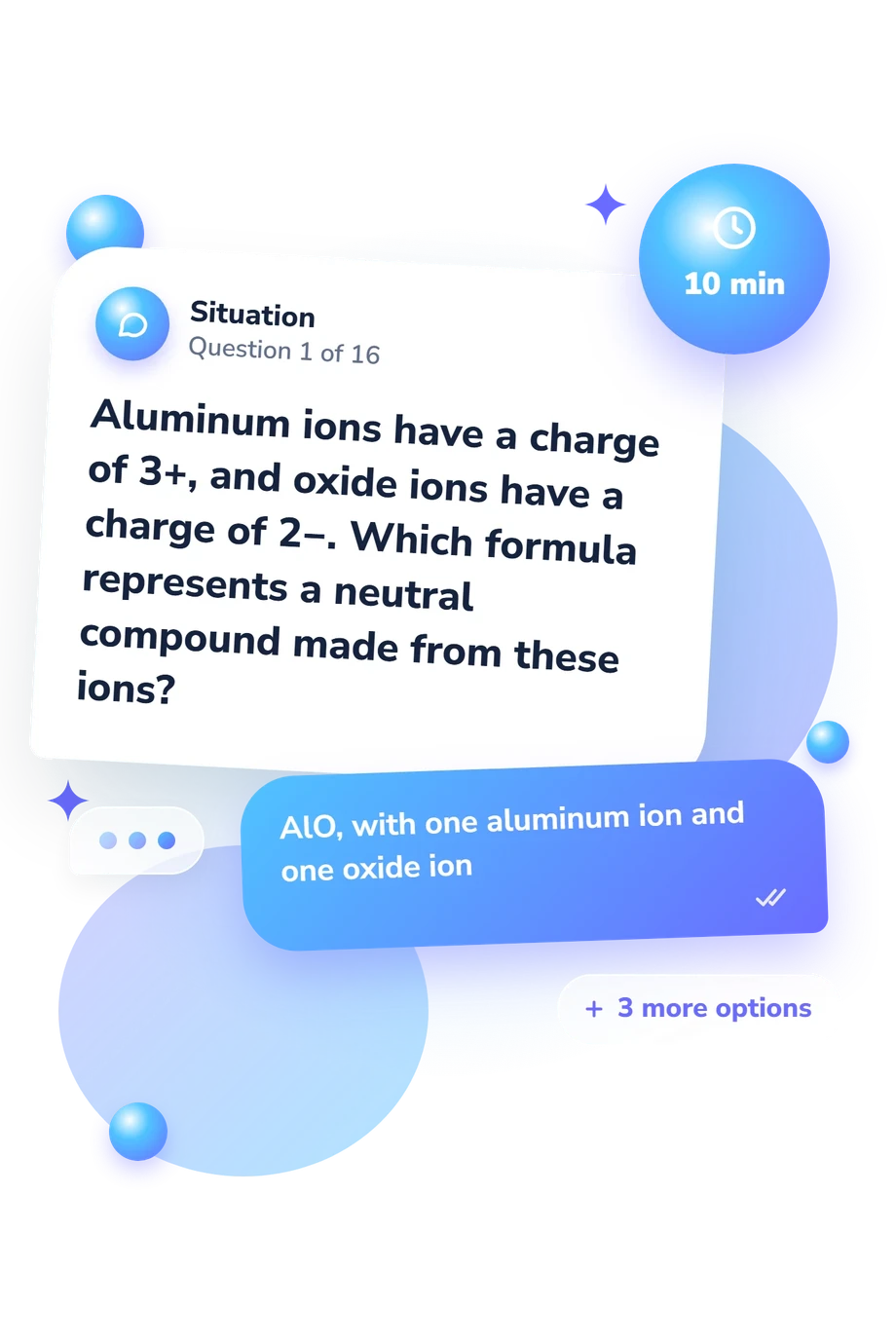
- Ca₃(PO₄)₂, with three calcium ions and two phosphate ions
- Ca₂PO₄, with two calcium ions and one phosphate ion
- Ca₃PO₄, with three calcium ions and one phosphate ion
- CaPO₄, with one calcium ion and one phosphate ion
- 18 electrons
- 17 electrons
- 16 electrons
- 19 electrons
Ion Quiz - Description and methodology of the test
Students reviewing introductory chemistry and anyone checking their grasp of charged particles can use the ion quiz to connect familiar symbols with the reasoning behind them. It suits learners preparing for homework, revision, or a lesson on ionic compounds. The format also supports ion-quiz practice by showing which core ideas are ready for application and which deserve another look before more complex bonding work.
What This Assessment Explores
This assessment examines how atoms and atom groups gain or lose charge and how those changes guide chemical reasoning. Items cover cations, anions, charge notation, electron counts, formulas, electrolysis, hydronium, polyatomic ions, and conductivity in molten compounds. As a chemistry ions quiz, it suits learners checking introductory ionic chemistry.
Four areas are tested:
- Electron changes show how gaining or losing electrons alters charge while preserving an element’s identity.
- Charge relationships show how cations and anions combine through balanced positive and negative charges.
- Formula construction shows whether ionic and polyatomic compounds are written with neutral overall formulas.
- Chemical behavior shows how ions participate in electrolysis, acid-water reactions, and electrical conduction.
The result is Ion Knowledge, scored 0-16. Foundations to Build (0-6) signals concepts to review; Developing Knowledge (7-12) reflects secure fundamentals; Strong Knowledge (13-16) indicates a well-developed grasp of tested concepts.
Methodology and Scientific Basis
Each item uses a multiple-choice format with one best answer. The questions move among definitions, electron accounting, charge relationships, neutral formulas, electrolysis, acid-base ions, and conductivity. Scoring is direct: one point is awarded for each correct response, producing the total shown in the result.
This online questionnaire is conceptually consistent with the Ionic and Covalent Bonds Three-Tier Diagnostic Test, which examines misconceptions in ionic and covalent bonding. It is not an adaptation of that instrument. Luxford and Bretz (2014) likewise connect bonding ideas with the representations students use. OpenStax’s introductory chemistry text provides reference knowledge for ion formation, charges, formulas, and behavior.
No standardization or validation is established for this online questionnaire, so the score should be read as a structured learning snapshot rather than a normed measure. Results can vary with recent instruction, wording, guessing, and how carefully a learner reasons through each option. Used with worked problems, error review, or classroom assessment, the ion knowledge test can help identify concepts that need targeted study.
- Anti Kolonial Prodjosantoso, Artanti Mulia Hertina, and Irwanto. "The Misconception Diagnosis on Ionic and Covalent Bonds Concepts with Three Tier Diagnostic Test." International Journal of Instruction, 12(1), 1477-1488, 2019. 10.29333/iji.2019.12194a
- Cynthia J. Luxford and Stacey Lowery Bretz. "Development of the Bonding Representations Inventory To Identify Student Misconceptions about Covalent and Ionic Bonding Representations." Journal of Chemical Education, 91(3), 312-320, 2014. 10.1021/ed400700q
- Paul Flowers, Klaus Theopold, Richard Langley, and William R. Robinson. Chemistry 2e. Houston, TX: OpenStax, 2019.
Updated: