
Intimacy Quiz 36 Questions
How the Scales are Structured
Who Usually Takes This Test?
See How You Compare
Below is a preview of how scores are typically distributed across each scale.
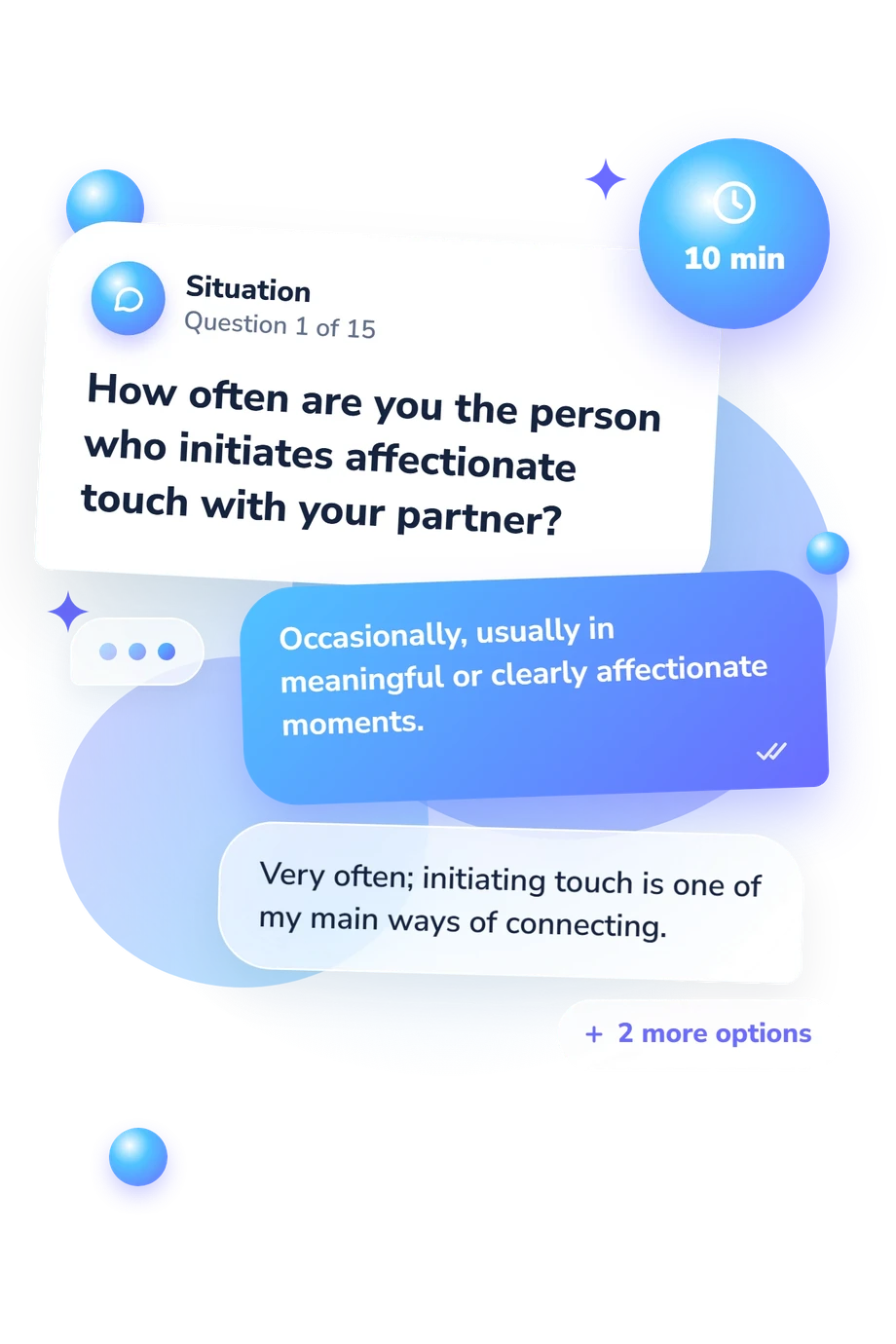
Example Questions From the Test
- Occasionally, usually in meaningful or clearly affectionate moments.
- Very often; initiating touch is one of my main ways of connecting.
- Not often; I am more comfortable responding or connecting without touch.
- Fairly often, especially during greetings, relaxation, or reassurance.
- Each continue with separate interests or tasks.
- Check in briefly, then decide independently how to use the time.
- Spend part of the hour together and leave part unstructured.
- Treat it as an opportunity for focused time together.
- A warm verbal greeting without necessarily touching.
- A brief affectionate touch if the moment feels right.
- A hug or kiss as a usual part of reconnecting.
- Lingering affectionate contact before moving on with the day.
Intimacy Quiz 36 Questions - Description and methodology of the test
People deciding whether to examine closeness in a relationship can use Intimacy Quiz 36 Questions to organize moments that feel easy, uncertain, or hard to discuss. It turns those patterns into a relationship closeness assessment, helping you ask why connection changes across situations and giving reflection a concrete structure. The profile can help you identify situations worth discussing and notice where your usual response may leave needs unspoken.
What This Assessment Explores
This physical and emotional intimacy quiz addresses touch, disclosure, support needs, attention, and reconnection after tension without ranking styles.
The result has three dimensions:
- Affection and Physical Ease (0-15) reflects comfort with consensual affection, welcome touch, and communication during physical intimacy: Space-Oriented (0-5), Contextual Warmth (6-10), or Touch-Forward (11-15); it cannot assess consent, boundaries, or compatibility.
- Emotional Openness (0-15) reflects how readily you share vulnerable feelings, personal meaning, and support needs with your partner: Private Processing (0-5), Selective Sharing (6-10), or Open Exchange (11-15); these bands describe a pattern, not emotional health or relationship quality.
- Shared Presence (0-15) reflects how intentionally you create shared attention, respond to bids for connection, and return to togetherness after distraction or tension: Parallel Rhythm (0-5), Available Connection (6-10), or Intentional Presence (11-15); the result is descriptive, not a verdict on commitment or relationship quality.
Methodology and Evidence Base
Each item presents a relationship situation with four response options describing ways of handling closeness. The choices address initiating touch, naming hurt, pausing to listen, and planning reconnection, so the result reflects self-reported preferences rather than observed behavior. Scoring is dimensional rather than a single total: it produces a three-scale descriptive profile, and the questionnaire does not state how individual answer choices are weighted, so no per-item scoring rule should be inferred.
As an emotional intimacy questionnaire, it is conceptually consistent with the Waring Intimacy Questionnaire (Waring & Reddon, 1983), which treats intimacy as measurable in close relationships. It also aligns with the PAIR Inventory, Miller and Lefcourt’s social-intimacy assessment, and Reis and Shaver’s interpersonal-process model, where disclosure, responsiveness, and connection develop through interaction. These sources support the constructs, not a claim that this online questionnaire adapts or standardizes those instruments.
Read bands as descriptive prompts. Self-report scores may shift with current stress, relationship context, self-awareness, and impression management. The online version is not presented with published norms, so interpret the profile alongside lived experience and partner conversation rather than as a standalone verdict.
- Waring, Edward M., and John R. Reddon. "The Measurement of Intimacy in Marriage: The Waring Intimacy Questionnaire." Journal of Clinical Psychology, vol. 39, no. 1, 1983, pp. 53-57. 10.1002/1097-4679(198301)39:1<53::AID-JCLP2270390110>3.0.CO;2-0
- Schaefer, Mark T., and David H. Olson. "Assessing Intimacy: The PAIR Inventory." Journal of Marital and Family Therapy, vol. 7, no. 1, 1981, pp. 47-60. 10.1111/j.1752-0606.1981.tb01351.x
- Miller, Rickey S., and Herbert M. Lefcourt. "The Assessment of Social Intimacy." Journal of Personality Assessment, vol. 46, no. 5, 1982, pp. 514-518. 10.1207/s15327752jpa4605_12
- Reis, Harry T., and Phillip Shaver. "Intimacy as an Interpersonal Process." In Handbook of Personal Relationships: Theory, Relationships, and Interventions, edited by Steve Duck, John Wiley & Sons, 1988, pp. 367-389. 10.4324/9780203732496-5
Updated: