
Integers Quiz
How the Scales are Structured
Who Usually Takes This Test?
See How You Compare
Below is a preview of how scores are typically distributed across each scale.
Example Questions From the Test
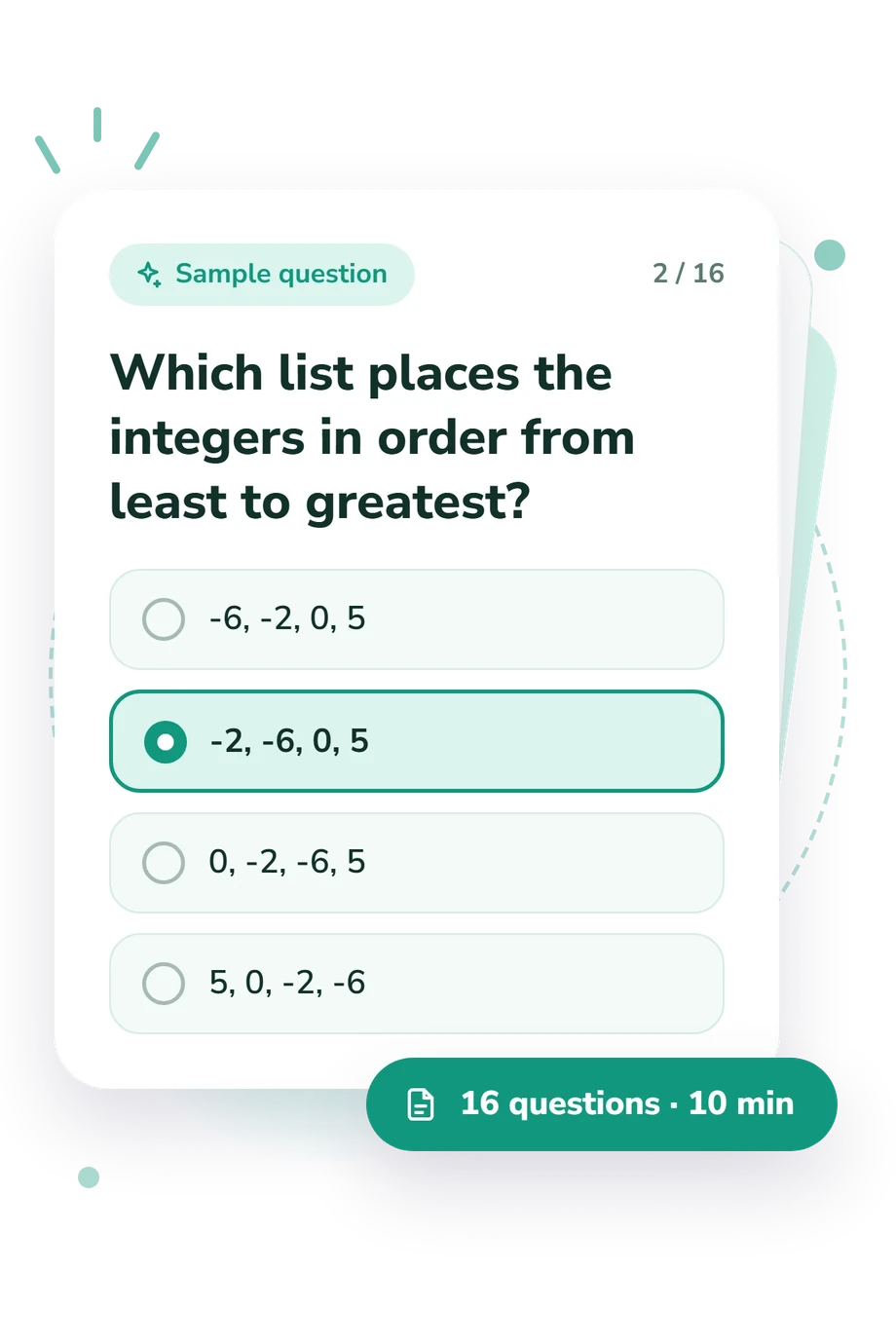
- -6, -2, 0, 5
- -2, -6, 0, 5
- 0, -2, -6, 5
- 5, 0, -2, -6
- 24 units, because the temperature is doubled
- -12 units, because the coordinate is negative
- 12 units, because distance is the absolute value
- 0 units, because both points refer to temperature
- -3 is greater because it lies to the right of -8.
- They are equal because both values have negative signs.
- -8 is greater because it is farther from zero.
- Their order cannot be determined until both signs are removed.
Integers Quiz - Description and methodology of the test
For learners, parents, or educators who want a focused look at foundational number reasoning, the integers quiz shows how consistently a respondent works with positive and negative values. Rather than offering a broad mathematics grade, an integers online quiz can clarify which core ideas appear secure and where deliberate practice may help. The result is a concise learning profile.
What This Test Measures
Rather than testing advanced algebra, the questionnaire samples integer reasoning through number-line position, absolute value, signed operations, temperatures, scores, elevations, balances, and movement. It suits learners reviewing foundational arithmetic and educators checking whether rules are applied consistently.
The four result areas are:
- Number-line comparison shows whether values are ordered correctly and judged relative to zero.
- Absolute value shows whether distance from zero is separated from a number’s sign.
- Addition and subtraction show whether signed changes are combined accurately in context.
- Multiplication, division, and expressions show whether sign rules and operation order remain consistent.
Together, these areas form Integers Knowledge (0-16): Foundation Building (0-6) calls for review; Developing Command (7-12) reflects developing consistency; Strong Command (13-16) indicates reliable performance across the tested concepts. In a math quiz about integers, the result is a focused learning profile, not a complete mathematics grade.
Methodology and Evidence Base
Each item presents a short problem with four answer choices covering comparison, absolute value, and signed operations. Distractors reflect errors such as reversing number-line order, confusing distance from zero with sign, or mishandling negative factors.
Viewed as an integer skills assessment, it uses direct answer scoring: the total equals the number of correct responses. The bands describe that total, and no weighting, penalty system, or separate diagnostic formula is stated.
Integer assessment research provides the closest conceptual comparison. Johar et al. (2026) examine cognitive-diagnostic item design; Nurnberger-Haag et al. (2022) validate a measure of primary integer operations; and Bishop et al. (2014) analyze obstacles and supports in integer reasoning. This questionnaire is conceptually consistent with those works, not an adaptation or standardized administration of them.
Attention, current learning context, self-awareness, and familiarity with the format may affect performance. Since no population norms are stated, the result is best used as a learning snapshot to guide focused practice.
- Johar, R., Ikhsan, M., Oktavia, R., et al. (2026). Development of cognitive diagnostic assessment questions items for integers. Discover Education, 5, Article 849. 10.1007/s44217-026-01968-y
- Nurnberger-Haag, J., Kratky, J., & Karpinski, A. C. (2022). The Integer Test of Primary Operations: A Practical and Validated Assessment of Middle School Students’ Calculations with Negative Numbers. International Electronic Journal of Mathematics Education, 17(1), em0667. 10.29333/iejme/11471
- Bishop, J. P., Lamb, L. L., Philipp, R. A., Whitacre, I., Schappelle, B. P., & Lewis, M. L. (2014). Obstacles and affordances for integer reasoning: An analysis of children’s thinking and the history of mathematics. Journal for Research in Mathematics Education, 45(1), 19-61. 10.5951/jresematheduc.45.1.0019
Updated: