
Instrument Quiz
How the Scales are Structured
Who Usually Takes This Test?
See How You Compare
Below is a preview of how scores are typically distributed across each scale.
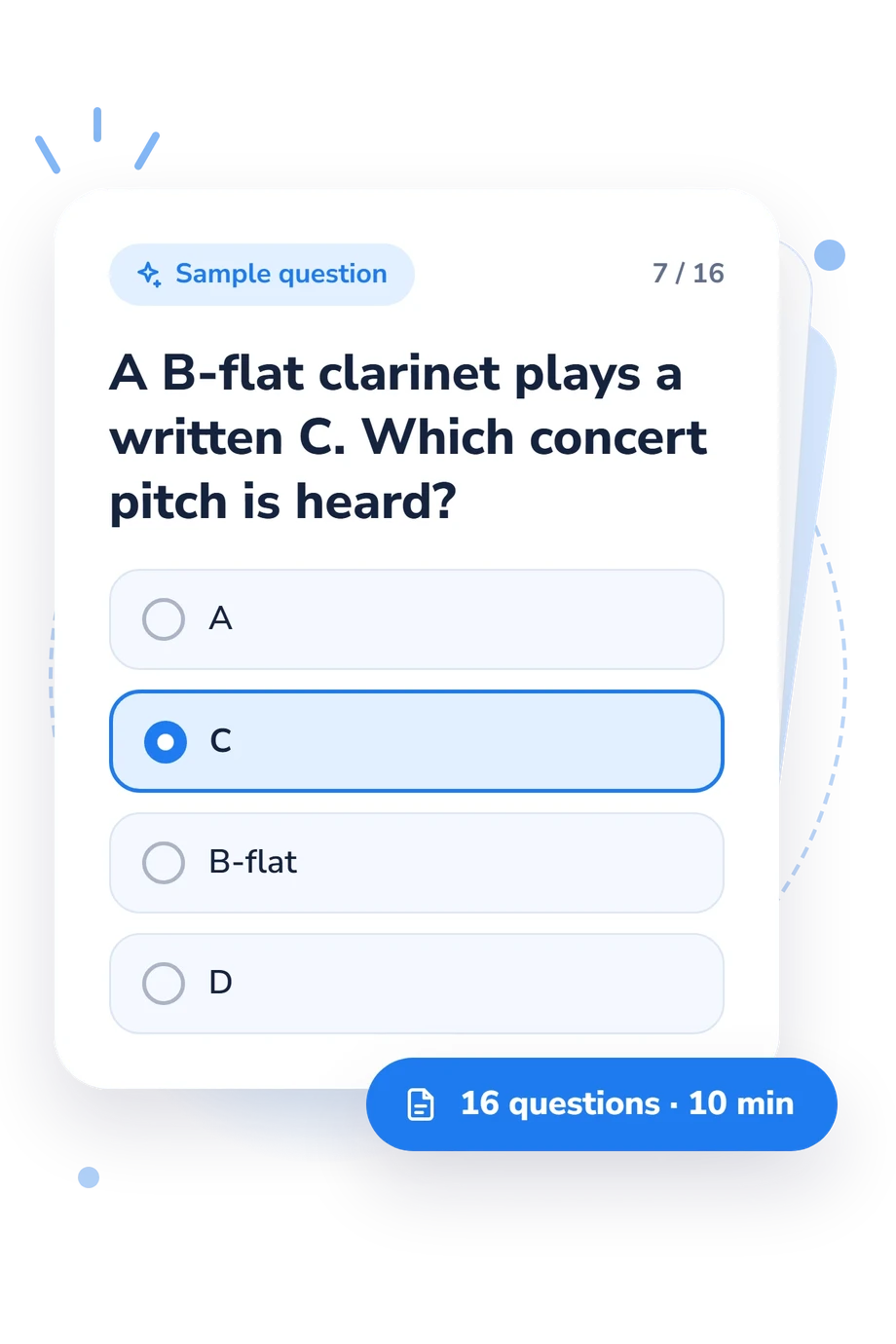
Example Questions From the Test
- Saxophone
- Clarinet
- Oboe
- Flute
- The note continues without the player’s airflow.
- The instrument changes into a non-transposing instrument.
- The sounding pitch becomes lower.
- The instrument begins using a reed.
- G–D–A–E
- E–A–D–G
- C–G–D–A
- A–D–G–C
Instrument Quiz - Description and methodology of the test
People who want to plan their next steps in music learning can use the instrument quiz as a concise check of overall knowledge. It suits learners, listeners, and performers who want an instrument knowledge assessment that summarizes their current foundation and points toward further study, rather than a personality profile or hearing test.
What This Assessment Explores
The questions move across orchestral families and physical principles that distinguish them. They cover reeds, embouchure, buzzing lips, vibrating strings, drumhead tension, keyboard mechanisms, transposition, tuning, mutes, and supports such as the cello’s endpin. Together, these situations test whether you can connect an instrument’s parts and technique with its sound and musical function.
This musical instruments quiz has a practical purpose: it turns broad familiarity into specific knowledge areas that can be reviewed. The single displayed scale, Musical Instrument Knowledge (0-16), is divided into these result bands:
- Foundations to Build (0-6) indicates that basic recognition is present, while families, sound production, or techniques need more review.
- Developing Knowledge (7-12) shows a useful grasp of many instruments alongside some gaps in mechanisms or performance details.
- Strong Knowledge (13-16) reflects accurate understanding across a broad range of families, features, and musical uses.
Methodology and Evidence Base
Each item uses four answer choices and asks for one best answer. The format is selected-response knowledge testing: the total reflects how many answers are correct, while the content spans recognition, classification, acoustics, and application. This questionnaire can show which concepts are secure, but it cannot reveal every part of musicianship, such as expressive control or aural memory.
The question design is conceptually consistent with the Musical Knowledge Test (Öztürk & Kalyoncu, 2020); this is a separate online knowledge questionnaire, not a validated adaptation of that instrument. Acoustic explanations also align with Fletcher and Rossing’s work on how strings, air columns, membranes, reeds, and resonators create musical sound.
The displayed bands are descriptive, not established population norms. Results can be affected by previous lessons, informal listening, instrument access, wording interpretation, and guessing among the options. Read the score as a focused snapshot of music-instrument knowledge, then use weaker topics to guide study or listening; it cannot by itself measure overall musical ability.
- Öztürk, Özlem, and Nesrin Kalyoncu. "Development of a ‘Musical Knowledge Test’ for the Sixth Grade Music Lesson of Turkish Primary Education." Journal of Theoretical Educational Science, vol. 13, no. 3, 2020, pp. 609-629.
- Fletcher, Neville H., and Thomas D. Rossing. The Physics of Musical Instruments. 2nd ed., Springer, 1998. 10.1007/978-0-387-21603-4
Updated: