
Industrial Revolution Quiz
How the Scales are Structured
Who Usually Takes This Test?
See How You Compare
Below is a preview of how scores are typically distributed across each scale.
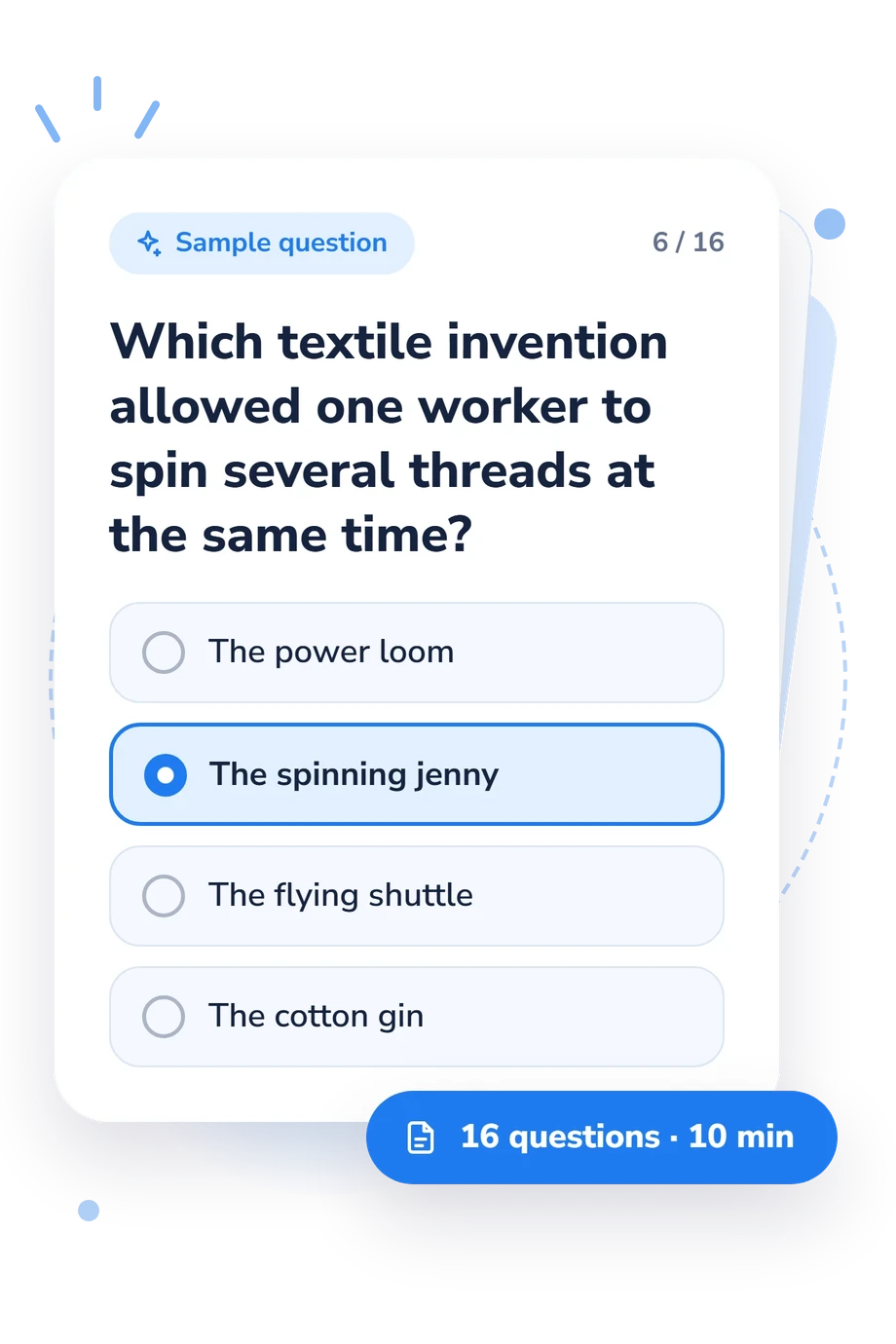
Example Questions From the Test
- The power loom
- The spinning jenny
- The flying shuttle
- The cotton gin
- Great Britain
- Germany
- France
- Russia
- The Bessemer converter
- The steam locomotive
- The telegraph
- The power loom
Industrial Revolution Quiz - Description and methodology of the test
Students, teachers, and adult learners who want a focused way to check their grasp of early industrialization can use this industrial revolution quiz to connect facts with historical causes and consequences. It suits readers revising the subject or exploring it independently, especially as an Industrial Revolution practice quiz. The questions move from agriculture and energy to factories, cities, reform, transport, and class relations.
What This Assessment Explores
This assessment checks historical knowledge rather than personality or opinion. It asks whether learners can explain why industrialization began in Britain, how resources, trade, labor, and production interacted, and what changed as factories expanded. Coverage includes inventions, railways, urban growth, child labor, reform, protest, and socialist criticism.
The thematic groups show what a learner can connect:
- Causes and conditions show whether the result links agriculture, resources, trade, investment, and labor supply.
- Inventions and production show whether it distinguishes spinning, weaving, steam power, interchangeable parts, and factories.
- Cities and reform show whether it recognizes urbanization, sanitation, workplace danger, and protective laws.
- Social responses show whether it connects industrial capitalism with Luddism, class conflict, Marx, and Engels.
Across the quiz, stronger performance on factual and connective questions about causes, technology, labor, cities, reform, and social effects can guide an industrial revolution history review toward weaker areas.
Methodology and Historical Basis
Each of the 16 items uses four answer choices and covers causes, technologies, institutions, and social effects. The scoring assigns one point for each correct answer, producing an Industrial Revolution Knowledge score of 0-16. The quiz reports that score in three catalogue-defined bands: Foundations to build (0-6), Developing knowledge (7-12), or Strong knowledge (13-16).
Historically, the questionnaire is conceptually consistent with Allen (2009), whose account connects Britain’s resources, markets, labor, and productivity with industrial change. Ashton (1997) supports the chronology and developments. Floud et al. (2014) addresses economic and social change from 1700 to 1870, while Wallis et al. (2018) supplies pre-industrial context. Together, these works provide historical context rather than psychometric validation.
Performance can be affected by prior study, wording familiarity, or guessing. The score describes performance on this question set; reviewing missed industrial revolution practice questions about agriculture, machinery, urban conditions, reform, or class conflict can help learners choose what to study next.
- Allen, Robert C. 2009. The British Industrial Revolution in Global Perspective. Cambridge University Press. 10.1017/CBO9780511816680
- Ashton, T. S. 1997. The Industrial Revolution 1760-1830. Oxford University Press. 10.1093/oso/9780192892898.001.0001
- Floud, Roderick, Jane Humphries, and Paul Johnson, eds. 2014. The Cambridge Economic History of Modern Britain, Volume 1: 1700-1870. 2nd ed. Cambridge University Press. 10.1017/CHO9781139815017
- Wallis, Patrick, Justin Colson, and David Chilosi. 2018. Structural Change and Economic Growth in the British Economy before the Industrial Revolution, 1500-1800. The Journal of Economic History, 78(3), 862-903. 10.1017/S0022050718000396
Updated: