
Indian Current Affairs Quiz
How the Scales are Structured
Who Usually Takes This Test?
See How You Compare
Below is a preview of how scores are typically distributed across each scale.
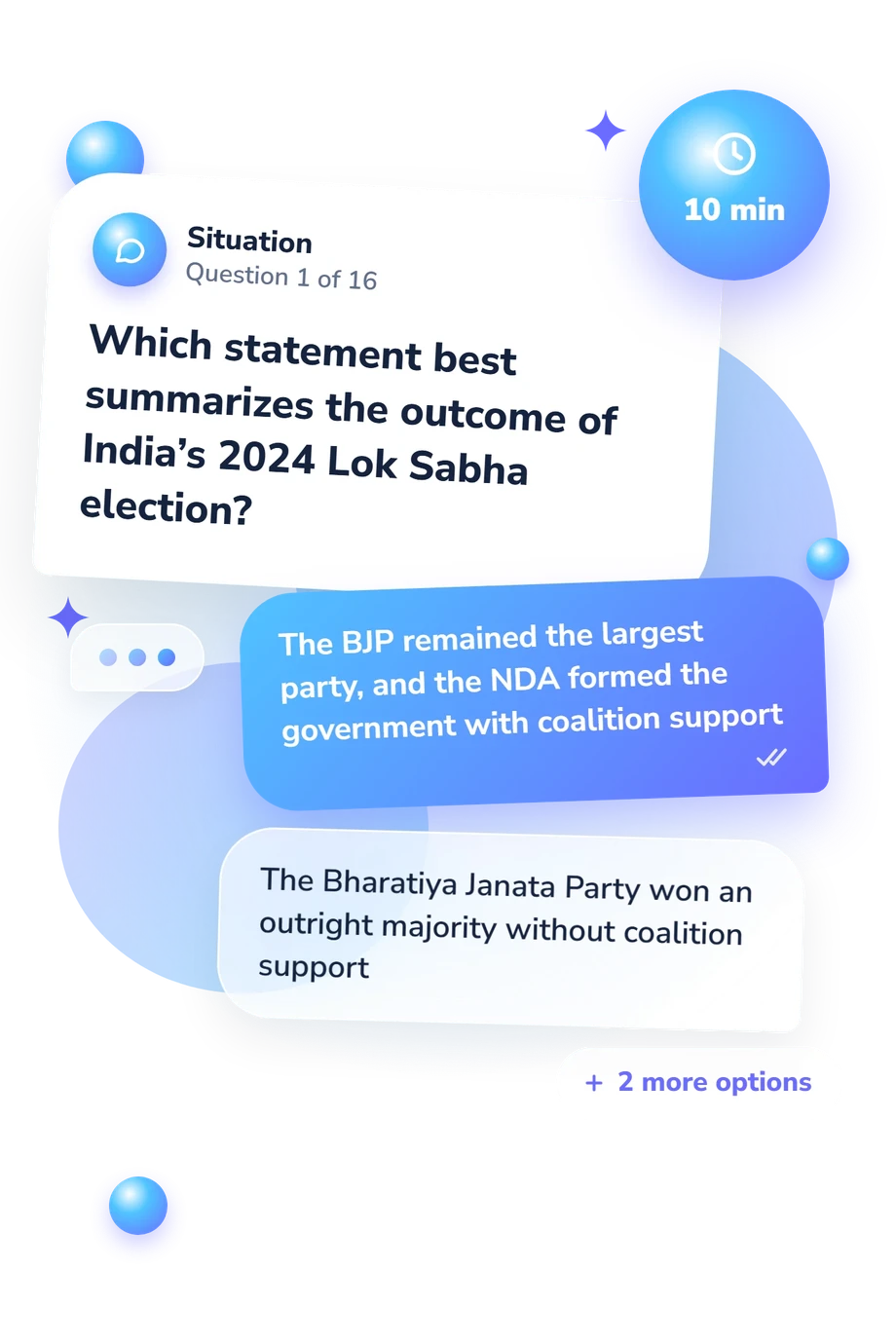
Example Questions From the Test
- Personal civil matters such as marriage, divorce, and inheritance
- Criminal sentencing and police investigations
- Corporate taxation and securities trading
- Interstate river-water allocation
- Varanasi
- Ayodhya
- Prayagraj
- Mathura
- 50%
- 00%
- 50%
- 25%
Indian Current Affairs Quiz - Description and methodology of the test
Readers who want to check their grasp of recent Indian public life can use this quiz on current affairs of India. The Indian Current Affairs Quiz is intended for people who follow national developments and want a structured knowledge check. Its result indicates which covered topics you recognize confidently and where targeted review may help.
What This Assessment Explores
The questionnaire measures knowledge rather than personal attitudes. Items ask respondents to distinguish plausible answers about laws, elections, government initiatives, economic policy, institutions, space missions, infrastructure, and international cooperation. As an Indian current affairs test, it profiles recognition and understanding of the dated events and decisions represented here, rather than complete knowledge of India.
The result provides one overall knowledge score, while the questions span three thematic groups:
- Indian Current Affairs Knowledge runs from 0-16 and is reported as Foundation (0-6), Developing (7-12), or Strong (13-16); it reflects this dated question set, not every current issue in India.
- Policy and law items identify what major statutes, regulations, and legal changes address.
- Elections and institutions items show understanding of representation, political funding, mandates, and national governance.
- Science, initiatives, and connectivity items cover missions, development programmes, energy plans, and transport or trade projects.
Methodology and Evidence Base
Each item presents a scenario or factual prompt with four choices. One option best matches the event, law, initiative, or outcome. Across this quiz on current affairs in India, the result summarizes performance across the questions and indicates the reported level for this dated set. It should be read as performance on these knowledge questions, not as a complete measure of current-affairs expertise.
The approach is conceptually consistent with political knowledge research. Soroka and colleagues connect current-affairs knowledge with exposure to public information and media environments, while Delli Carpini and Keeter offer a broader framework for factual political knowledge. These sources support relevance, not authorship, adaptation, or established norms for the online version.
This is an online knowledge check rather than a standardized published instrument. Performance may vary with memory, attention, wording, current context, and prior exposure to selected topics. The result is best used to identify review priorities and then examine the underlying laws, policies, and events more closely.
- Stuart Soroka, Blake Andrew, Toril Aalberg, Shanto Iyengar, James Curran, Sharon Coen, Kaori Hayashi, Paul Jones, Gianpietro Mazzoleni, June Woong Rhee, David Rowe, and Rod Tiffen. “Auntie Knows Best? Public broadcasters and current affairs knowledge.” British Journal of Political Science, 43(4), 719-739, 2013. 10.1017/S0007123412000555
- Sumitra Badrinathan, Devesh Kapur, Annabel Richter, and Milan Vaishnav. How Indian Americans Live: Results From the 2024 Indian American Attitudes Survey. Carnegie Endowment for International Peace, 2025.
- Michael X. Delli Carpini and Scott Keeter. What Americans Know About Politics and Why It Matters. Yale University Press, 1996.
Updated: