
Implantation Bleeding Quiz
How the Scales are Structured
Who Usually Takes This Test?
See How You Compare
Below is a preview of how scores are typically distributed across each scale.
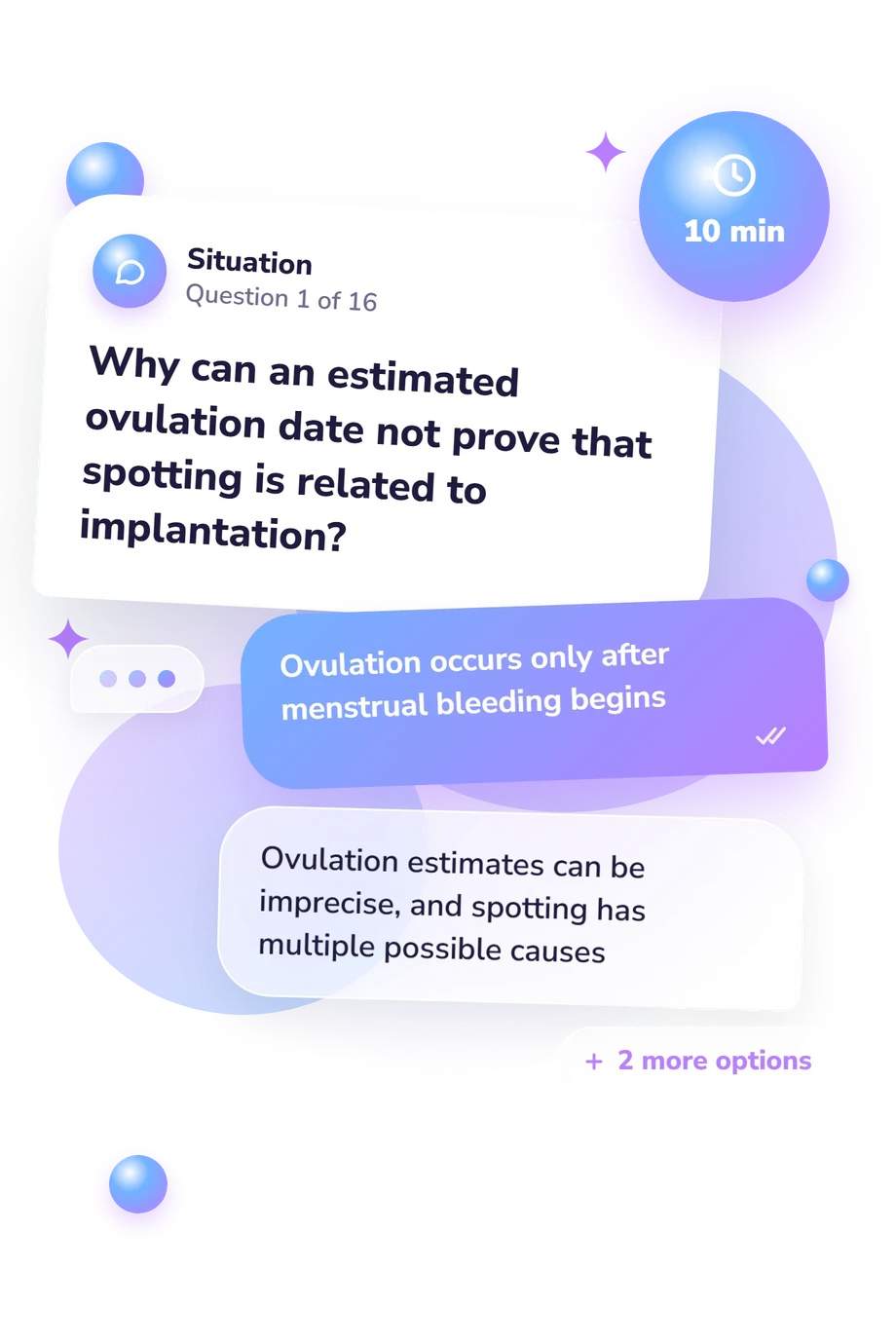
Example Questions From the Test
- Ovulation occurs only after menstrual bleeding begins
- Ovulation estimates can be imprecise, and spotting has multiple possible causes
- Spotting prevents ovulation dates from being calculated at all
- Implantation and ovulation always happen on the same day
- A late period with no other symptoms
- Mild fatigue that improves after rest
- Pregnancy-related bleeding with one-sided pelvic pain, shoulder pain, or faintness
- A positive pregnancy test with increased appetite
- The pregnancy test must be a false positive
- It does not rule out pregnancy; many pregnant people report no early spotting
- Implantation cannot have occurred
- A menstrual period must begin within 24 hours
Implantation Bleeding Quiz - Description and methodology of the test
People noticing early-pregnancy spotting can use this assessment to weigh uncertainty before deciding what information or care they need. The implantation bleeding quiz helps readers judge what a symptom can reasonably show, rather than treating it as proof of a particular cause. Overlapping features make menstrual bleeding and early-pregnancy spotting difficult to distinguish from symptoms alone, which is the practical problem this implantation bleeding vs period quiz addresses.
What This Assessment Explores
The questions examine whether you can separate evidence from conclusions that symptoms cannot support. They cover spotting near an expected period, bleeding after sex, color, amount, absent spotting, cramps, one-sided pain, faintness, changing flow, early negative tests, and information worth recording.
Symptoms overlap, so the result cannot determine whether bleeding is menstrual or implantation-related; it provides context rather than the yes-or-no certainty suggested by a quiz asking whether spotting is a period or implantation bleeding. The profile also reflects understanding of testing windows and responses to concerning changes. It reports one educational scale, Implantation Bleeding Knowledge (0-16):
- Foundation to build (0-6) means reviewing why spotting alone cannot identify implantation and learning the main warning signs.
- Developing knowledge (7-12) means revisiting testing windows and symptom overlap.
- Strong knowledge (13-16) means showing sound understanding of early-pregnancy spotting and appropriate responses.
Methodology and Evidence Base
Each item uses a brief scenario or factual question with several answer choices. The documented response format covers timing, spotting patterns, symptom overlap, pregnancy testing, and urgent-care decisions. The item-to-score mapping is not specified; individual choices should not be assigned an inferred point value.
A prospective study of bleeding in very early pregnancy supports caution about treating early bleeding as proof of implantation. Separate studies of implantation timing explain why calendar estimates cannot fix the date, while early home-testing research explains why a very early negative result may not settle pregnancy status. Clinical guidance addresses heavy bleeding, severe or one-sided pain, shoulder pain, faintness, and other concerning symptoms.
The questionnaire is conceptually consistent with these sources, not an adaptation of them. Its questions organize learning around uncertainty, evidence, and appropriate responses rather than offering the certainty implied by an implantation quiz.
The displayed result is an unvalidated educational score with no diagnostic cutoff. Honest responding, misunderstanding, and current anxiety can affect it, while urgent warning signs matter independently of the total.
- Harville EW, Wilcox AJ, Baird DD, Weinberg CR. Vaginal bleeding in very early pregnancy. Human Reproduction. 2003;18(9):1944-1947. 10.1093/humrep/deg379
- Wilcox AJ, Baird DD, Weinberg CR. Time of implantation of the conceptus and loss of pregnancy. New England Journal of Medicine. 1999;340(23):1796-1799. 10.1056/NEJM199906103402304
- Wilcox AJ, Baird DD, Dunson D, McChesney R, Weinberg CR. Natural limits of pregnancy testing in relation to the expected menstrual period. JAMA. 2001;286(14):1759-1761. 10.1001/jama.286.14.1759
- American College of Obstetricians and Gynecologists. Bleeding During Pregnancy. FAQ038; last reviewed December 2024.
Updated: