
How Well Read Are You Quiz
How the Scales are Structured
Who Usually Takes This Test?
See How You Compare
Below is a preview of how scores are typically distributed across each scale.
Example Questions From the Test
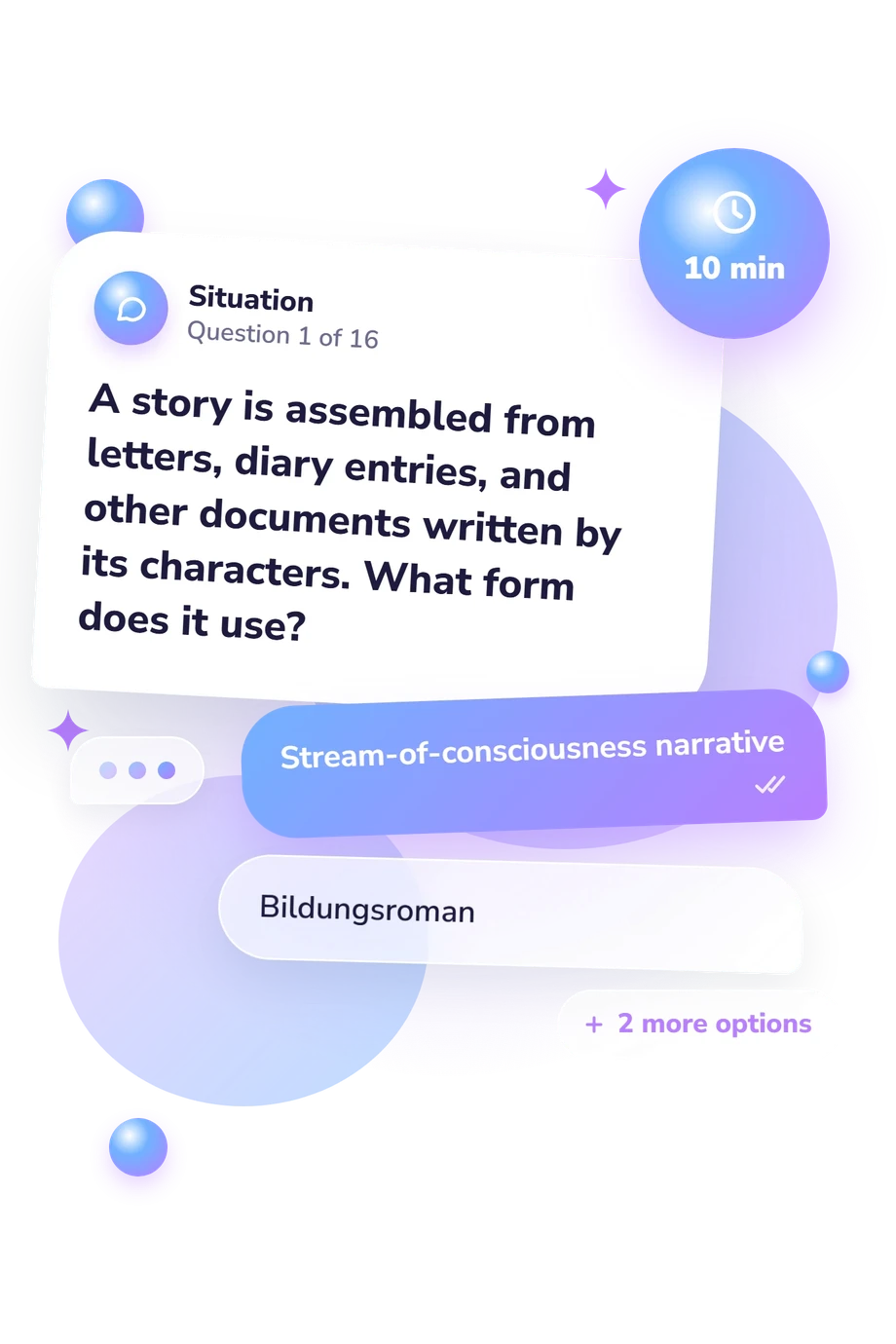
- Stream-of-consciousness narrative
- Bildungsroman
- Dramatic monologue
- Epistolary narrative
- Crime and Punishment
- The Brothers Karamazov
- Fathers and Sons
- Notes from Underground
- Moby-Dick
- The Old Man and the Sea
- Twenty Thousand Leagues Under the Seas
- The Sea-Wolf
How Well Read Are You Quiz - Description and methodology of the test
Readers seeking a structured check of literary familiarity can use this assessment to see how confidently they recognize works, authors, forms, and interpretive ideas. The How Well Read Are You Quiz turns broad curiosity into a focused self-check. It may suit anyone choosing what to read next or reflecting on gaps in a familiar canon. Readers wondering whether they are well read can use the result to guide further exploration.
What This Assessment Explores
Questions move across literary history, narrative form, authorship, genre, plot recognition, and interpretation. Some identify a work from its premise or characters; others test concepts such as free indirect discourse or the volta. Together, they sample factual familiarity and the ability to connect a clue with a broader literary idea.
For readers seeking a compact profile, this literary-knowledge quiz shows overall performance across a varied sample rather than separate results for genres, authors, traditions, or techniques.
The result reports one dimension:
- Literary Knowledge (0-16) reflects performance on this literary sample; Starting Shelf (0-6) signals recognized landmarks with room to explore, Growing Range (7-12) signals developing breadth with some gaps, and Broad Command (13-16) signals strong handling of varied recognition and interpretation.
Methodology and Evidence Base
This self-administered, knowledge-based multiple-choice questionnaire asks respondents to select the best answer from four options for each prompt. Its single result and bands summarize performance on these 16 questions, not everything the respondent has read or understood.
Belal and Ouahmiche's 2022 study treats literary competence as more than recall, including knowledge and interpretation; that framing fits these identification and concept questions. Calafato and Hunstadbråten's 2025 work examines several aspects of competence, while Nishihara's 2023 study connects it with classroom assessment. The questions are conceptually consistent with these studies, not adapted from or validated by them.
That makes it a compact literary competence assessment for reflection and choosing topics to revisit. The single result combines recognition of works, authors, and forms with interpretation of literary concepts, offering a broad snapshot rather than a domain-by-domain profile.
Memory, guessing, attention, and familiarity with the selected canon can affect performance. A missed item may reflect an unfamiliar tradition or overlooked clue as well as a knowledge gap, so use the result as a current snapshot rather than a fixed measure of intelligence.
- Belal, Yamina, and Ouahmiche, Ghania. (2022). Literary Competence in the EFL Context: A Case Study of Undergraduate Freshmen. International Journal of Multilingualism and Languages for Specific Purposes, 4(1), 50-66. 10.52919/ijmlsp.v4i01.80
- Calafato, Raees, and Hunstadbråten, Siri. (2025). Literature in Language Education: Exploring EFL Learners’ Literary Competence Profiles. English Teaching & Learning, 49, 537-559. 10.1007/s42321-024-00193-w
- Nishihara, Takayuki. (2023). The Innsbruck Model of Literary Competence: A Potent Tool for Designing Classroom-based Assessment. JAILA Journal, 9, 17-31. 10.57359/jailajournal.9.0_17
Updated: