
How Many Squares Do You See Quiz
How the Scales are Structured
Who Usually Takes This Test?
See How You Compare
Below is a preview of how scores are typically distributed across each scale.
Example Questions From the Test
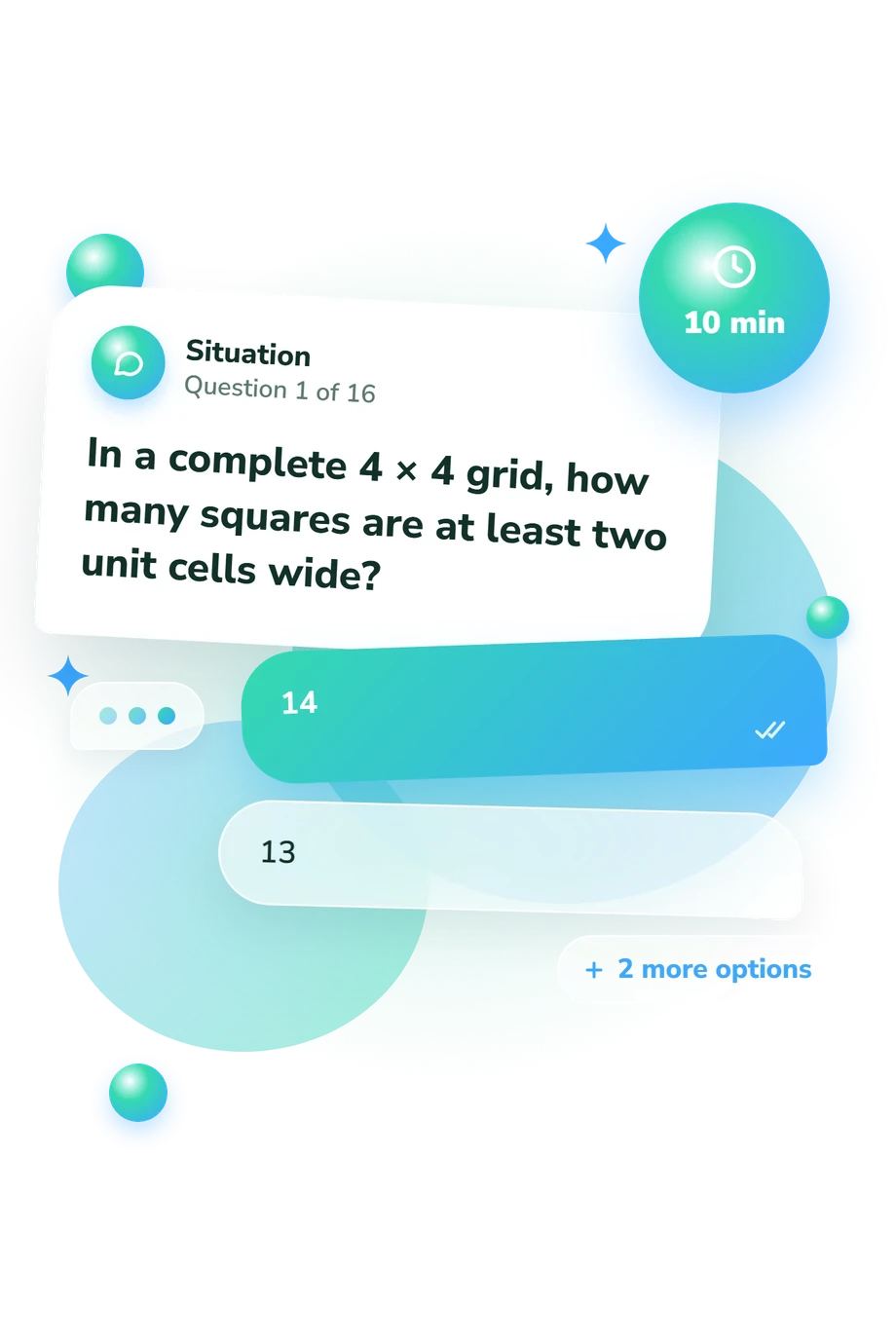
- 14
- 13
- 15
- 16
- 50
- 55
- 60
- 45
- A 2 × 2 grid
- A 2 × 3 grid
- A 2 × 4 grid
- A 3 × 3 grid
How Many Squares Do You See Quiz - Description and methodology of the test
People who enjoy visual mathematics, teach geometric patterns, or want to check a careful counting method can use this assessment as a focused exercise. The How Many Squares Do You See Quiz examines how accurately you apply square-counting principles across grids, composite figures, and rotated shapes. This quiz about how many squares you can count offers a structured check of performance on that specific task.
What This Test Measures
These items form a focused set of square counting questions about visual layouts. They cover unit cells, composite shapes, complete grids, exact-size placements, and rotated figures.
The result supports focused practice but measures a narrow task, not general mathematical ability. The themes below are covered by the questions, not separately scored dimensions:
- Grid structure shows whether you read cells and complete lines accurately.
- Composite counting shows whether you include larger squares across sizes.
- Rotation and placement show whether you classify tilted squares and track possible starting positions.
Square Counting Knowledge runs from 0-16: Foundation (0-6) means you recognize basic squares but may overlook composite shapes or possible placements; Developing (7-12) means you handle many standard grids and improve consistency with formulas and systematic scans; Strong (13-16) means you accurately apply square-counting principles across complete grids, comparisons, and rotated figures.
Methodology and Evidence Base
Each question offers four answer choices. Some ask for totals across every size; others isolate one size, compare rectangular grids, apply the n × n pattern, or classify a rotated figure. A deliberate method counts one size at a time, tracks starting positions, and uses a formula when the pattern is clear.
The scoring presentation is task-specific: the displayed total treats the questionnaire as a square counting test, with defined bands summarizing performance rather than general mathematical ability.
The mathematical approach is conceptually consistent with Finkel's square-enumeration activity, which emphasizes systematic enumeration and larger squares; this questionnaire is not an adaptation of it. AIMSSEC's guide uses square problems for pattern recognition and explanation, while Cheng and Mix provide related educational context on spatial training and mathematics. These sources are context, not evidence for this score.
Attention, prior exposure to grid formulas, and solving method may affect performance, so the result is best treated as a snapshot of square-counting performance rather than a fixed trait.
- Finkel, Dan. On the Grid - Square Counting. Math for Love, 2017.
- African Institute for Mathematical Sciences Schools Enrichment Centre (AIMSSEC). How Many Squares? Home Learning Guide. AIMSSEC, 2020.
- Cheng, Yi-Ling, and Kelly S. Mix. "Spatial Training Improves Children's Mathematics Ability." Journal of Cognition and Development, vol. 15, no. 1, 2014, pp. 2-11. 10.1080/15248372.2012.725186
Updated: