
Guess My Age Quiz
How the Scales are Structured
Who Usually Takes This Test?
See How You Compare
Below is a preview of how scores are typically distributed across each scale.
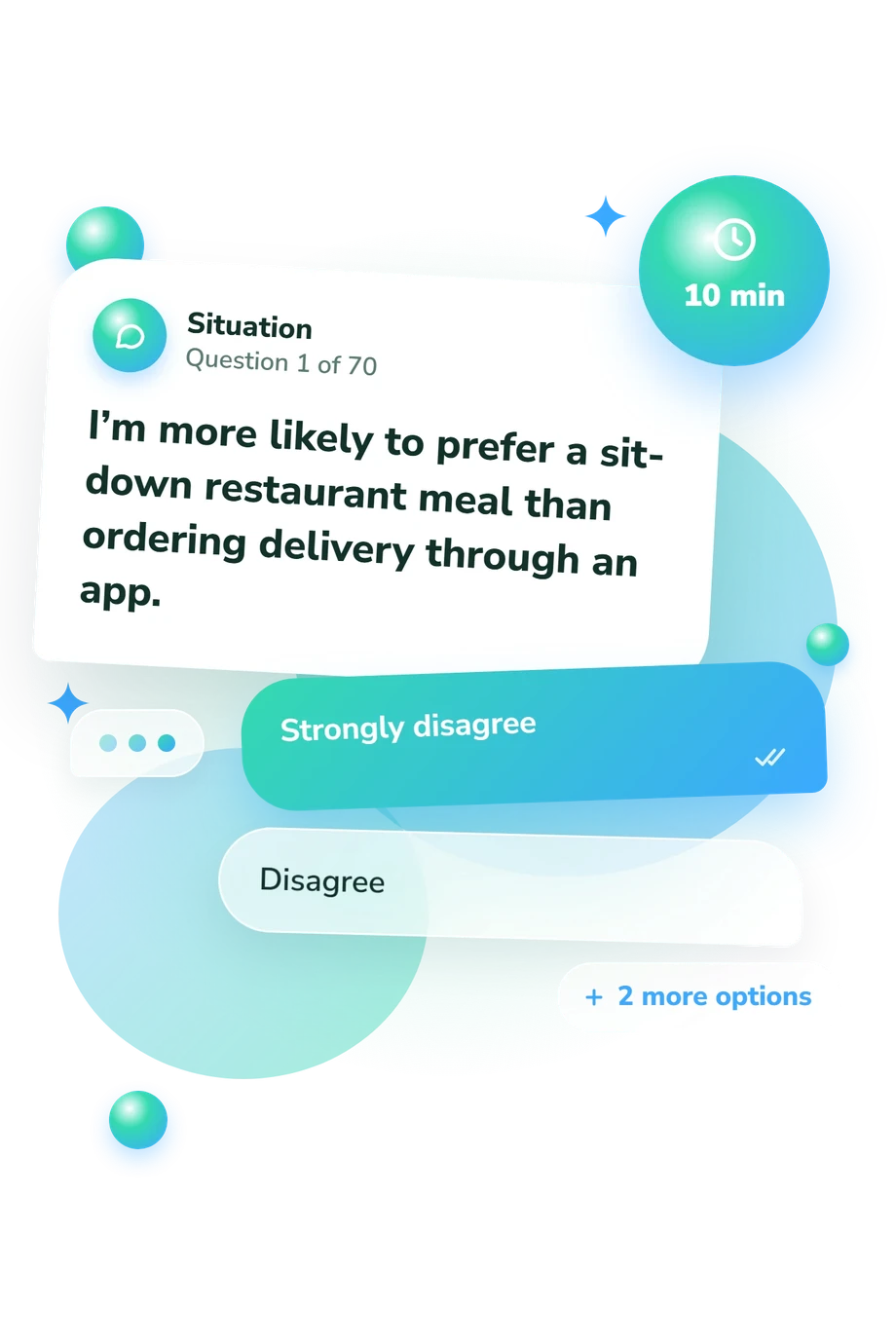
Example Questions From the Test
- Strongly disagree
- Disagree
- Not sure
- Agree
- Strongly disagree
- Disagree
- Not sure
- Agree
- Strongly disagree
- Disagree
- Not sure
- Agree
Guess My Age Quiz - Description and methodology of the test
People curious about age-associated patterns in everyday life can use the Guess My Age Quiz as a light self-reflection exercise. It explores media choices, technology habits, communication styles, routines, and nostalgia rather than asking for a birth date. People who enjoy a how old are you quiz may find its questions a lively way to consider which cues feel older or younger.
What This Assessment Explores
Rather than measuring chronological age, the assessment reads age-associated cues in preferences, habits, media familiarity, communication, routines, and nostalgia. It suits anyone who wants a playful profile of how choices can pull an estimate older or younger. People interested in a guess your age quiz can treat this assessment as a pattern of cues, not a verdict about identity.
The three result dimensions are:
- Estimated Age (10-70) gives a best-guess age; bands are Younger estimate 10-29, Mid-range estimate 30-49, and Older estimate 50-70.
- Mature Signals (0-40) reflects older-skewing tastes, habits, and milestones; bands are Youth-leaning 0-13, Mixed signals 14-26, and Mature-leaning 27-40.
- Youthful Signals (0-40) reflects younger-skewing trends, media, slang, apps, and routines; bands are Low Youthful Signals 0-13, Moderate Youthful Signals 14-27, and High Youthful Signals 28-40.
Methodology and Scientific Basis
Among the sampled items, short self-report statements use response options that include four-point agreement scales and, in one example, frequency choices from almost never to constantly. The contrasts cover delivery and sit-down meals, short clips and full programs, newer apps and familiar channels, plus emojis, streaming, and printed materials. Answers combine into the three displayed summaries, but the questionnaire does not specify how many points each response contributes, so it does not disclose a per-answer scoring rule.
Rosenthal and McKeown (2011) offer the closest conceptual parallel: age can be associated with differences in style, content, and online behavior. This questionnaire is conceptually consistent with that work, not an adaptation of that research. Kalmus, Masso, and Lauristin (2013) add context on media preferences and perceived generational differences, while Olson, O’Brien, Rogers, and Charness (2011) address age-related variation in technology-use frequency. These studies are conceptual parallels, not validation studies for this questionnaire.
A guess how old i am quiz can produce different estimates as interests, cultural context, technology access, nostalgia, and candor change. Treat the outcome as a snapshot of emphasized cues rather than a fixed measure of actual age.
- Sara Rosenthal and Kathleen McKeown. "Age Prediction in Blogs: A Study of Style, Content, and Online Behavior in Pre- and Post-Social Media Generations." Proceedings of the 49th Annual Meeting of the Association for Computational Linguistics, 2011, pp. 763-772.
- Veronika Kalmus, Anu Masso, and Marju Lauristin. "Preferences in Media Use and Perception of Inter-Generational Differences among Age Groups in Estonia: A Cultural Approach to Media Generations." Northern Lights: Film & Media Studies Yearbook, vol. 11, no. 1, 2013, pp. 15-34. 10.1386/nl.11.1.15_1
- Katherine E. Olson, Marita A. O'Brien, Wendy A. Rogers, and Neil Charness. "Diffusion of Technology: Frequency of Use for Younger and Older Adults." Ageing International, vol. 36, no. 1, 2011, pp. 123-145. 10.1007/s12126-010-9077-9
Updated: