
Globalisation Quiz
How the Scales are Structured
Who Usually Takes This Test?
See How You Compare
Below is a preview of how scores are typically distributed across each scale.
Example Questions From the Test
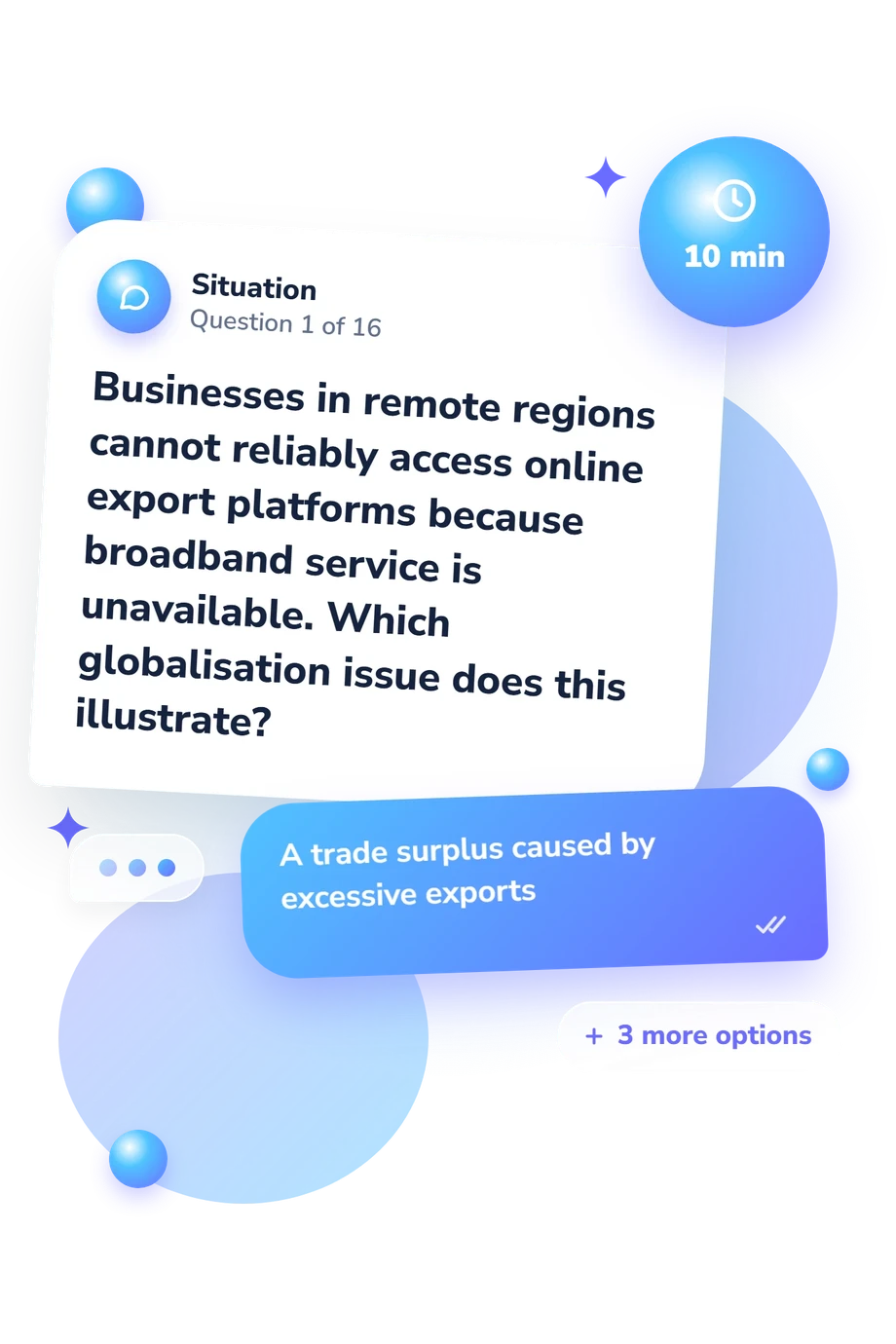
- A trade surplus caused by excessive exports
- A digital divide limiting participation in global markets
- A customs union restricting internal trade
- Cultural convergence caused by international media
- Glocalisation
- Economic isolation
- Cultural homogenisation
- Protectionism
- Interdependent supply chains can transmit disruptions across borders
- Tariffs are the only source of disruption in international trade
- International production prevents local events from affecting other economies
- Specialized suppliers make global production completely self-sufficient
Globalisation Quiz - Description and methodology of the test
For learners, teachers, and curious readers, this globalisation quiz offers a practical check before revising a course, preparing a lesson, or exploring the subject independently. Several globalization quiz questions present applied situations, helping readers decide which concepts to review and where further study may be useful. Taken together, the responses can shape a more targeted review plan.
What This Assessment Explores
The questionnaire measures practical understanding of globalisation, not personal attitudes. It suits readers checking trade, investment, migration, technology, culture, institutions, and cross-border connections. As a globalisation test, it asks respondents to apply ideas to short situations rather than recall isolated definitions.
Globalisation Knowledge: 0-16. The result bands are Foundations to build (0-6), Developing knowledge (7-12), and Strong knowledge (13-16). They show increasing ability to identify and apply concepts; the score is educational, not a formal credential.
The thematic groups show what the respondent is asked to recognize:
- Trade concepts connect tariffs, comparative advantage, exchange rates, agreements, and the WTO to cross-border exchange.
- Production and investment concepts explain outsourcing, offshoring, foreign direct investment, and supply-chain links.
- Migration and communication concepts cover remittances, brain circulation, digital access, and cross-border information flows.
- Cultural concepts examine glocalisation, hybridisation, and local adaptation of global forms.
Methodology and Scientific Basis
Each item presents a definition or scenario with four answer choices. Selecting the best answer tests recognition and application, including distinctions such as outsourcing versus offshoring and free trade areas versus customs unions.
The result is assigned to the educational bands for this questionnaire. As a globalisation knowledge test, it offers a compact learning check, and the educational score describes performance on this question set rather than serving as a formal credential. It helps show which concepts the respondent can recognize and apply in the situations presented.
Its conceptual coverage is consistent with the Global Transformations framework, which treats globalisation as interconnected change across economic, political, social, and cultural domains. Trade and comparative-advantage items align with established international-trade theory, while World Trade Organization rules support the item about trade rules. These works are conceptual reference points; the questionnaire is not an adaptation or validation of them.
As an online knowledge exercise, results can be affected by prior study, wording interpretation, attention, and the ability to distinguish related concepts. The score describes performance on this question set rather than complete expertise.
- Held, David, Anthony McGrew, David Goldblatt, and Jonathan Perraton. Global Transformations: Politics, Economics and Culture. Polity Press, 1999.
- Held, David, Anthony McGrew, David Goldblatt, and Jonathan Perraton. “Global Transformations: Politics, Economics and Culture.” In Politics at the Edge, edited by Chris Pierson and Simon Tormey, 14-28. Palgrave Macmillan, 2000. 10.1057/9780333981689_2
- Krugman, Paul R., Maurice Obstfeld, and Marc J. Melitz. International Economics: Theory and Policy. 11th ed. Pearson, 2018.
- World Trade Organization. Understanding the WTO. Updated 2012. World Trade Organization, 2012.
Updated: