
Gilded Age Quiz
How the Scales are Structured
Who Usually Takes This Test?
See How You Compare
Below is a preview of how scores are typically distributed across each scale.
Example Questions From the Test
- Poor ventilation, inadequate sanitation, and limited fire escapes
- Falling farm prices and railroad freight charges
- Restrictions on building suburban single-family homes
- Shortages of office space near Wall Street
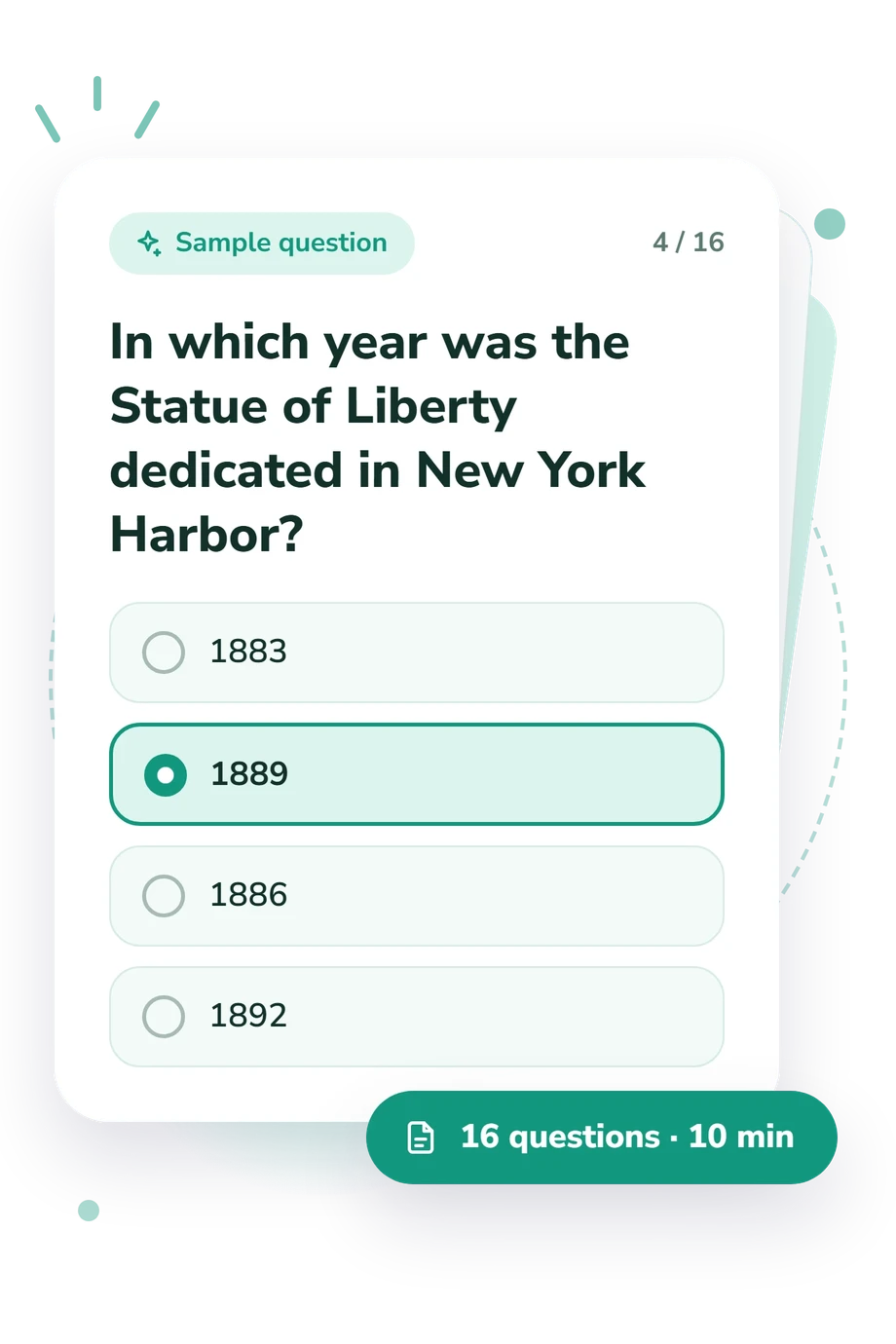
- 1883
- 1889
- 1886
- 1892
- Governors Island
- Angel Island
- Federal Hall
- Castle Garden
Gilded Age Quiz - Description and methodology of the test
Designed for readers who want to check their grasp of urban America, the Gilded Age Quiz connects factual recall with the social contrasts that shaped late-nineteenth-century New York. As a Gilded Age history quiz, it suits students, history enthusiasts, and anyone revisiting the period through focused historical situations. The result highlights secure knowledge and topics that merit further study.
What This Assessment Explores
The questionnaire treats the Gilded Age as a connected setting rather than a list of dates. Its scenarios ask you to interpret urban inequality, immigration, labor, politics, media, consumer culture, philanthropy, and transportation in 1880s New York. An incorrect response can point toward a broader Gilded Age study topic, helping you decide what to revisit.
The questions bring together these areas:
- Gilded Age Knowledge (0-16) classifies performance as Foundations to build (0-6), Developing knowledge (7-12), or Strong knowledge (13-16).
- Urban inequality and reform show how tenements, sanitation, fire safety, and reporting exposed unequal living conditions.
- Immigration, politics, and labor examine exclusion, patronage, elections, worker demands, and newcomers’ civic experiences.
- Infrastructure, consumption, wealth, and media connect bridges, railways, department stores, philanthropy, and competing views of industrial power.
Together, the result reflects command of the period’s relationships, not recognition of one fact in isolation.
Methodology and Historical Basis
Each item presents a historical situation with four answer choices, combining recall with interpretation. You may need to identify a person, date, institution, policy, or urban change, while the surrounding context tests whether you understand its significance. The result is reported on the displayed scale through three named bands.
The historical frame is conceptually consistent with Crain’s account, which connects New York’s urban growth with social contrasts, immigration, labor, politics, and infrastructure. Twain and Warner’s 1873 book explains the era’s language of gilded wealth and corruption, while Riis’s study offers a closely related lens on tenements, reform, and visual reporting. The questionnaire is not an adaptation of any one source.
As a Gilded Age knowledge test, it helps identify topics for review when an answer feels familiar but its context is unclear. The displayed bands describe different degrees of period knowledge, while performance may shift with prior coursework, memory, and the examples emphasized by the items. Use the result as a snapshot of topic knowledge, not a complete measure of historical understanding.
- Crain, Esther. The Gilded Age in New York, 1870-1910. Black Dog & Leventhal Publishers, 2016.
- Twain, Mark, and Charles Dudley Warner. The Gilded Age: A Tale of To-Day. American Publishing Company, 1873.
- Riis, Jacob A. How the Other Half Lives: Studies among the Tenements of New York. Edited by Sam Bass Warner, with an introduction by Alan Trachtenberg. Belknap Press of Harvard University Press, 2010. 10.2307/j.ctv1p6hntz
Updated: