
Geography Quiz
How the Scales are Structured
Who Usually Takes This Test?
See How You Compare
Below is a preview of how scores are typically distributed across each scale.
Example Questions From the Test
- Stockholm
- Copenhagen
- Oslo
- Helsinki
- Sydney
- Melbourne
- Canberra
- Perth
- Brasília
- Lisbon
- Rio de Janeiro
- São Paulo
Geography Quiz - Description and methodology of the test
Curious learners, travelers, and adults rebuilding their sense of place can use this geography quiz to connect countries with their national capitals. A quiz on world geography combines straightforward recall with location-based clues, so the result reflects more than memorized city names. It offers a focused snapshot of capital knowledge and shows where further regional review may strengthen your mental map.
What This Assessment Explores
The questions assess national-capital knowledge through recognition and contextual placement. Some ask for a capital from a country; others add clues about coastlines, neighboring states, direction, political status, or the difference between a capital and a larger city. This suits people refreshing general knowledge, planning travel, or strengthening their mental map.
The result, considered in a geo quiz context, shows how consistently you connect countries, regions, and capitals across continents. It is a performance snapshot rather than a profile of every geographic skill.
The item themes can be understood through these three result-relevant abilities:
- Capital recognition shows whether you identify the official city linked to a country.
- Spatial clues show how you use direction, borders, coastlines, and regional context.
- Global coverage shows how broadly your knowledge extends beyond familiar places.
The catalogue reports one scale, World Capitals Geography Knowledge (0-16). The bands are Foundations to build (0-6), Developing knowledge (7-12), and Strong command (13-16).
Methodology and Scientific Basis
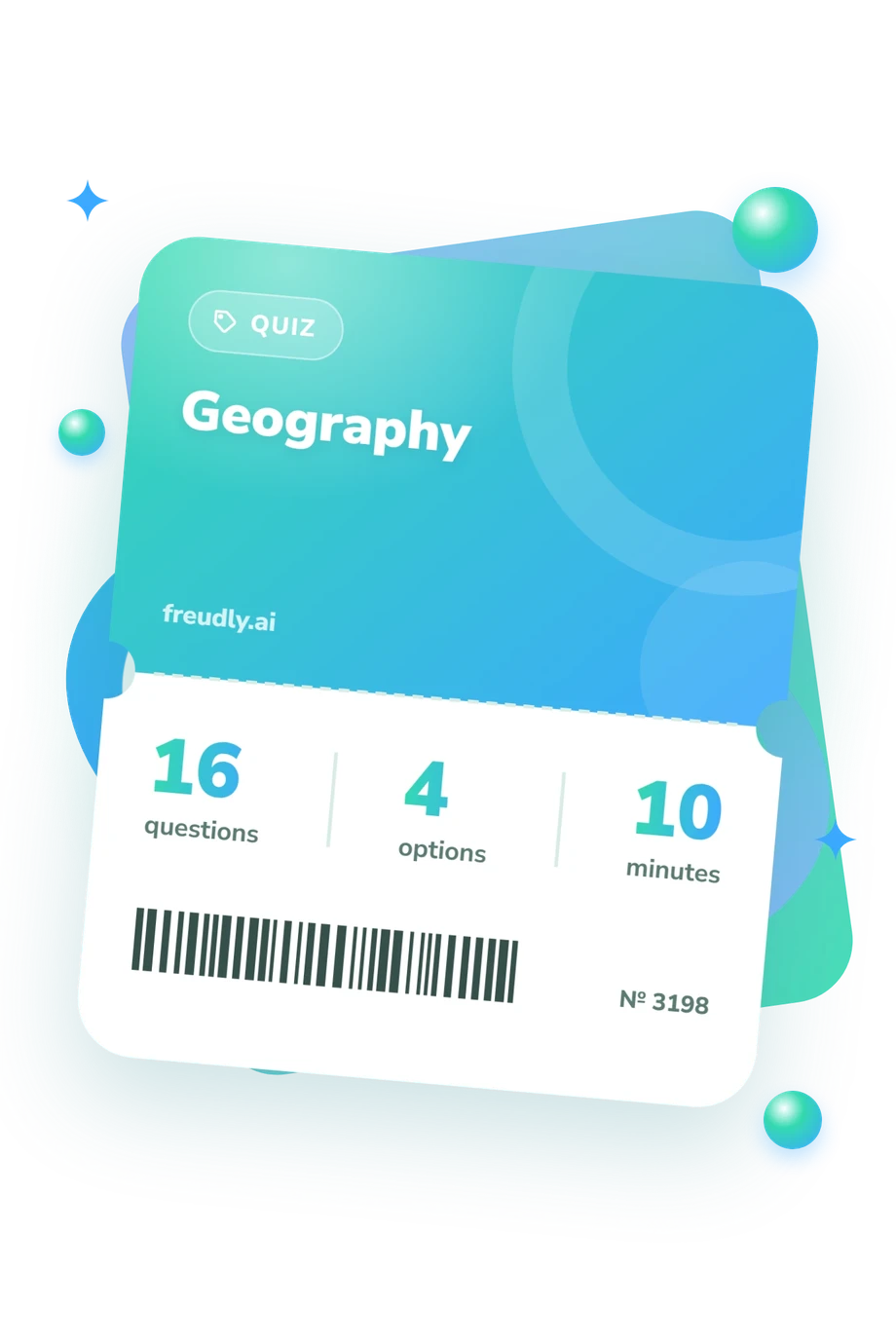
Each item presents a prompt with four answer choices. Questions combine direct capital identification with travel or location scenarios involving borders, coastlines, neighboring countries, and larger non-capital cities. A game-like format built around geography questions therefore tests recognition supported by context, not map drawing.
Scoring is direct: each correct answer adds one point to the total. The bands describe performance on this question set, not a percentile or population norm. An online assessment of geography can highlight regions for review, although results may reflect recent study, attention, and familiarity with the places named.
De Witte et al. (2024) provides a conceptual reference for relating factual knowledge to cognitive load and spatial abilities. Eve, Price, and Counts (1994) offers a relevant comparison through its study of geographic knowledge. Geography for Life frames content through factual knowledge, mental maps, and spatial thinking. This questionnaire is conceptually consistent with these works, not an adaptation of them.
As an online self-report knowledge check, it is not standardized or norm-referenced. Results show performance on these capitals, not every form of geographic competence.
- De Witte, Benjamin, Vincent Reynaert, Jerome Hutain, Danny Kieken, Joseph Jabbour, and Jalal Possik. 2024. “Immersive learning of factual knowledge while assessing the influence of cognitive load and spatial abilities.” Computers & Education: X Reality 5: 100085. 10.1016/j.cexr.2024.100085
- Eve, Raymond A., Bob Price, and Monika Counts. 1994. “Geographic Illiteracy among College Students.” Youth & Society 25 (3): 408-427. 10.1177/0044118X94025003006
- Heffron, Susan Gallagher, and Roger M. Downs, eds. 2012. Geography for Life: National Geography Standards, Second Edition. Washington, DC: National Council for Geographic Education.
Updated: