
General Knowledge Quiz About Animals
How the Scales are Structured
Who Usually Takes This Test?
See How You Compare
Below is a preview of how scores are typically distributed across each scale.
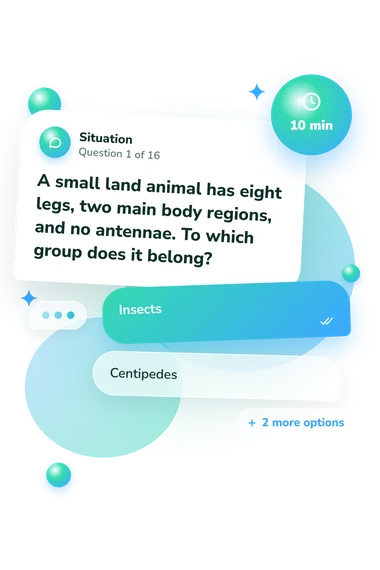
Example Questions From the Test
- Insects
- Centipedes
- Crustaceans
- Arachnids
- Marine plants with mineral-coated leaves
- Fungi growing on submerged rock
- Colonies of small animals called polyps
- Single shelled mollusks joined together
- Breathing atmospheric air into its lungs
- Finding floating food with its blowhole
- Removing salt through its lungs
- Cooling its blood with surface water
General Knowledge Quiz About Animals - Description and methodology of the test
Readers who want a focused way to check their understanding of animal life can use this assessment to connect familiar facts with broad biological concepts. The general knowledge quiz about animals suits learners, general readers, and anyone wanting a clear snapshot rather than a specialized examination. This animal facts quiz gives an overall result for the sampled concepts, while leaving you to choose which ideas to review independently.
What This Assessment Explores
Questions link animal features with biology. They range from identifying groups and structures to interpreting breathing, feeding, movement, reproduction, seasonal travel, and ecology. The assessment suits learners, general readers, and anyone wanting an animal knowledge quiz beyond simple recall.
The result has one scale, Animal Knowledge: 0-16, summarizing broad, accurate knowledge across the sampled topics. Its bands are Building Foundations (0-6), Developing Knowledge (7-12), and Strong Knowledge (13-16). Together, these themes contribute to one overall result:
- Classification is represented by questions about placing organisms in biological groups.
- Anatomy and physiology are represented by links between structures and their functions.
- Behavior is sampled through actions such as migration, echolocation, and thermoregulation.
- Ecology appears in questions about food availability, habitats, and species relationships.
- Adaptation and life cycles appear through survival features and developmental stages.
Methodology and Evidence Base
Each item presents a scenario or factual question with four answer choices. The format combines factual recall with applying concepts to examples, such as linking bat echoes with navigation. This animal trivia quiz with answers therefore asks you to select the best response using both remembered facts and applied concepts.
The displayed band reflects performance across the sampled questions.
The content is conceptually consistent with subject-matter references such as Hickman et al. (2020) and Clark et al. (2018), which cover classification, form and function, ecology, and evolution. Behavior items are also conceptually consistent with the animal-behavior coverage in Alcock (2013). These references support the subject matter, but they do not establish the online questionnaire as an adaptation, validated measure, or standardized instrument.
Interpret the band as a guide to the breadth of concepts sampled. Prior study, guessing, concentration, and question selection can affect performance, so the result cannot represent all zoological knowledge.
- Hickman, Cleveland P., Jr., Susan L. Keen, Allan Larson, and David J. Eisenhour. Animal Diversity, 9th ed. McGraw Hill LLC, 2020. ISBN 978-1-260-24088-7.
- Clark, Mary Ann, Matthew Douglas, and Jung Choi. Biology 2e. OpenStax, Rice University, 2018.
- Alcock, John. Animal Behavior: An Evolutionary Approach, 10th ed. Sinauer Associates, 2013. ISBN 978-0-87893-966-4.
- Bednekoff, Peter A. “Animal Behavior: An Evolutionary Approach. Tenth Edition.” The Quarterly Review of Biology, vol. 89, no. 2, 2014, p. 178. 10.1086/676074.