
French Revolution Quiz
How the Scales are Structured
Who Usually Takes This Test?
See How You Compare
Below is a preview of how scores are typically distributed across each scale.
Example Questions From the Test
- Louis XVI regained the throne
- Robespierre fell from power, helping bring the Terror to an end
- The Estates-General met for the first time
- Napoleon declared himself emperor
- A military consulate headed by Napoleon Bonaparte
- An absolute monarchy governed without a legislature
- A federal republic led by elected provincial presidents
- A constitutional monarchy with a legislative assembly
- The First Estate
- The Third Estate
- The Second Estate
- The royal household
French Revolution Quiz - Description and methodology of the test
Readers who want to test how securely they understand the Revolution’s causes, institutions, social tensions, and political turns can use the French Revolution Quiz as a focused history check. This French Revolution online quiz is suited to learners, general readers, and anyone revising the period who wants to identify strong areas and topics that need closer study. The result offers a concise knowledge profile rather than a narrative of events.
What This Assessment Explores
The assessment focuses on historical understanding, not personal opinion. Questions connect events with political consequences, identify institutional changes, and place developments in sequence. This French Revolution history quiz links events with consequences, making it useful for understanding crisis, conflict, and constitutional change rather than isolated facts.
These items examine three linked areas:
- French Revolution Knowledge (0-16) summarizes the respondent’s knowledge of the Revolution. The Foundations to Build band covers 0-6; Developing Command covers 7-12; Strong Command covers 13-16.
- Chronology and turning points are tested through sequences involving the Estates-General, the Bastille, the Republic, the Terror, the Directory, and the Consulate.
- Political and social interpretation is tested through concepts such as the Third Estate, sans-culottes, constitutional monarchy, church reorganization, war, and revolutionary government.
Together, they show how well the respondent connects events, ideas, groups, and political phases.
Methodology and Historical Basis
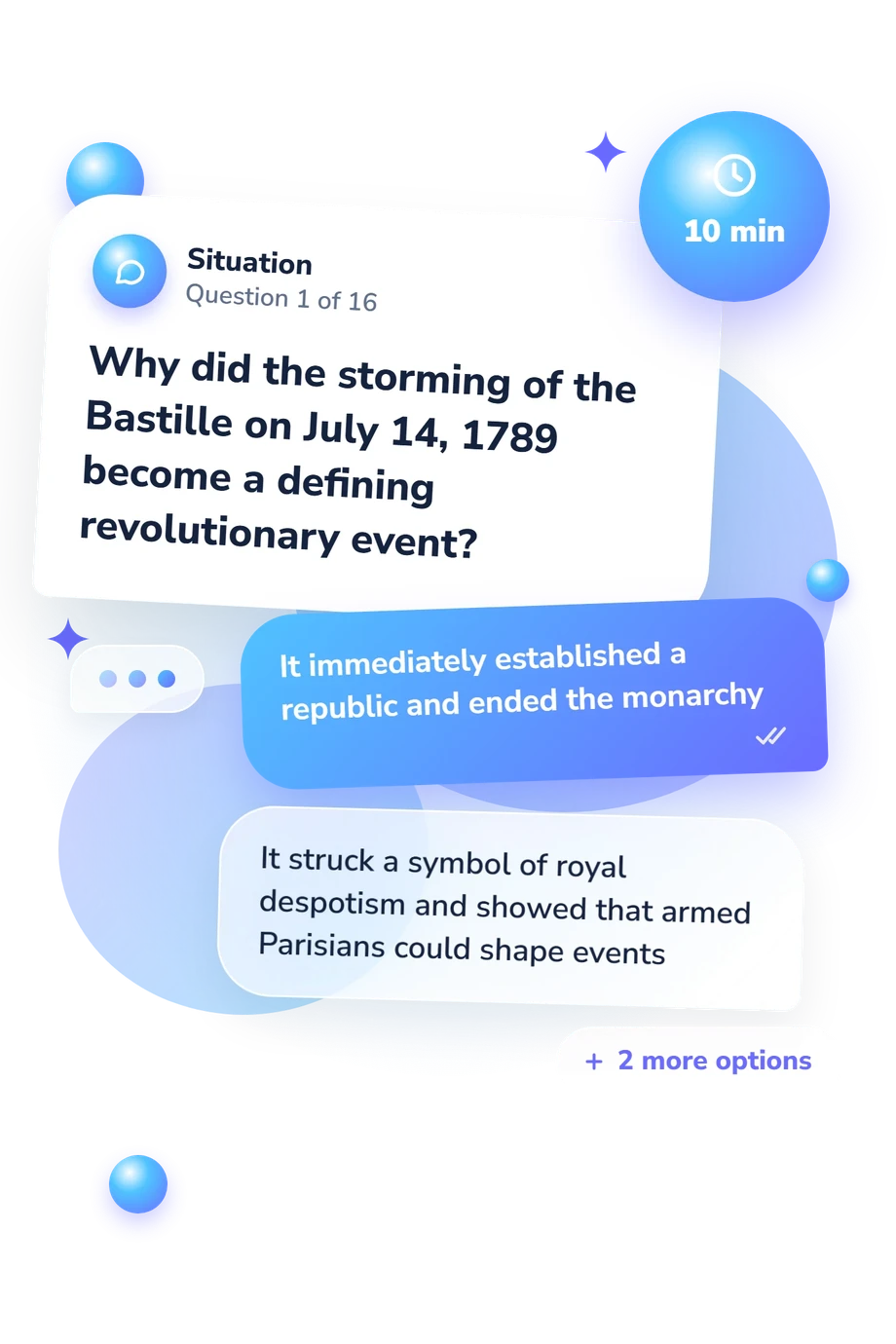
Each item presents a historical scenario, statement, or chronology prompt with four choices. The respondent selects the option that best fits the evidence rather than writing an essay. Used as a French Revolution practice quiz, this questionnaire can reveal gaps in factual recall and causal reasoning, although it cannot capture every aspect of historical skill.
The historical treatment by Dwyer and McPhee helps connect political phases, institutions, social groups, and conflict. Doyle’s account supplies an interpretive framework for the period. The 1789 declaration of rights supports items about legal equality, citizenship, and revolutionary principles. Together, these works serve as content references for the questions.
The displayed result summarizes performance on this question set, while its bands express the stated interpretations. It should be read as performance on these questions, not a complete measure of historical expertise. Questions range from social composition and constitutional arrangements to war, radicalization, and the transition from Convention to Directory and Consulate. Prior study, wording familiarity, and uncertainty between plausible choices can affect performance, so the result is best used to guide focused review.
- Philip Dwyer and Peter McPhee, eds. The French Revolution and Napoleon: A Sourcebook. 2nd ed., Routledge, 2024. 10.4324/9781032618814.
- William Doyle. The Oxford History of the French Revolution. 3rd ed., Oxford University Press, 2018.
- National Assembly of France. Declaration of the Rights of Man and of the Citizen, 26 August 1789. French Presidency, Élysée.
Updated: