
Flags of Oceania Quiz
How the Scales are Structured
Who Usually Takes This Test?
See How You Compare
Below is a preview of how scores are typically distributed across each scale.
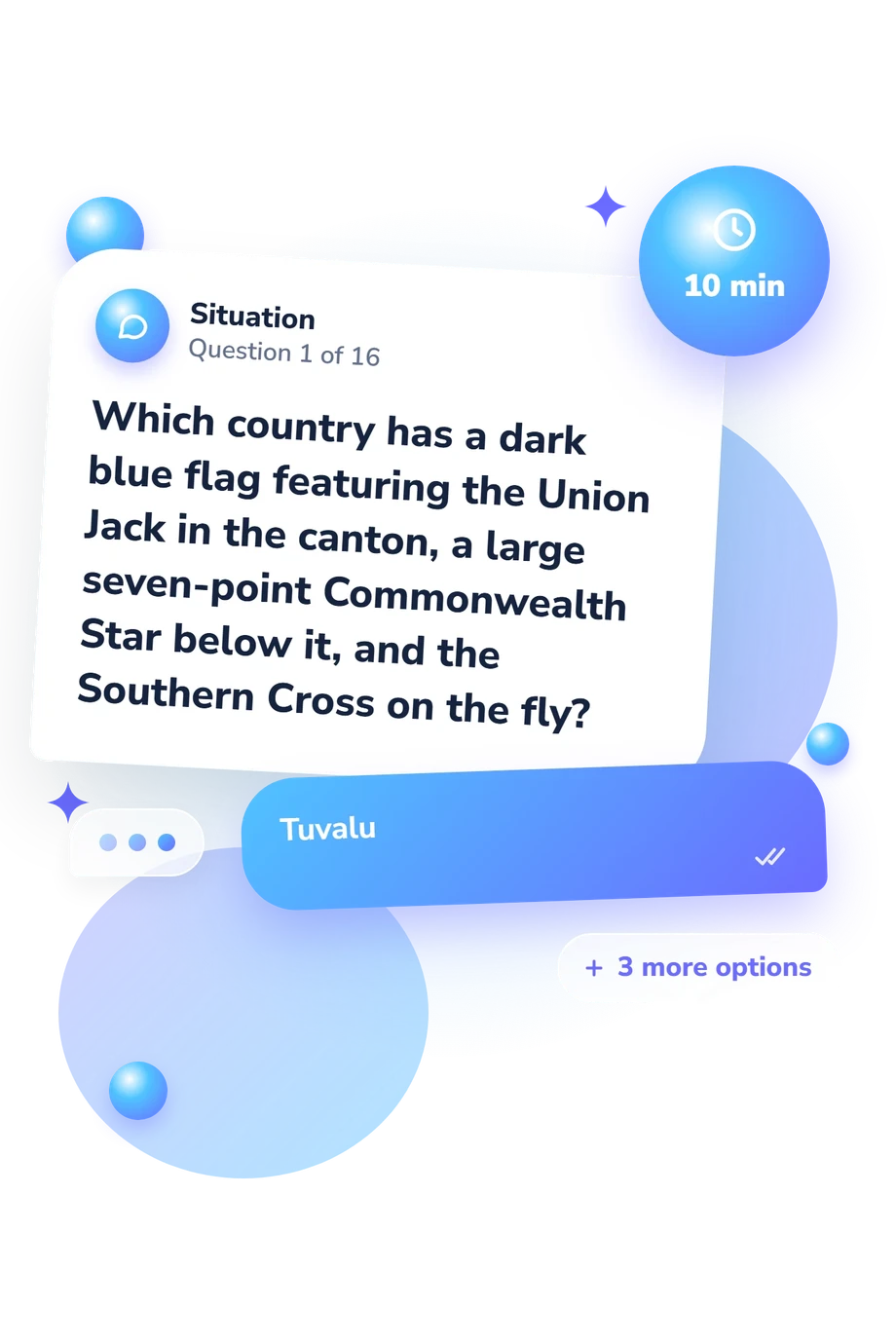
Example Questions From the Test
- Solomon Islands
- Vanuatu
- Papua New Guinea
- Fiji
- New Zealand
- Tonga
- Samoa
- Australia
- Federated States of Micronesia
- Palau
- Marshall Islands
- Samoa
Flags of Oceania Quiz - Description and methodology of the test
People who want to check how confidently they recognize national symbols can use the Flags of Oceania Quiz as a focused visual knowledge check. It suits learners, travelers, geography enthusiasts, and anyone comparing closely related designs. Its result summarizes the respondent's success in identifying Oceania flags across the set, showing whether the respondent has limited, growing, or broad knowledge of distinctive national flag details.
What This Assessment Explores
Rather than measuring personality or political knowledge, this assessment focuses on visual identification: recognizing a country from field color, canton, stars, crosses, emblems, bands, and other defining arrangements. It suits readers testing geographic recall or comparing related Oceania designs.
The questions reward precise observation of star counts, Union Jack details, bird emblems, shields, and diagonal or wavy divisions. The quiz uses Oceania flag examples to ask respondents to use colors, symbols, and arrangements as clues, while the result reflects overall identification accuracy.
The result is organized around these elements:
- The Flags of Oceania Knowledge scale spans 0-16; Foundation (0-6) indicates partial recognition, Developing (7-12) reflects broader but incomplete accuracy, and Strong (13-16) indicates broad recognition of defining details.
- Comparison items examine related blue-field designs, especially Australia, New Zealand, Tuvalu, and Fiji.
- Symbol-focused items use stars, birds, suns, shields, and geometric divisions as identification clues.
Methodology and Evidence Base
Each item presents a visual description and four answer choices. The respondent selects one country, so the task emphasizes recognition and discrimination rather than open-ended recall or written explanation. Results are reported on the displayed scale and interpreted through its supplied bands; no separate trait profile is claimed.
Methodologically, the quiz is closest to the flag-recognition study by Blake and Castel, which examines how familiarity with flags can shape recognition and metacognitive judgments. This questionnaire is conceptually consistent with that work, not an adaptation of it. Whitney Smith's history of flags supplies broader context for national symbols and design conventions.
That evidence provides context for familiarity and visual salience, but it does not establish norms for this online quiz. The questionnaire is a structured knowledge check, not a standardized psychological measure. Performance can vary with prior travel, schooling, repeated exposure, cultural familiarity, and description clarity. Because answers are selected from options, guessing and test-taking strategy can affect the result. The quiz's result can guide review of Oceania flag knowledge, but one score cannot capture every aspect of geographic knowledge.
- Blake, Adam B., and Alan D. Castel. “Memory and availability-biased metacognitive illusions for flags of varying familiarity.” Memory & Cognition, vol. 47, no. 2, 2019, pp. 365-382. 10.3758/s13421-018-0872-y
- Smith, Whitney. Flags Through the Ages and Across the World. McGraw-Hill, 1975.
Updated: