
First Aid Quiz
How the Scales are Structured
Who Usually Takes This Test?
See How You Compare
Below is a preview of how scores are typically distributed across each scale.
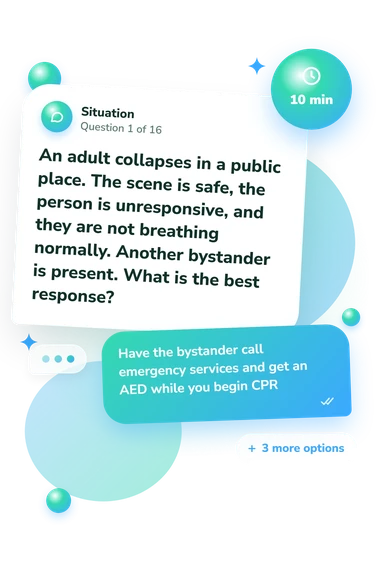
Example Questions From the Test
- Have the bystander call emergency services and get an AED while you begin CPR
- Place the person in the recovery position and wait for regular breathing
- Give several rescue breaths before asking anyone to call for help
- Raise the person’s legs and check again after a minute
- Cover the burn before cooling it
- Hold ice directly against the burned area
- Apply butter or an oily cream to seal the skin
- Cool the burn under cool running water
- Encourage continued coughing and watch closely for deterioration
- Immediately begin abdominal thrusts despite the effective cough
- Give water to help wash down the obstruction
- Sweep the mouth with your fingers to locate the object
First Aid Quiz - Description and methodology of the test
For readers who want to refresh practical emergency knowledge, this assessment offers a focused way to examine how they prioritize safety, urgent care, and escalation. The first aid quiz is intended for general readers preparing for a course, workplace refresher, or everyday situation where calm decisions matter. Taking this online first-aid quiz can begin that review and point to topics for further practice.
What This Assessment Explores
These scenarios examine recognition of immediate priorities across common emergencies rather than detailed diagnosis or treatment planning. The situations cover scene safety, CPR/AED activation, burns, seizures, eye exposure, severe bleeding, anaphylaxis, suspected spinal injury, stroke, choking, fractures, poisoning, and shock. The emphasis is on choosing a safe first action and knowing when emergency help is required.
The result is organized around one educational dimension:
- First Aid Knowledge, scored from 0-16, reflects how consistently your choices match core first-aid priorities; Foundations to build (0-6) indicates several essential principles need review, Developing knowledge (7-12) shows many appropriate actions alongside meaningful gaps, and Strong knowledge (13-16) indicates a solid grasp of common priorities.
As a basic first-aid quiz, this assessment can show whether these principles are familiar. The result reflects recognition of recommended responses rather than hands-on performance.
Methodology and Evidence Base
Each item presents a brief emergency scenario with four possible actions. The respondent chooses the response that best fits the immediate priority, testing recognition and sequencing rather than recall of explanations. Responses are combined into the displayed knowledge score; no separate weighting or item-level rule is specified. The first-aid quiz questions move between routine injuries and time-critical events, requiring attention to hazards, breathing, bleeding, neurological signs, and escalation.
Joseph et al. (2014) provide the closest subject-matched evidence: this questionnaire is conceptually consistent with first-aid knowledge research, but it is not an adaptation of that study. The 2024 AHA/Red Cross guidelines provide a current reference point for recommended actions. Idland et al. (2023) and the FAQA tool distinguish correct-action recognition from first-aid quality in practice. This interactive first-aid quiz is an educational knowledge check whose score is not a standardized measure of hands-on first-aid performance.
Interpret the band as an educational guide to familiar priorities and review needs. Use the result to choose learning. Responses can shift with wording, current context, guessing, and familiarity with first-aid guidance; practical competence also requires rehearsal, communication, and local guidance.
- Joseph N, Kumar GS, Babu YPR, Nelliyanil M, Bhaskaran U. Knowledge of First Aid Skills Among Students of a Medical College in Mangalore City of South India. Annals of Medical and Health Sciences Research. 2014;4(2):162-166. 10.4103/2141-9248.129022
- Hewett Brumberg EK, Douma MJ, Alibertis K, Charlton NP, Goldman MP, Harper-Kirksey K, Hawkins SC, Hoover A, Kule A, Leichtle S, McClure SF, Wang GS, Whelchel M, White L, Lavonas EJ; American Heart Association and American Red Cross. 2024 American Heart Association and American Red Cross Guidelines for First Aid. Circulation. 2024;150(24):e519-e579. 10.1161/CIR.0000000000001281
- Idland S, Kramer-Johansen J, Bakke HK, Hjortdahl M. Assessing bystander first aid: development and validation of a First Aid Quality Assessment (FAQA) tool. BMC Emergency Medicine. 2023;23(1):39. 10.1186/s12873-023-00811-z
Updated: