
Egypt Quiz
How the Scales are Structured
Who Usually Takes This Test?
See How You Compare
Below is a preview of how scores are typically distributed across each scale.
Example Questions From the Test
- The Egyptian Revolution of 1919
- The Free Officers movement of 1952
- The opening of the Suez Canal in 1869
- The October War of 1973
- Ramadan
- Mawlid al-Nabi
- Eid al-Fitr
- Sham el-Nessim
- Mawlid al-Nabi
- Eid al-Adha
- Wafaa El-Nil
- Sham el-Nessim
Egypt Quiz - Description and methodology of the test
People who want a structured way to check their familiarity with Egypt can use the Egypt Quiz to connect landmarks, historical periods, landscapes, and living traditions. This Egyptian quiz suits curious learners, travelers, students, and anyone revisiting the subject. The result offers a focused snapshot of recognized knowledge and points toward topics that may deserve closer study.
What This Assessment Explores
The assessment spans ancient and modern Egypt rather than one dynasty or landmark. Questions cover historical periods, political turning points, regions, waterways, religious observances, languages, institutions, architecture, music, monuments, writing materials, and food. The result reflects breadth of factual familiarity across connected domains.
This quiz about Egypt examines four thematic groups:
- Historical knowledge shows how you place monuments, rulers, and political events in sequence.
- Geographic knowledge indicates how well you recognize regions, elevation, waterways, and routes.
- Religious and linguistic knowledge reflects familiarity with observances, communities, and language history.
- Cultural knowledge captures recognition of objects, music, architecture, heritage sites, and dishes.
Someone choosing an Egyptian quiz should note that the scope includes later history and living traditions. The result describes recognition in this set, not identity, intelligence, or complete expertise.
Methodology and Historical Basis
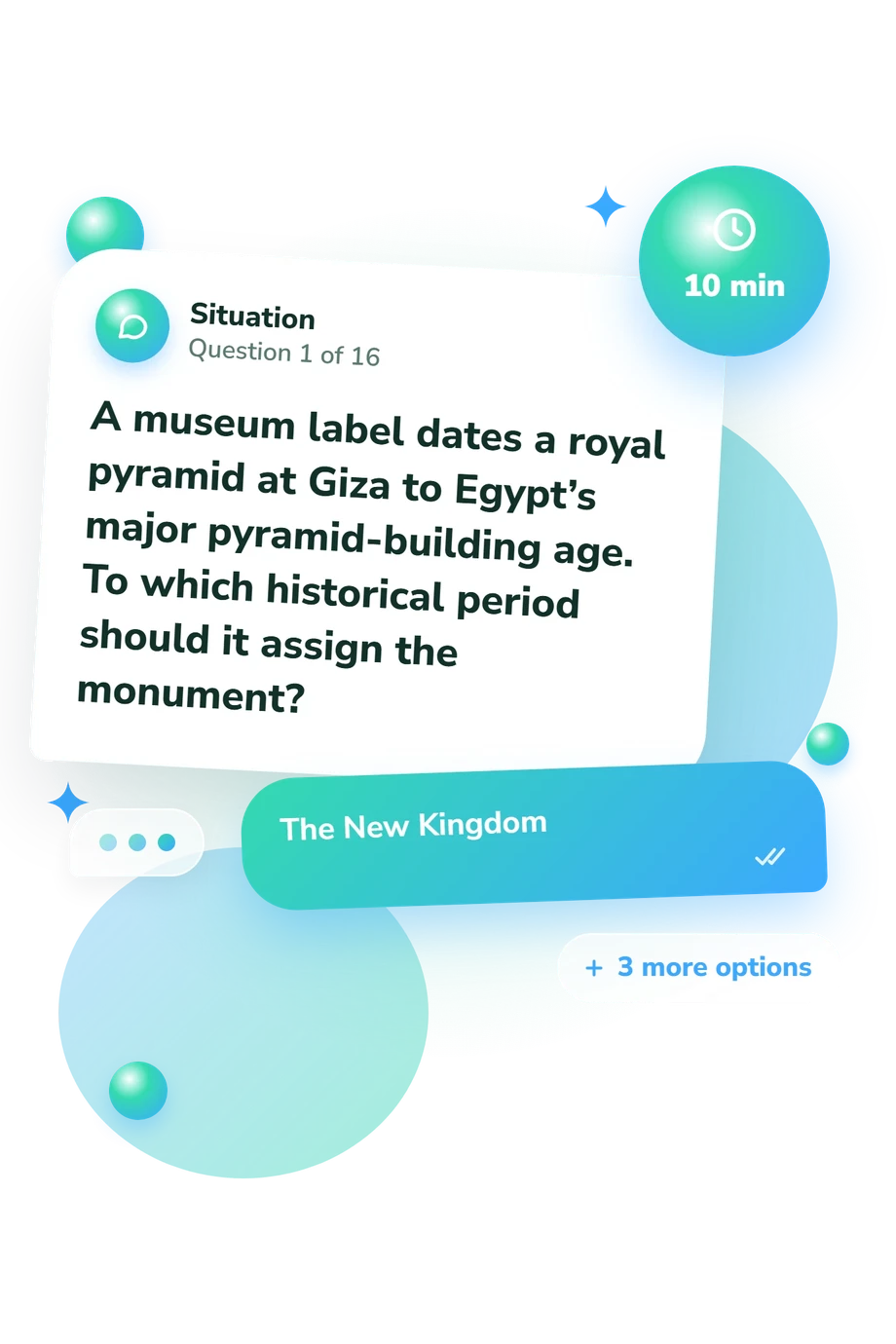
Each item presents a short scenario with four answer options. Some require direct recall; others ask you to distinguish a precise answer from plausible alternatives through context. The format tests recognition, not opinion.
Although it is a quiz about ancient Egypt as well as modern Egypt, this questionnaire includes political history, Islamic and Coptic heritage, geography, music, and food, treating Egypt as a continuous cultural subject. The result summarizes performance across the question set on the Egypt Knowledge scale, 0-16. The displayed bands are Foundations to Build (0-6), Developing Knowledge (7-12), and Strong Knowledge (13-16). They describe performance on these questions across history, geography, and culture, not complete expertise.
The historical framing is conceptually consistent with Tignor (2010), Trigger and colleagues (1983), and Al-Sayyid Marsot (2007). These works supply context for ancient society, political change, and religious and cultural developments; the questionnaire is not an adaptation or validation of them.
Responses can vary with memory, attention, education, guessing, and current context. The result is therefore a structured self-reflection tool for choosing subjects to study and identifying gaps in recall.
- Tignor, Robert L. Egypt: A Short History. Princeton University Press, 2010. 10.1515/9781400839827.
- Trigger, Bruce G., Barry J. Kemp, David O'Connor, and Alan B. Lloyd. Ancient Egypt: A Social History. Cambridge University Press, 1983.
- Al-Sayyid Marsot, Afaf Lutfi. A History of Egypt: From the Arab Conquest to the Present. 2nd ed. Cambridge University Press, 2007. 10.1017/CBO9780511607578.
Updated: