
Do I Need My Wisdom Teeth Removed Quiz
How the Scales are Structured
Who Usually Takes This Test?
See How You Compare
Below is a preview of how scores are typically distributed across each scale.
Example Questions From the Test
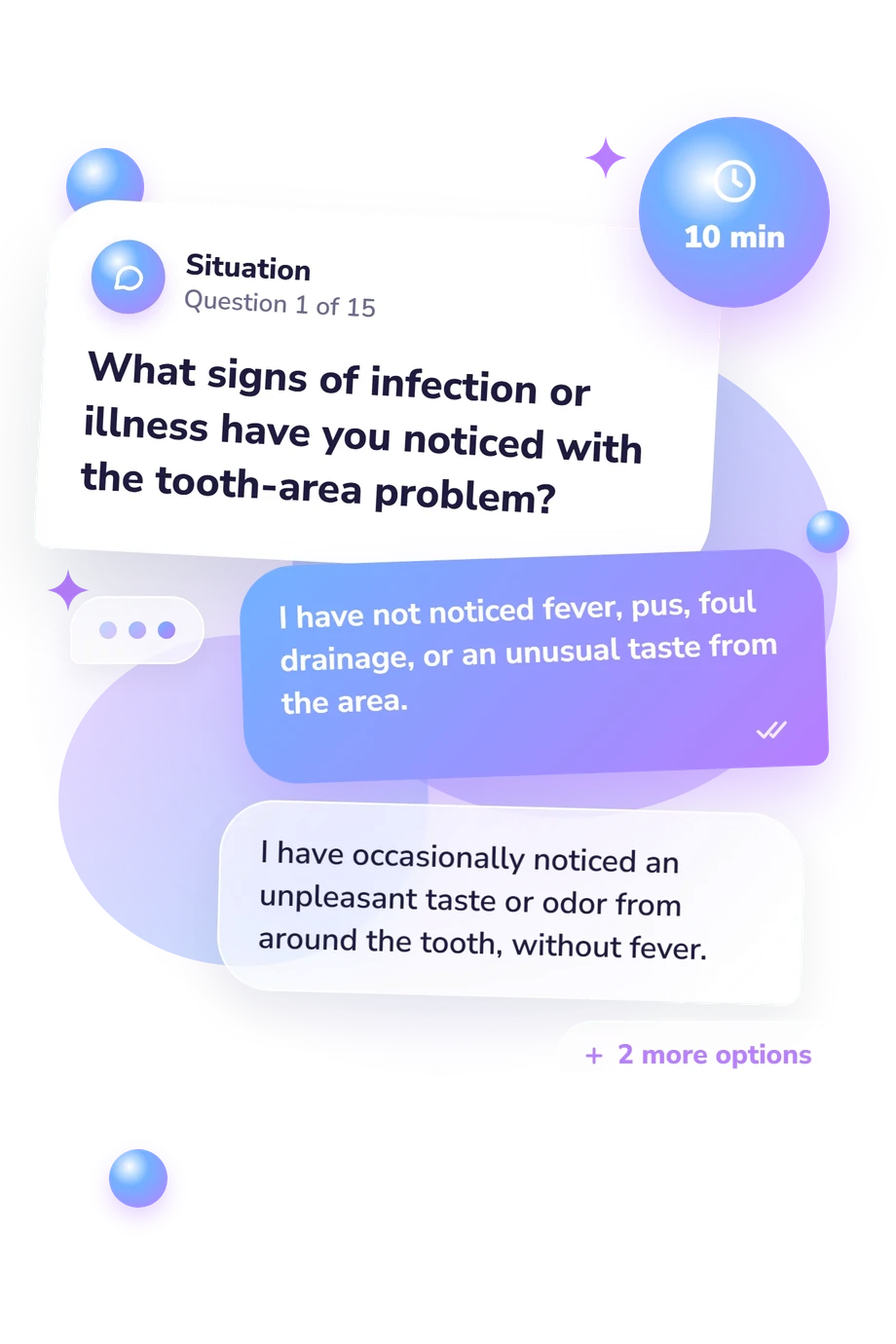
- I have not noticed fever, pus, foul drainage, or an unusual taste from the area.
- I have occasionally noticed an unpleasant taste or odor from around the tooth, without fever.
- I have seen pus or drainage, or I have had a measured fever with the dental symptoms.
- I have fever with rapidly worsening swelling, faintness, confusion, or a strong sense of being seriously unwell.
- I have not noticed bleeding, tenderness, or a gum flap there.
- The area is occasionally tender or bleeds only when I clean it more firmly than usual.
- Tenderness or bleeding returns during normal brushing, flossing, or eating.
- A gum flap repeatedly becomes markedly swollen, drains pus, or makes it difficult to close my mouth comfortably.
- It has not required symptom-related dental care.
- I have managed one short-lived episode or mentioned a minor issue once.
- I have needed more than one visit, prescription, cleaning, or other treatment for the same area.
- Problems continue despite prior treatment, or a dentist has said the source cannot be predictably kept healthy without further intervention.
Do I Need My Wisdom Teeth Removed Quiz - Description and methodology of the test
People deciding whether a back molar needs observation, treatment, or removal can use the Do I Need My Wisdom Teeth Removed Quiz to organise what they know before a dental appointment. Readers wondering whether their wisdom teeth are coming in can use the same questions to sort uncertainty about eruption, symptoms, and previous findings. The result offers a focused agenda for discussing next steps with a dental professional.
What This Assessment Explores
It covers eruption status, decay, gum inflammation, food trapping, repeated episodes, pain, swelling, restricted opening, and effects on eating, drinking, swallowing, or breathing. Anyone can use it to organise findings before an appointment. The result frames a wisdom tooth removal decision by indicating whether monitoring, discussion, or timely assessment deserves attention.
The displayed results group those observations into three scales:
- Eruption and Dental Findings (0-15) measures tooth position, decay, damage, imaging, and maintainability; bands are Monitoring noted (0), Information needed (1-2), and Professional review indicated (3-15).
- Recurring Local Problems (0-15) measures repeated inflammation, food trapping, irritation, prior treatment, and pain; bands are No recurring problems (0), Worth discussing (1-2), and Timely assessment (3-15).
- Urgent Symptom Signals (0-15) measures fever, spreading swelling, dehydration, and airway or swallowing concerns; bands are No urgent signals selected (0-0), Prompt attention (1-2), and Act now (3-15).
Methodology and Evidence Base
Each item offers four ordered responses, moving from no known problem or routine monitoring through uncertainty, recurring concern, or a more serious finding. The selected answers are organised into the three displayed scales, but the questionnaire does not state how many points each response contributes. The bands are unvalidated reflective summaries; any concerning finding merits attention independently of the total, and a single score-3 red-flag response overrides the total.
Clinically, the questionnaire is conceptually consistent with a systematic review of extraction indications in symptomatic impacted third molars, but it is not adapted from or validated by that review. NICE TA1 states that pathology-free impacted wisdom teeth should not be routinely removed and limits removal to pathology. The Hounsome review examines prophylactic removal's uncertain balance; these works clarify clinical themes rather than establish this questionnaire's scoring or validity.
Because the items rely on self-reported wisdom teeth symptoms, results depend on current symptoms and recall of examinations or imaging. Breathing or swallowing difficulty, rapidly spreading swelling, dehydration, severe illness, or worsening symptoms warrant same-day urgent dental or medical guidance; other elevated results prompt dental review.
- Peñarrocha-Diago M, Camps-Font O, Sánchez-Torres A, Figueiredo R, Sánchez-Garcés MA, Gay-Escoda C. Indications of the extraction of symptomatic impacted third molars. A systematic review. Journal of Clinical and Experimental Dentistry. 2021;13(3):e278-e286. 10.4317/jced.56887
- National Institute for Health and Care Excellence. Guidance on the extraction of wisdom teeth: NICE technology appraisal guidance [TA1]. London: National Institute for Health and Care Excellence; 2000.
- Hounsome J, Pilkington G, Mahon J, Boland A, Beale S, Kotas E, Renton T, Dickson R. Prophylactic removal of impacted mandibular third molars: a systematic review and economic evaluation. Health Technology Assessment. 2020;24(30):1-116. 10.3310/hta24300
Updated: