
Do I Have IBS Quiz
How the Scales are Structured
Who Usually Takes This Test?
See How You Compare
Below is a preview of how scores are typically distributed across each scale.
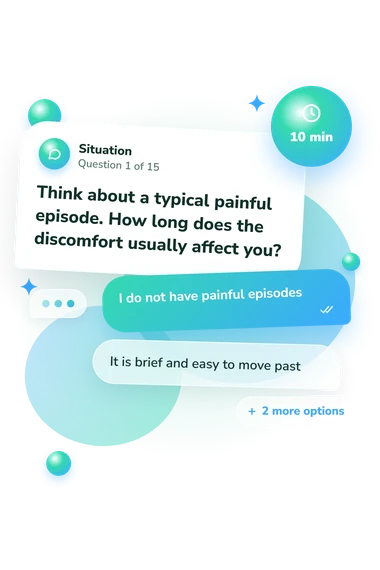
Example Questions From the Test
- Occasionally, but less than monthly
- On several days most weeks
- Never
- On several days in a typical month
- Six months or longer
- Between one and five months
- Less than one month
- I have not had a recurring pattern
- On several days in a typical month
- Never
- On several days most weeks
- Occasionally, but less than monthly
Do I Have IBS Quiz - Description and methodology of the test
People who are trying to make sense of recurring abdominal discomfort, stool changes, or urgency may use the Do I Have IBS Quiz as a structured starting point. This IBS quiz organizes self-reported patterns into a profile that can help you decide what to monitor, especially when symptoms are confusing, fluctuate over time, or raise questions about what deserves follow-up.
What This Assessment Explores
This questionnaire examines abdominal pain, stool form and frequency, urgency, incomplete emptying, bloating, sleep disruption, and effects on plans. It also includes bleeding, fever, vomiting, unplanned weight loss, anemia-related signs, and severe or constant pain, which can change next steps. For female IBS symptoms, this quiz organizes patterns and warnings without a gender-based score.
The result separates three kinds of information:
- Abdominal Pain Pattern (0-15) rates recurrence, bowel links, duration, and disruption: Not endorsed (0), Limited pattern (1-2), or Pattern to discuss (3-15).
- Bowel Pattern Changes (0-15) covers stool form, frequency, urgency, emptying, and bloating: Not endorsed (0), Limited pattern (1-2), or Pattern to discuss (3-15).
- Medical Review Indicators (0-15) flags concerns: No listed alerts (0), Check-in warranted (1-2), or Prompt action indicated (3-15); symptoms may still merit attention.
Methodology and Scientific Basis
Each item offers concrete descriptions, not yes-or-no choices, addressing frequency, duration, timing, functional impact, and warning signs. Responses are grouped into three scales; the result gives each a total and corresponding band.
Its closest conceptual reference is the Rome IV Diagnostic Questionnaire (Palsson et al., 2016), a published adult questionnaire operationalizing Rome IV symptom criteria. This online questionnaire is conceptually consistent with that work, not an adaptation. Mearin et al. (2016) describes Rome IV bowel-disorder criteria, while Lacy et al. (2021) provides IBS evaluation and management guidance; these sources contextualize themes, not authorship or scoring.
Interpret bands proportionately: they are unvalidated reflective summaries, not diagnostic, severity, or triage cutoffs. The result cannot distinguish IBS from inflammatory bowel disease; treat it as a symptom-pattern summary, not as an IBS or IBD quiz. Recall, current context, and self-awareness shape self-report, so one concerning response matters independently. Severe constant pain, fainting, a rigid or swollen abdomen, substantial bleeding or black stools, marked dehydration, or inability to keep fluids down warrants urgent care.
- Palsson OS, Whitehead WE, van Tilburg MAL, Chang L, Chey W, Crowell MD, Keefer L, Lembo AJ, Parkman HP, Rao SSC, Sperber A, Spiegel B, Tack J, Vanner S, Walker LS, Whorwell P, Yang Y. Development and Validation of the Rome IV Diagnostic Questionnaire for Adults. Gastroenterology. 2016;150(6):1481-1491. 10.1053/j.gastro.2016.02.014
- Mearin F, Lacy BE, Chang L, Chey WD, Lembo AJ, Simren M, Spiller R. Bowel Disorders. Gastroenterology. 2016;150(6):1393-1407.e5. 10.1053/j.gastro.2016.02.031
- Lacy BE, Pimentel M, Brenner DM, Chey WD, Keefer LA, Long MD, Moshiree B. ACG Clinical Guideline: Management of Irritable Bowel Syndrome. The American Journal of Gastroenterology. 2021;116(1):17-44. 10.14309/ajg.0000000000001036
Updated: